
24/7 Customer Support

Free returns

Same-day & Next-day Delivery

Quality Guaranteed

Unlock Your Welcome Offers: FREE Delivery | Up to 80% OFF | Free 30-day JoyPlus trial
Download the APP
A countertop ice maker can solve a familiar UK problem: the freezer is full, guests arrive unexpectedly or you need more ice for cocktails, soft drinks or a whisky serve. Unlike freezer trays, a portable ice maker can produce fresh bullet-shaped ice in minutes and usually needs only a worktop, clean water and an earthed socket.
However, headline figures do not tell the whole story. A machine advertised as a “fast ice maker” may produce only a small batch at a time, while a compact ice maker may need more ventilation than its size suggests. Before buying an ice machine for home, check the details that affect everyday use.
A specification such as 12 kg in 24 hours describes the claimed production potential under stated conditions. It does not mean the appliance stores 12 kg of ice. Many countertop models have a basket holding roughly 0.4 kg to 0.5 kg, so you may need to transfer ice to a freezer or insulated container during a party.
Ice also melts if left in the basket. A countertop ice maker is designed to make ice on demand, not to replace a freezer.
Noise levels vary by model and operating conditions. Compressor cooling, water movement and fan noise can all be audible in a quiet kitchen, office or caravan. Where a figure is provided, compare it directly: some listed models specify operation below 45 dB, while others list approximately 48 dB or below 50 dB.
Place the machine on a level, solid surface away from a bedroom or meeting area if sound is a concern.
A self-cleaning ice maker still needs regular care. The automatic cycle helps rinse internal water pathways, but it does not remove every mineral deposit or replace wiping the basket and surrounding surfaces. Use clean, drinkable water, empty residual water through the drain where available and follow the manufacturer’s cleaning instructions.
Never immerse the main appliance or power cable in water. Unplug the unit before moving or manually cleaning it.
For everyday drinks, a first batch in 6–9 minutes is practical. Models producing around eight or nine bullet ice cubes per cycle can suit a small household, home office or spontaneous guests. For larger gatherings, look for a stated daily capacity around 12 kg, but also consider how often you can empty the basket.
Warm rooms, direct sunlight, poor ventilation and very hot water can reduce ice-making performance. Leave the clearance specified in the manual; some supplied instructions recommend around 15 cm around the appliance.
Most compact machines produce bullet ice, which has a hollow or rounded form and is suitable for soft drinks, juice and mixed drinks. Two selectable sizes add flexibility: smaller pieces can chill drinks quickly, while larger pieces may be more suitable for cocktails or whisky.
If your priority is presentation and slower-melting ice, a dedicated clear ice ball maker is a different type of appliance. It generally produces fewer pieces more slowly, so compare output with your intended use rather than choosing by appearance alone.
Check the product listing and manual for the correct voltage, plug and operating instructions before purchase. Use a properly earthed UK socket and avoid extension cables where the manufacturer advises against them. Keep ventilation openings clear, do not operate the machine on an unstable surface and follow refrigerant safety warnings.
For camping, caravan and motorhome use, portability matters, but a handle does not make every model suitable for every power setup. Confirm electrical compatibility before taking an appliance on the road.
The following options are matched to different shopping priorities rather than ranked as universally superior choices.
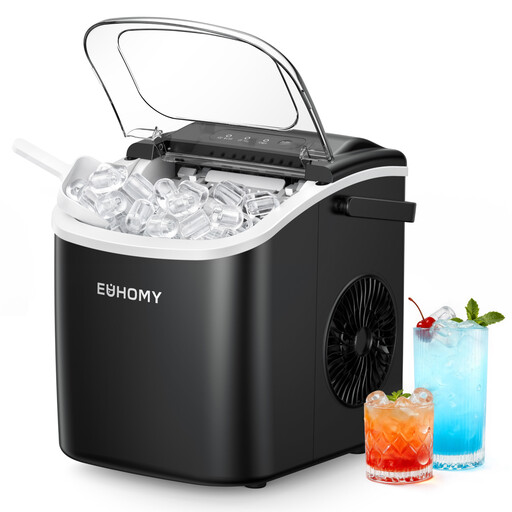
Why This Fits Their Persona: A straightforward choice for renters, flat-sharers and first-time buyers who want ice for everyday drinks without installing an appliance.
The listing states a 6–9-minute cycle, two ice sizes and indicator lights for low water and a full basket, making capacity limits easier to manage.
Produces nine bullet cubes per stated cycle, includes an ice basket and scoop and has a handle for moving between rooms.
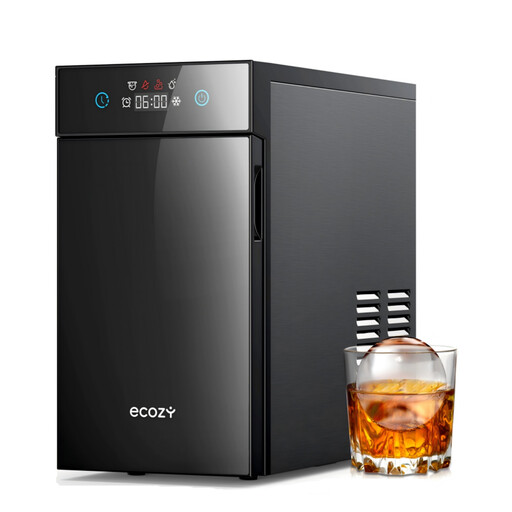
Why This Fits Their Persona: Designed for whisky and bourbon drinkers, home-bar owners and hosts who prioritise large spherical ice over rapid bulk production.
Its stated output is one sphere in about 40 minutes, so expectations are clearer than with a bullet ice machine marketed for high-volume use.
Makes 60 mm ice spheres, includes an 8-hour timer, LED touchscreen, 0.85-litre tank and self-cleaning mode.
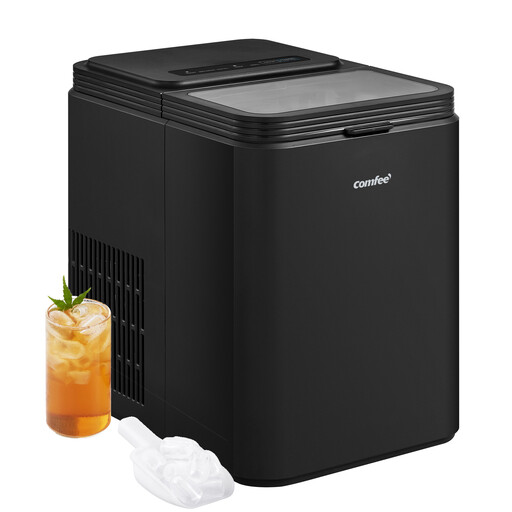
Why This Fits Their Persona: Suitable for family gatherings, parties, offices and kitchens where repeated batches are more important than freezer-style storage.
The 1.3-litre tank and removable 0.4 kg basket show the distinction between water supply, production rate and storage capacity.
Produces eight ice bullets in a stated 6–9 minutes, offers two sizes and includes a scoop, basket and self-cleaning function.
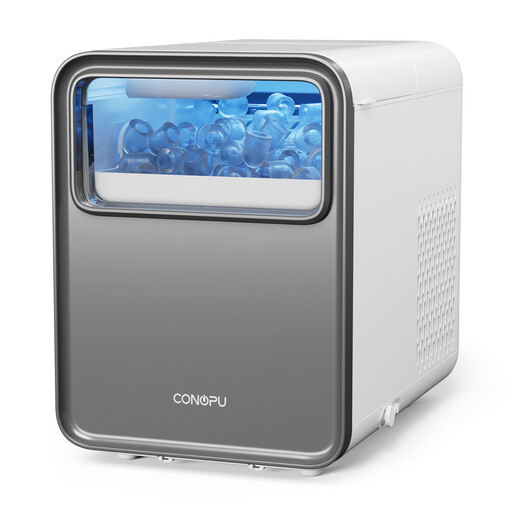
Why This Fits Their Persona: Its carry-friendly format suits households that move the appliance between the kitchen, barbecue area, camping pitch or motorhome.
The listing provides dimensions of 35 × 23 × 30 cm, weight of 6.9 kg and a stated noise level below 50 dB, useful for checking storage and transport needs.
Offers a 1.5-litre tank, two bullet ice sizes, water and ice-full indicators, side drainage and a 30-minute cleaning cycle.
We have compiled a complete, real-time list of products that fully satisfy these strict selection criteria and UK safety regulations.
Running cost depends on electricity use, water cost, ambient temperature and how often the machine operates. A countertop ice maker may be convenient for regular small quantities, but buying occasional bags can be more suitable for infrequent events. Compare the appliance’s wattage and your expected usage rather than relying only on its daily output figure.
Lifespan depends on maintenance, water quality, ventilation and operating frequency. Regular cleaning helps reduce mineral build-up, while correct placement protects the compressor and ventilation system. Follow the supplied manual and stop using the appliance if the cable, plug or refrigerant circuit is damaged.
Check the manufacturer’s instructions first. Many models pause when the basket is full, but the ice can melt and the machine may continue monitoring or cycling. For overnight preparation, a timer-equipped model may be useful, but transfer the finished ice to a freezer or suitable insulated container when appropriate.