
24/7 Customer Support

Free returns

Same-day & Next-day Delivery

Quality Guaranteed

Unlock Your Welcome Offers: FREE Delivery | Up to 80% OFF | Free 30-day JoyPlus trial
Download the APP
A countertop ice maker can be useful when your freezer cannot keep up with drinks, guests or outdoor plans. It can also prevent last-minute trips to the supermarket for bags of ice. However, compact machines are not interchangeable. Production figures, tank size, noise, cleaning functions and storage arrangements can vary considerably.
Before buying, look beyond phrases such as “fast ice” or “high capacity”. The practical details below will help you choose an ice maker for home, an office, a party, a motorhome or a camping trip without paying for features you will not use.
A listing may state 12kg in 24 hours, but this does not mean the machine stores 12kg of ice. Countertop models usually make ice in cycles and place it in a smaller removable basket. Ice may also begin melting if left inside the machine, as many compact units are designed to make ice rather than freeze and preserve it indefinitely.
Check three separate figures:
For parties, remove finished ice regularly and transfer it to a freezer or insulated container.
A self-cleaning ice machine can reduce routine effort, but it does not remove the need to empty, rinse and dry the appliance. The function generally circulates water through internal parts for a set period; it should not be treated as sterilisation or a guarantee of hygienic conditions.
Look for a clearly stated cleaning cycle, an accessible drain outlet and instructions for removing residual water. A side drain hole can be particularly useful after use in a caravan, motorhome or holiday accommodation.
“Portable ice maker” usually means a machine that is easy to move, not necessarily one that operates without mains electricity. Most countertop models still need a suitable electrical supply and a stable, level surface. Dimensions and weight matter if you intend to use one in a motorhome, caravan or tent-side cooking area.
Noise descriptions also need context. A stated level below 50dB may be more suitable for a kitchen or office than a louder appliance, but the perceived sound can change during water filling, pumping and ice release.
For occasional use, a compact ice maker producing its first batch in around six to nine minutes may be sufficient. Households hosting regular gatherings should also check the tank capacity. A 1.3L to 1.5L water tank can support repeated cycles, but the actual number of batches depends on cube size and room temperature.
Do not rely solely on “fast ice maker” wording. Compare the stated cycle time and output under the manufacturer’s specified conditions. Higher ambient temperatures can affect performance, so avoid placing the machine beside an oven, radiator or in direct sunlight.
A bullet ice maker typically produces hollow or rounded bullet-shaped pieces that cool drinks relatively quickly. Two size settings can make a machine more flexible: smaller pieces may suit tea, juice and soft drinks, while larger pieces may be preferable for cocktails or spirits.
The cube shape is also relevant to storage. Bullet ice may melt or clump differently from solid cubes, so remove it promptly and store it in a freezer if it will not be used immediately.
Measure the available worktop space, including clearance around ventilation areas. For example, a machine measuring approximately 35 × 23 × 30cm may fit beneath some cupboards, but it still needs room for the lid and airflow.
Useful convenience features include:
For UK buyers, also check the product listing for electrical compatibility, delivery information, warranty terms and the supplied plug arrangement before ordering.
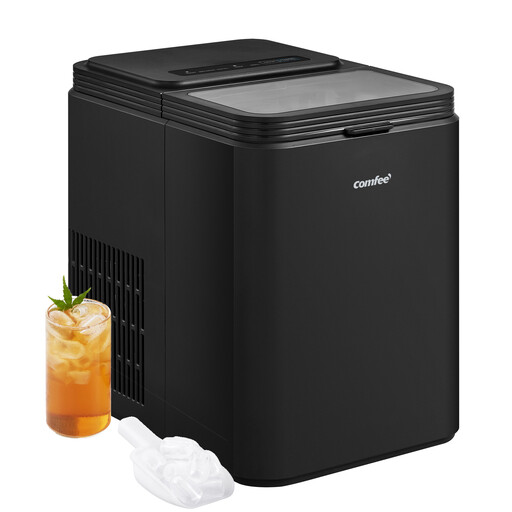
Why This Fits Their Persona: A practical choice for UK households wanting a compact ice maker with straightforward controls for everyday drinks, small gatherings or office use.
The listing separates its 12kg daily production claim from its 0.4kg removable container, helping buyers understand that output is not storage capacity.
Produces eight bullet-shaped cubes in 6–9 minutes; includes two sizes, an ice scoop, basket and self-cleaning function.
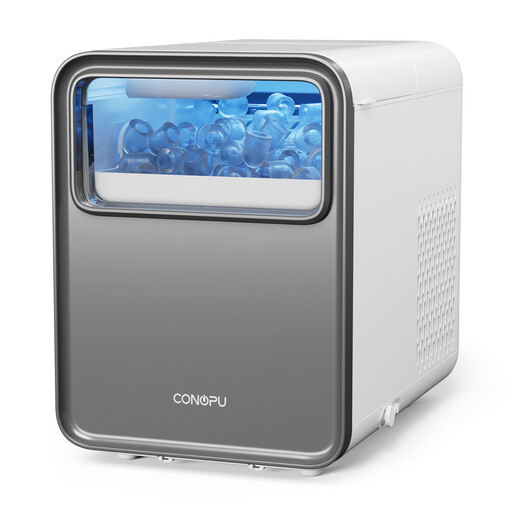
Why This Fits Their Persona: Suits buyers who value visible operation, flexible cube sizing and a quieter footprint for a kitchen island, shared home or workspace.
Its specifications state the 1.5L tank, below-50dB working noise and a 30-minute automatic cleaning cycle instead of relying only on vague “quiet” wording.
Makes nine cubes in approximately 6–8 minutes; measures 35 × 23 × 30cm and weighs 6.9kg.

Why This Fits Their Persona: A useful match for party hosts, families and users who want repeat batches for drinks without installing a built-in appliance.
The listing advises removing completed ice and placing it in a freezer, making the machine’s role as a fresh-ice producer clear.
Produces eight ice bullets in 6–9 minutes and up to 12kg in 24 hours; offers two sizes and a five-minute cleaning cycle.
We have compiled a complete, real-time list of products that fully satisfy these strict selection criteria and UK safety regulations.
The electricity cost of a countertop ice maker depends on its rated power, usage time and your tariff. To estimate the running cost, multiply the appliance’s kilowatt rating by the hours used, then multiply by your electricity price per kWh. The product’s daily ice capacity is not the same as its energy consumption.
For longer service life:
A machine may be portable enough for camping and motorhome use, but confirm that the available power supply can support it before travelling. For occasional outdoor use, transport it upright and allow it to stand according to the product instructions before switching it on.
It can be convenient for regular use, but total cost depends on purchase price, electricity, water, cleaning supplies and how often you use it. Compare your expected weekly ice consumption with local bagged-ice prices rather than assuming a machine will always cost less.
Lifespan varies with construction, water quality, cleaning routine and usage frequency. A machine used daily for parties may experience more wear than one used occasionally. Following the cleaning, drainage and storage instructions can help reduce avoidable problems, but no appliance has a guaranteed lifespan beyond its stated warranty.
It is generally more practical to remove the ice and store it in a freezer, as many compact ice makers do not keep the basket frozen. Melting ice may return water to the tank or create clumps. Always follow the instructions supplied with your chosen model.