
24/7 Customer Support

Free returns

Same-day & Next-day Delivery

Quality Guaranteed

Unlock Your Welcome Offers: FREE Delivery | Up to 80% OFF | Free 30-day JoyPlus trial
Download the APP
A countertop ice maker can solve a familiar UK household problem: the freezer is full, drinks need chilling quickly or guests arrive before you have had time to make enough ice. However, compact machines can look very similar online while differing considerably in output, storage and day-to-day convenience.
Before choosing an automatic ice machine, watch for three common purchasing traps.
A listing may advertise a high figure such as 12 kg of ice in 24 hours, but that does not mean the machine stores 12 kg at once. Many portable ice maker models have a relatively small removable basket. Ice can also melt if left inside, particularly in a warm kitchen or conservatory.
Check both the daily production figure and the basket capacity. If you need ice for a gathering, plan to transfer batches to a freezer rather than relying on the machine as an insulated storage unit.
“Six-minute ice” usually refers to the first production cycle under suitable conditions, not a guaranteed rate in every environment. High room temperatures, insufficient ventilation, unsuitable water levels and frequent opening can affect performance.
A countertop unit needs clear space around its vents and should not be pushed against a wall or placed beside a heat-producing appliance. Always follow the manufacturer’s instructions for ambient conditions and water use.
A self-cleaning ice maker can reduce the effort involved in flushing the internal water path, but it is not a substitute for regular cleaning. The basket, scoop, water tank and external surfaces still need attention. Empty and dry the machine when it will not be used for a while, and follow the supplied care instructions.
For everyday drinks, a first batch in approximately 6–9 minutes can be useful. A stated capacity of 12 kg per 24 hours is more relevant to family gatherings, offices and entertaining than to occasional use.
Treat these figures as operating specifications rather than promises for every condition. A machine placed in a cool, well-ventilated kitchen may perform differently from one used in a hot room.
A bullet ice maker typically produces rounded, hollow or partially hollow pieces that are suitable for soft drinks, juice and mixed beverages. If you regularly serve cocktails or spirits, check whether the machine offers two ice sizes. Smaller pieces can chill drinks quickly, while larger pieces may be preferable when you want slower melting.
The shape also affects how much ice fits in a glass and how easily it can be transferred to a freezer bag or container.
Measure your worktop before ordering. Compact appliances still need room for ventilation, the lid to open and the power cable to reach a suitable socket. A 1.3-litre water tank can support repeated production, but the refill frequency depends on the selected size and operating conditions.
For UK homes and offices, check that the supplied plug and electrical information are appropriate for your installation. Do not use an extension lead or multi-way adaptor unless the manufacturer permits it, and keep water away from sockets.
If your worktop is already crowded, a kitchen cupboard with LED lighting or a kitchen cabinet with power outlet may create a dedicated beverage station. Furniture with integrated electrics should be assembled securely, kept level and used according to its instructions.
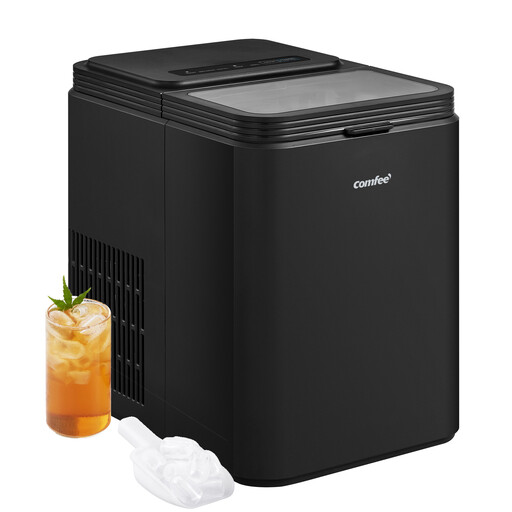
Why This Fits Their Persona: Its compact 295.7 x 213 x 295 mm footprint suits renters, smaller kitchens and first-time buyers who want a straightforward ice maker machine for home use.
The stated output is paired with a 0.4 kg removable ice container, making the storage limitation clear rather than leaving buyers to infer it from the daily figure.
Produces up to 12 kg in 24 hours, offers two bullet ice sizes and includes an ice scoop and basket.

Why This Fits Their Persona: One-touch controls and visible water and full-ice indicators suit households that value simple operation for daily drinks and entertaining.
The five-minute automatic cleaning cycle is clearly operated through the Clean button, while the guidance to remove finished ice helps prevent reliance on the basket for long-term storage.
Makes eight ice pieces in approximately 6–9 minutes, with two bullet sizes and a self-cleaning function.
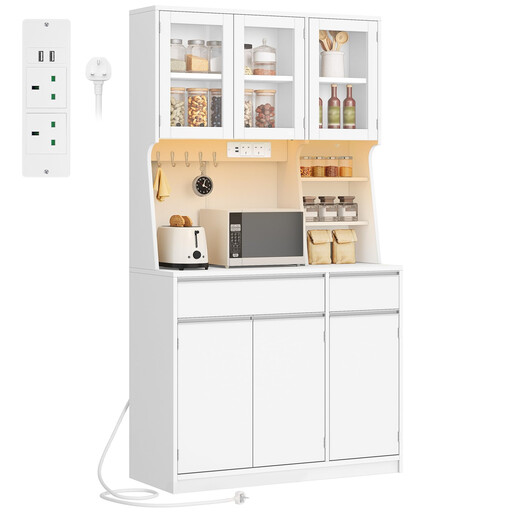
Why This Fits Their Persona: Hosts, office managers and families can create a dedicated beverage and appliance station around a countertop ice maker, with storage for cups, dry goods and accessories.
Its 100 x 38.5 cm work surface and layered storage help prevent an appliance from occupying an already crowded worktop. Water and electrical safety still need to be managed separately.
Includes two UK AC outlets, two USB ports, adjustable shelving and 25 LED lighting modes within a 40.5 x 100.5 x 180.5 cm cabinet.
We have compiled a complete, real-time list of products that fully meet these strict selection criteria and UK safety regulations.
Running cost depends on the appliance’s rated wattage, how often it operates and your electricity tariff. To estimate usage, multiply the machine’s power in kilowatts by operating hours, then multiply that figure by your tariff. Producing ice continuously will use more electricity than making occasional batches, so select a capacity that matches your actual demand.
Usually, no. Many compact machines make and hold ice temporarily but are not designed as freezers. Ice can melt in the basket and return to the water tank. For parties or office use, remove batches regularly and store them in a freezer or insulated container.
Service life depends on cleaning, ventilation, water quality, frequency of use and correct handling. A self-cleaning cycle can simplify routine care, but users should still clean removable parts and follow the maintenance schedule. Choosing a machine with clear indicators, accessible components and a suitable capacity can help avoid unnecessary strain from constant overuse.