Daily iced-coffee drinker with limited worktop space
If you usually make one or two drinks, focus on the first batch and where the appliance will sit. Check the tank and basket separately, and plan what to do with ice you do not use immediately.


For one or two iced coffees at a time, start with a compact ice maker and compare its stated first-batch time, cubes per batch, water capacity and cleaning instructions. A claimed daily output alone will not tell you when the first drink can be made; a larger machine makes more sense when repeated refills or serving several people matter enough to justify its worktop space and upkeep.
If you usually make one or two drinks, focus on the first batch and where the appliance will sit. Check the tank and basket separately, and plan what to do with ice you do not use immediately.
When iced coffee shares the ice supply with other drinks, a larger reservoir or basket may reduce interruptions. Balance those capacities against the room the machine needs on the worktop.
Look for accessible cleaning instructions and a practical way to empty the machine. The Drinking Water Inspectorate notes that hard water can cause scale in domestic appliances, so check your local water hardness and the model’s descaling guidance.
For iced coffee, establish how soon you need the first batch before weighing refills, cleaning and capacity for several people.
| Concern | What to check | Who this matters to |
|---|---|---|
| First ice for a regular coffee | Check the stated first-batch time and cubes per batch for the exact model; do not substitute its 24-hour output figure. | If I make coffee and want to add ice soon afterwards, the first batch matters more to me than a full day’s production. Around 37% of consumers would put prompt first ice first. |
| Refills during repeated use | Compare water-tank and basket capacities, and check where finished ice will go. | When I make drinks throughout the day, stopping to refill the tank is what I most want to avoid. For around 27% of consumers, fewer refills would be the primary concern. |
| Cleaning and limescale | Read the model’s cleaning and descaling instructions; check local water hardness rather than relying on a regional assumption. | With hard water or frequent use, I want a cleaning routine I can follow and a hygienic way to handle the ice. Roughly 27% of consumers would prioritise upkeep. |
| Ice for several people | Check daily output alongside tank and basket capacities, dimensions and the model’s ventilation requirements. | When several drinks need ice close together, I care most about whether the machine fits that demand and my worktop. Around 9% of consumers would put multi-person capacity first. |
A 24-hour production claim does not show when enough ice for the first coffee will be ready. Batch times are product claims, and the first cycle can differ from later ones.
Compare the stated first-batch time and cubes per cycle for the exact model before using its daily figure to plan repeated drinks.
Finished ice can melt in a countertop machine. The COMFEE' RCI12WH1UK(E) listing specifically instructs users to move completed ice to a freezer promptly.
Use the batch when it is ready or make room in a freezer for ice you want to keep. Check basket capacity separately from water-tank capacity.
Ice needs hygienic handling, while hard water can leave scale in domestic appliances. A cleaning-cycle button does not establish the full cleaning or descaling routine.
Follow the exact model’s instructions, keep the scoop and storage area clean, and check your water supplier’s hardness information when planning descaling.
An ice maker needs the clearances specified for its model. An appliance or extension lead used outside its ratings can create an electrical hazard.
Measure the intended space and check the manual’s ventilation, voltage and plug requirements before use. Electrical Safety First advises against overloading or daisy-chaining extension leads.
The RCI12WH1UK(E) represents a compact bullet-ice option for small batches of iced coffee.
The Caldwell is a compact ice-only model; the Aqueous combines ice making with chilled- and hot-water dispensing.
The IM03A illustrates a tabletop option with delayed-start scheduling for planned drink preparation.
These Joybuy listings cover compact countertop machines for making small batches of ice for routine drinks. Compare their stated cycles with tank capacity, electrical suitability and cleaning instructions before choosing.
 Image unavailable
Consider this for small batches of ice for routine drinks: the listing advertises nine cubes in six minutes, two ice sizes and a self-cleaning function. Its product details describe a 110–120 V/60 Hz supply; confirm electrical suitability, the plug and the documentation for your intended socket before ordering or use.
 Image unavailable
For one or two iced coffees at a time, the listing claims eight ice bullets in 6–9 minutes, two sizes, a 1.3-litre tank and a five-minute cleaning cycle. Transfer completed ice to a freezer to prevent melting, and check the model’s electrical and cleaning instructions before use.
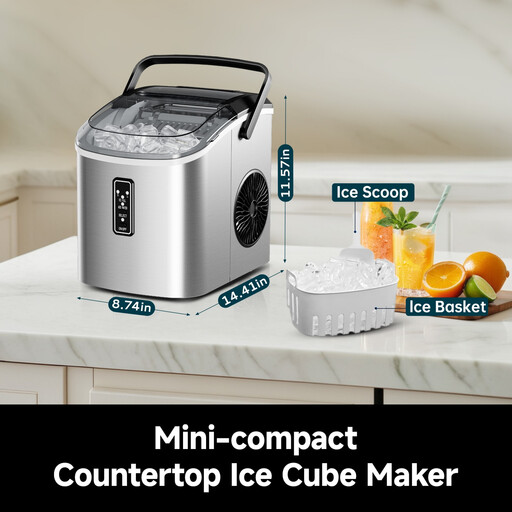 Image unavailable
This portable listing offers two ice sizes and a self-cleaning mode for repeated drinks. Its title claims nine cubes in six minutes, but its description gives a 6–12-minute range; check the exact cycle timing, tank capacity and electrical requirements before choosing it.
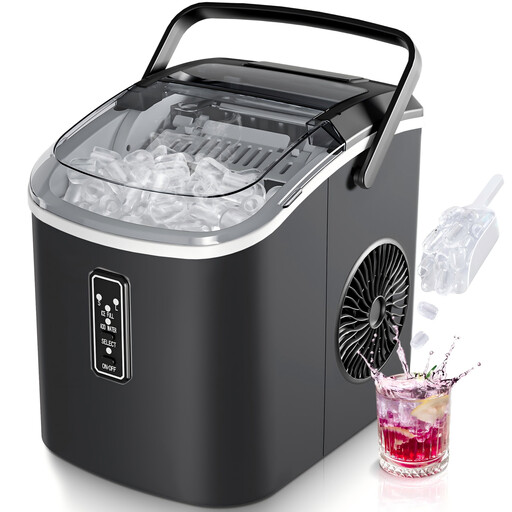 Image unavailable
This countertop model is another option for small batches, with two ice sizes and a self-cleaning mode in the listing. The title claims nine cubes in six minutes, while the description gives a 6–12-minute range. Check cycle timing, tank and basket capacities, placement requirements and electrical suitability for this exact SKU.
Do not assume its basket keeps ice frozen. The COMFEE' RCI12WH1UK(E) listing says to remove completed ice promptly and store it in a freezer; follow the instructions for the model you choose.
Use water unless your exact model’s instructions expressly permit another liquid. An IceQ ice-maker manual calls for fresh water and forbids milk, juice and other liquids because they may damage that machine; make the coffee separately and add the finished ice.
No: follow the model’s complete cleaning instructions and handle the finished ice hygienically. Keep the scoop and ice-contact areas clean; West Lothian Council’s guidance for food businesses treats ice as food that must be made, stored and handled hygienically.
Check your water supplier’s local hardness information and the ice maker’s descaling instructions. The Drinking Water Inspectorate notes that hard water can cause scale in domestic appliances; a self-cleaning button alone does not tell you how the model should be descaled.
Check the exact model’s stated voltage, frequency, plug and product documentation against where you intend to use it. Do not treat a UK-facing listing as proof that an appliance is suitable for your socket; confirm unclear details with the seller before ordering or connecting it.