Solo cold-drink maker
You usually need ice for one iced coffee, soft drink, juice or cocktail. The time until the first batch is ready may matter more to you than maximum daily production.


For one person’s cold drinks, a compact countertop bullet-ice maker is a sensible starting point if you want a small batch without preparing freezer trays. Compare first-batch time, worktop fit and cleaning access before daily output; a larger tank matters more if you make drinks repeatedly or serve guests, while spare ice still needs freezer storage.
You usually need ice for one iced coffee, soft drink, juice or cocktail. The time until the first batch is ready may matter more to you than maximum daily production.
You need to leave room not just for the appliance, but also to open it, remove the basket and provide the ventilation specified in its instructions.
You want a manageable cleaning routine and are prepared to wash accessible parts manually, even if the machine has a self-cleaning cycle. Coventry City Council advises that such cycles do not replace all manual cleaning.
For a single drink, start with the time and quantity of the first batch, then check where the machine will sit. Tank and basket capacity become more important when you make several drinks between refills.
| Concern | What to check | Who this matters to |
|---|---|---|
| Ice for an immediate drink | Compare stated first-batch time and cubes per cycle; check any temperature conditions attached to the claim. | If I usually make one drink, I want to know how soon a small batch will be ready, not how much ice the machine could make all day. Around 36% of consumers put first-batch speed first. |
| Worktop fit | Measure the available width, depth and height, including lid access; follow the model’s ventilation instructions. | On a crowded worktop, I need space to open and clean the machine without blocking its cooling airflow. Worktop fit comes first for around 29% of consumers. |
| Cleaning and ice handling | Look for accessible surfaces and a removable basket and scoop; check the manual-cleaning instructions even if there is a self-clean cycle. | With regular use, I want to keep the ice and the parts that touch it clean without relying on one automatic cycle. Around 21% of consumers make ease of hygienic care their main concern. |
| Refills and ice sizes | Compare tank and basket capacities and available ice sizes; check how the instructions say to store finished ice. | If I make several drinks across the day, I would rather refill less often or choose a size that suits each drink. Around 14% of consumers prioritise that convenience. |
A figure such as 12 kg in 24 hours describes production over a day, not the ice waiting when you make one drink.
Compare the stated first-batch time and cubes per cycle before using daily output to distinguish machines.
Coventry City Council says self-cleaning cycles clean the surface where ice is made, while other parts still require manual cleaning.
Follow the manufacturer’s cleaning instructions for accessible parts and the scoop, and avoid handling serving ice with bare hands.
The Comfee RCI12 listing advises transferring finished ice to a freezer to prevent it melting. A collection basket should not be treated as freezer storage.
Make what you expect to use soon, or move surplus ice into a clean container in the freezer.
CASO Design specifies a Schuko plug for its IceChef Compact; that specification alone does not establish what a UK seller will supply. Electrical Safety First identifies the UK supply as 230 V and 50 Hz.
Confirm the exact model’s supplied plug, electrical compatibility and seller warranty arrangements before ordering.
The Joybuy-listed RCI12BL1UK(E) is a compact countertop example with a stated 1.3 L tank, two bullet-ice sizes and self-cleaning mode.
Klarstein UK lists home ice makers with differing capacities; its IceVolcano is one example to consider for repeated drinks or occasional guests.
CASO Design describes its IceChef Compact as a two-size countertop ice maker with a 1 L tank.
These compact countertop models offer two sizes of bullet ice for cold drinks. Compare their stated batch information and worktop requirements for your own routine.
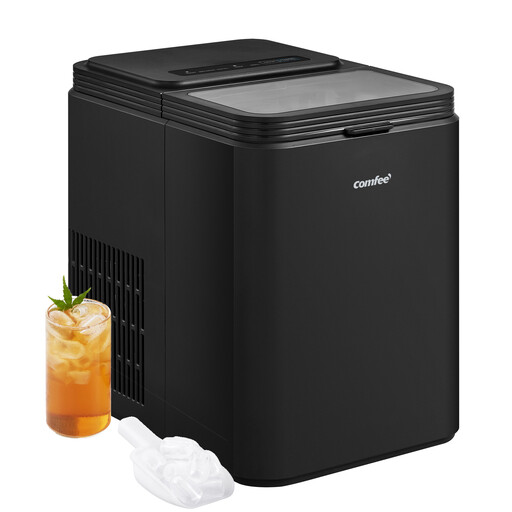 No image available
Consider this model if a stated small first batch and measurable worktop footprint matter for your usual single drink.
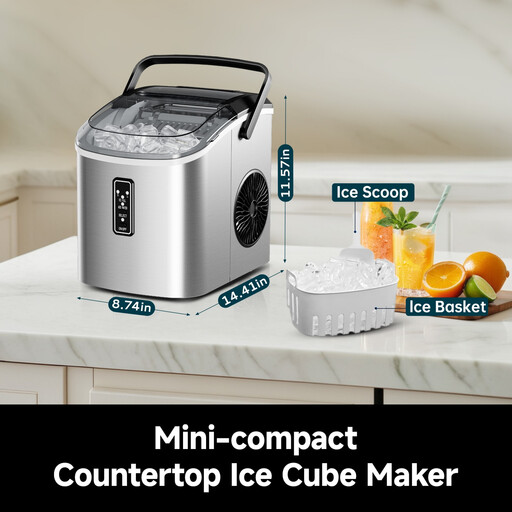 No image available
Consider this model if you want a choice of bullet-ice sizes and a handle for moving the appliance.
Do not rely on the collection basket for freezer storage. The Comfee RCI12 listing advises moving finished ice to a freezer to prevent melting; check the instructions for whichever model you choose.
No. Coventry City Council says these cycles clean the ice-making surface but other manual cleaning is still required. Clean accessible parts and the scoop according to the selected machine’s instructions.
Confirm the exact supplied plug and compatibility with the UK’s 230 V, 50 Hz supply, as identified by Electrical Safety First. For example, CASO Design specifies a Schuko plug for the IceChef Compact, so do not assume a seller supplies a UK-ready version.
Check your local electrical recycling arrangements or a retailer take-back route rather than putting it in household rubbish. Coventry City Council advises against placing electrical appliances in household bins, and GOV.UK provides guidance on waste electrical and electronic equipment.