Regular iced-coffee drinkers with limited space
If you make iced coffee often but cannot leave much worktop space occupied, check whether you can still open the lid, refill the tank and remove the basket once the machine is in place.


For regular iced coffee in a small kitchen, start with the usable worktop space and the clearance required by the exact machine, then compare first-batch time with your usual number of drinks. A larger tank or daily-output claim matters more when you make several drinks, while a stated noise figure is worth checking if the machine will run near living space. Self-cleaning can help with upkeep, but it does not replace cleaning the basket and other food-contact surfaces.
If you make iced coffee often but cannot leave much worktop space occupied, check whether you can still open the lid, refill the tank and remove the basket once the machine is in place.
If the machine will run near a desk or living area, look for a stated noise figure rather than assuming that a compact machine will be quiet.
If you usually make one or two iced coffees but sometimes serve visitors, consider tank capacity and daily output alongside the space the machine occupies.
Measure the space you can actually use before comparing ice-production claims: a machine also needs room for access and the clearance specified in its manual.
| Concern | What to check | Who this matters to |
|---|---|---|
| Worktop fit and access | Compare width, depth and height in the same orientation, then check the manual for access and ventilation clearance. | With little counter space, I need to fill the tank and lift out the basket without moving the machine each time; around 40% of consumers put worktop fit first. |
| Ice for regular drinks | Check the stated first-batch time and daily output separately; daily output is not basket capacity. | When making iced coffee regularly or serving visitors, I want to know how long the first batch takes and whether the machine can keep up; around 30% of consumers prioritise ice production. |
| Hygiene and cleaning | Check how the basket and food-contact surfaces are cleaned, even if the machine has a self-cleaning cycle. | If I use the machine frequently, I need a cleaning routine I can keep up with; roughly 20% of consumers make maintenance their main concern. |
| Noise near living space | Look for a stated noise level in dB, and compare figures cautiously because operating conditions may differ. | With the maker running near my desk or conversations, I want noise information before choosing; about 10% of consumers place quiet operation first. |
A daily-output claim does not tell you how much ice the basket holds or how long you will wait for one iced coffee.
Compare first-batch time, tank and basket capacity, and the machine's dimensions against the number of drinks you usually make.
Coventry City Council advises that self-cleaning cycles clean the surface where ice is made, while other parts still need manual cleaning.
Follow the appliance manual for cleaning the basket, lid, scoop and accessible food-contact surfaces, and handle fresh ice with a clean scoop.
Product dimensions alone do not account for opening the lid, adding water, removing ice or providing the manufacturer's required clearance.
Measure the usable width, depth and height, then check placement and ventilation instructions for the exact model.
GOV.UK advises checking safety markings and manufacturer details when buying electrical products, particularly from sellers outside the UK.
Check the seller, instructions, applicable marking and manufacturer name and address for your delivery location before ordering.
The RCI12BL1UK (E) is a manual-fill countertop option for consumers weighing a narrow listed dimension against everyday ice needs.
The Cookworks ice maker offers another compact-counter option to measure against your available space.
The IceChef Compact is worth considering when both worktop dimensions and a published noise figure matter.
The SDA2931GE offers published tank, basket and noise figures for consumers comparing everyday use in an open-plan room.
The researched Pro Breeze model is a route to consider when several drinks make tank size and stated daily output important.
These countertop models offer two ice-size choices for iced drinks. Check each machine's placement requirements against your kitchen, and weigh its ice-production claims against how often you make coffee.
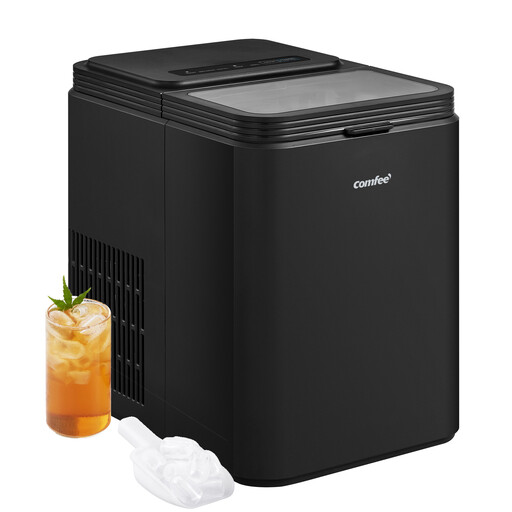 Image unavailable
Consider this model if counter space is tight and you make iced coffee regularly.
Its listing gives dimensions of 295.7 × 213 × 295 mm, a 1.3 L tank, two ice sizes, ice in 6–9 minutes and up to 12 kg of ice per day. Check the exact manual for access and ventilation clearance. Its self-cleaning function does not replace manual cleaning of food-contact surfaces.
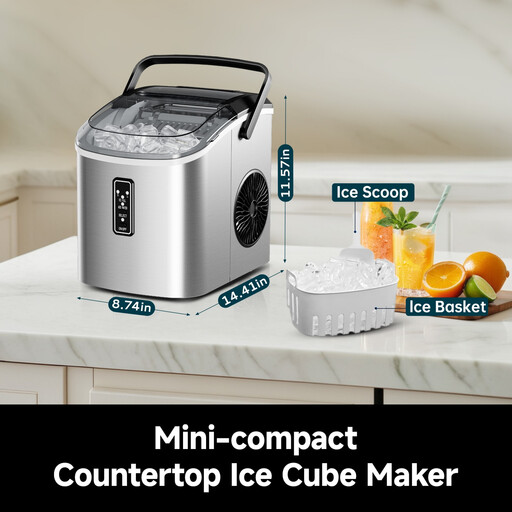 Image unavailable
Consider this model if you want two bullet-ice sizes and can allow room around the machine on your counter.
The listing claims up to 12 kg of ice per day and describes a removable basket, scoop and self-cleaning function. It specifies at least 15 cm clearance from walls; check the manual for full placement requirements and confirm first-batch timing if waiting time matters to you. Clean food-contact parts manually as directed.
No. Coventry City Council advises that self-cleaning cycles clean the surface where ice is made, but manual cleaning of other parts remains necessary. Follow the appliance manual for the basket, lid, scoop and other accessible food-contact surfaces.
Treat ice as food and use a clean scoop rather than your hands or a drinking glass. West Lothian Council advises keeping ice-making and storage areas clean and removing old ice before cleaning the storage compartment.
Check the seller's identity, the product instructions, applicable safety marking and the manufacturer's name and address. GOV.UK recommends these checks for consumer products, particularly when buying from a seller outside the UK.
For relevant products placed on the Great Britain market, GOV.UK says CE marking continues to be recognised alongside or instead of UKCA marking. Arrangements differ in Northern Ireland, so check the marking requirements and seller information for your delivery location rather than relying on a Great Britain rule alone.