
24/7 Customer Support

Free returns

Same-day & Next-day Delivery

Quality Guaranteed

Unlock Your Welcome Offers: FREE Delivery | Up to 80% OFF | Free 30-day JoyPlus trial
Download the APP
A sudden burst of sunshine, an impromptu garden party or simply the desire for a perfectly chilled drink—these moments often call for one thing: ice. Yet, many of us find our freezer trays empty or too slow to refreeze. A countertop ice maker seems like the perfect solution, promising a near-endless supply of ice on demand.
However, the market is flooded with models that often over-promise and under-deliver. As a Joybuy Product Recommendation Officer, my role is to help you see past the marketing jargon. Before you invest, be aware of a few common pitfalls that can lead to disappointment and a wasted purchase.
To ensure your new ice maker machine for home meets your expectations, focus on these core specifications. They provide a much clearer picture of performance than the headline features alone.
The most important balance to consider is how quickly the machine produces a batch of ice versus how much the internal basket can hold. A fast ice maker might produce 9 cubes in 6-8 minutes, which is excellent for topping up drinks during a party. However, if the basket only holds 500g of ice, it will fill up in under an hour and stop making more.
If you plan to use your machine beyond the kitchen counter, such as for camping or in a caravan, its physical attributes are non-negotiable. Look for a portable ice maker with:
A reliable self-cleaning ice maker simplifies upkeep, but you should also check for features that facilitate proper manual cleaning. A machine with an easily accessible drainage plug at the bottom allows you to empty the water reservoir completely, preventing stagnant water and making it easier to dry. Smooth, wipeable interior surfaces will also make it much simpler to prevent the mineral and mould build-up that automated cycles can't always tackle.
Based on these practical considerations, here are some recommendations matched to different user needs.
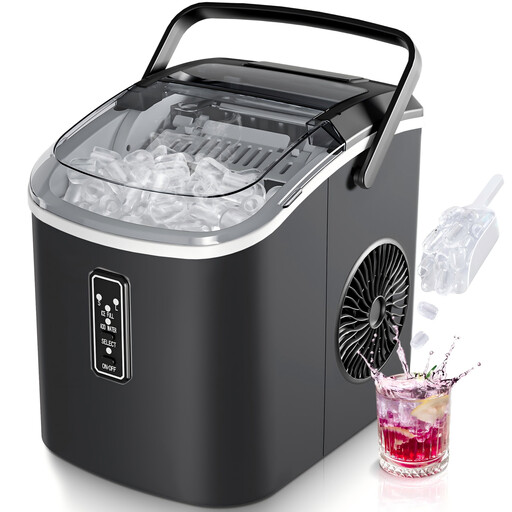
Why This Fits Their Persona: Ideal for those who host gatherings. Its rapid cycle time ensures a steady flow of ice for drinks and its compact design doesn't monopolise precious counter space in a busy kitchen. The choice of two ice cube sizes is a practical touch for different beverages.
It directly addresses the "output illusion" with clear indicator lights for when the basket is full or water is low, allowing you to manage production effectively rather than relying on a theoretical 24-hour figure.
Produces 9 bullet-shaped ice cubes in as little as 6 minutes. The dedicated self-cleaning function provides a convenient starting point for regular maintenance.
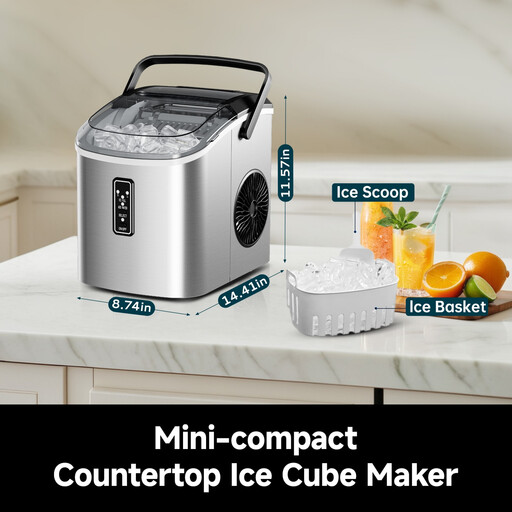
Why This Fits Their Persona: Perfect for those with a caravan, RV or a love for well-equipped camping. It's genuinely portable, weighing just 6.3 kg and featuring a robust handle for easy carrying from the car to the campsite. It only requires a power source, not plumbing.
This model counters vague "portability" claims with specific, practical features. Its defined low weight (6.3 kg) and integrated handle make it truly suitable for an on-the-go lifestyle, unlike heavier, handle-less models.
Excellent portability without sacrificing performance. The simple control panel and self-cleaning function are ideal for quick setup and easy maintenance while travelling.
We have compiled a complete, real-time list of products that fully satisfy these strict selection criteria and UK safety regulations.
The running cost is relatively low. Most countertop ice makers have a power rating between 100W and 150W. Based on current average UK electricity tariffs, running a 120W machine continuously for 8 hours would cost approximately 25-30 pence. Since the machine cycles on and off, the actual daily cost for intermittent use is often even lower.
While you can use standard tap water, it's advisable to use filtered or bottled water. This helps prevent the build-up of mineral deposits (limescale) inside the machine, which can affect performance and taste over time. Using filtered water will reduce the frequency with which you need to perform a full manual descaling.
The ice basket in a countertop ice maker is insulated, but it is not a freezer. Ice will begin to melt slowly over a few hours. However, this is part of the design; the melted water drains back into the reservoir and is used to create the next batch of ice. For best results, it's recommended to transfer the ice to a freezer or an insulated ice bucket if you need to store it for an extended period.