
24/7 Customer Support

Free returns

Same-day & Next-day Delivery

Quality Guaranteed

Unlock Your Welcome Offers: FREE Delivery | Up to 80% OFF | Free 30-day JoyPlus trial
Download the APP
A countertop ice maker can be useful when your freezer cannot keep up with drinks, parties or summer gatherings. It can also be a costly purchase if you focus only on phrases such as “fast ice” or “12 kg per day” without checking how the appliance will fit into your routine.
The main buying pitfalls are often easy to overlook:
For everyday drinks, check both cycle time and daily output. A fast ice maker may produce its first batch in around 6–9 minutes, but the quantity per cycle matters just as much.
The products featured here generally make between 8 and 9 bullet-shaped cubes per cycle and list output of up to 12 kg in 24 hours. This can suit a household, home bar or small gathering, but a larger party may still require batches to be transferred to a freezer or insulated container.
Look for:
A 12 kg ice maker is suitable for regular domestic use, but do not interpret the figure as the machine’s storage capacity.
Measure the worktop before ordering. A compact ice maker still needs space for its power cable, lid and ventilation openings. Some manufacturers recommend at least 15 cm of clearance around the appliance; always follow the specific user manual.
A portable ice maker with a handle can be moved between a kitchen, office, bar or motorhome, but it should be transported upright and placed on a level, stable surface before use. Avoid direct sunlight, hot surroundings and enclosed cupboards.
For camping and RVs, check the available socket, power requirements and ventilation. Do not assume that every model is suitable for outdoor use or every vehicle electrical system.
A self-cleaning ice maker can reduce routine effort, particularly if it offers a dedicated cycle controlled from the front panel. However, you should still empty unused water, wipe accessible surfaces and clean the basket and scoop according to the manual.
Noise is another practical specification. Models listed below 45–50 dB may be more comfortable in an open-plan kitchen or office, although the perceived sound can vary with the surface and room acoustics.
Consider the ice shape too:
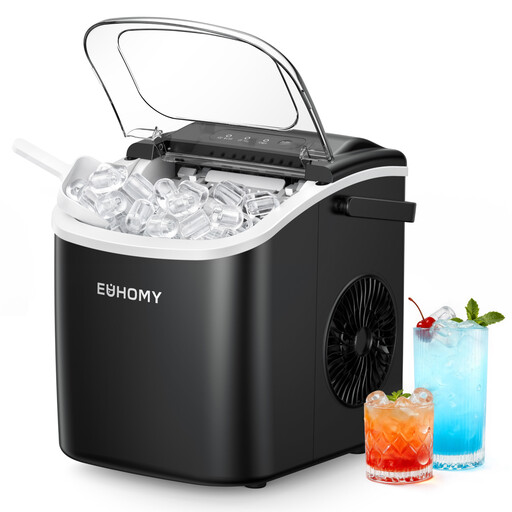
Why This Fits Their Persona: A straightforward option for UK households, flats and offices that need occasional fresh ice without a built-in appliance. Its 6.2 kg weight and integrated handle make storage between uses more manageable.
The product information states a 30-minute self-cleaning programme, plus water-low and ice-full indicators, rather than relying on vague maintenance wording.
Produces 9 bullet-shaped cubes in approximately 6–9 minutes; includes a removable basket and scoop; listed noise level is below 45 dB.
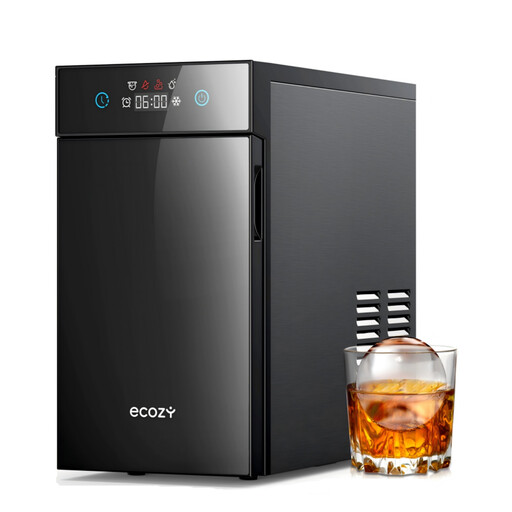
Why This Fits Their Persona: Designed for home bar owners who prioritise spherical presentation for whisky, bourbon and cocktails over rapid bulk production.
Its stated output is one clear sphere in around 40 minutes, making the slower production rate clear instead of presenting it as a conventional fast ice machine.
Makes 60 mm clear ice spheres; includes an 8-hour timer, LED touch screen and storage box; listed capacity is up to 32 spheres per day.
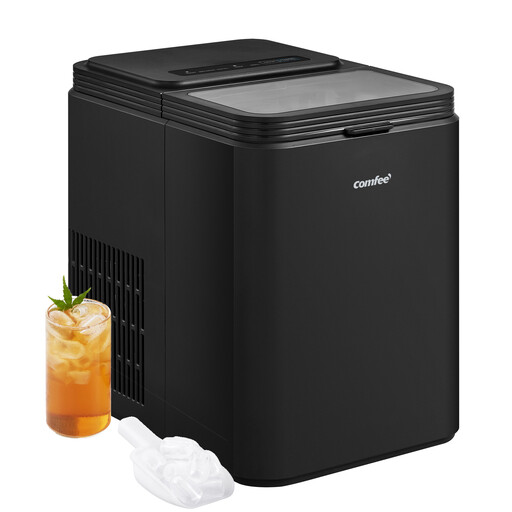
Why This Fits Their Persona: A practical match for party hosts, busy family kitchens, offices and motorhome users who want two cube sizes and a higher stated daily output.
The stated 1.3 L tank, 0.4 kg removable container and 12 kg per 24-hour output help set realistic expectations about refilling and transferring ice.
Produces 8 ice bullets in approximately 6–9 minutes; offers two ice sizes; includes self-cleaning, basket and scoop.
We have compiled a complete, real-time list of products that fully satisfy these strict selection criteria and UK safety regulations.
Use only clean, drinkable water and do not fill beyond the MAX line. Connect the appliance to a properly earthed socket and avoid extension leads unless the manufacturer specifically permits them. Keep ventilation openings clear and unplug the unit before moving or cleaning.
Ice makers commonly use refrigerant systems, so do not puncture tubing or attempt to repair the refrigeration circuit yourself. Keep the appliance away from children, particularly while the ice-ejection mechanism is operating. The main unit and power cord must not be immersed in water.
Running cost depends on the appliance’s power consumption, room temperature, water temperature and how often it operates. A shorter cycle does not automatically mean lower electricity use. To estimate cost, multiply the appliance’s kilowatt rating by your electricity tariff and operating hours. Allowing the machine to run only when needed can reduce unnecessary consumption.
Lifespan depends on cleaning, ventilation, water quality and frequency of use. Mineral deposits can affect performance, particularly in hard-water areas. Empty the reservoir when the appliance will not be used for an extended period, wipe accessible parts and follow the manufacturer’s cleaning schedule. A self-cleaning cycle supports maintenance but does not replace manual care.
It is generally preferable to transfer unused ice to a freezer or insulated container. A countertop ice maker usually produces ice rather than freezing and storing it long-term, so cubes can melt back into the water reservoir. Check the specific manual before leaving the appliance operating unattended.