Solo summer-drinks host
You usually make drinks for yourself but want ice ready for a small gathering. Repeat production helps only if you can transfer finished batches to cold storage before serving.


A countertop ice maker is worth considering if you want to make repeated batches, have room to run it and can move finished ice to a freezer before guests arrive. A quick first batch does not mean the collection basket will keep a party’s supply frozen. For occasional drinks, freezer trays may be simpler; for an occasional larger gathering, bought ice is another option if you have somewhere cold to keep it.
You usually make drinks for yourself but want ice ready for a small gathering. Repeat production helps only if you can transfer finished batches to cold storage before serving.
You want to make ice without a plumbed-in appliance, but need enough worktop room to fill the tank, remove the basket and use the machine safely.
You care about the ice shape or available sizes as well as the rate of production. Check that the exact model makes the ice you want without losing sight of how much you need ready at once.
For summer drinks at home, work out where finished ice will go before comparing production claims. Then check whether filling, emptying and cleaning the machine will fit your routine.
| Concern | What to check | Who this matters to |
|---|---|---|
| Ice ready for serving | Compare first-batch time and repeat output with basket capacity; plan freezer space for completed batches. | If I need ice ready when guests arrive, a quick first batch alone will not cover the drinks I plan to serve; around 40% of consumers put a party-ready supply first. |
| Filling and cleaning | Check tank size, drain access and the exact model’s cleaning instructions. | When I am running the machine on my own, frequent refills or awkward draining can interrupt preparations; roughly 30% of consumers prioritise manageable upkeep. |
| Worktop fit | Measure the intended position and check the manual for access and ventilation clearances. | With limited counter space, I need to reach the tank and basket without crowding the kitchen; about 20% of consumers place worktop fit first. |
| Ice for particular drinks | Check whether the exact model makes bullet ice, offers size settings or produces clear ice in the required shape. | If the ice is part of how I want to serve cocktails or iced coffee, its shape matters alongside quantity; around 10% of consumers make drink-specific ice their main concern. |
The first batch begins a repeat-cycle process; the collection basket is not a freezer. Joybuy’s COMFEE' listing instructs users to remove finished ice and store it in a freezer to prevent melting.
Plan backwards from serving time. Check batch timing and basket capacity, then decide when and where you will transfer the ice.
A daily production claim does not tell you how much ice will be waiting in the basket at serving time. The listed models also differ in tank size, footprint and the information given about basket capacity.
Compare specifications for the exact models you are considering, especially batch time, basket capacity and the space needed to operate them.
A self-cleaning cycle does not replace the model’s instructions for draining and care, particularly if you use the machine only occasionally.
Check the manual for the drain position and for cleaning and storage steps between uses.
The machine also needs room for filling, basket access and any placement clearance specified in its manual.
Measure the intended worktop position, then compare it with the exact model’s dimensions and operating instructions.
Joybuy lists the COMFEE' RCI12WH1UK (E) as a countertop bullet-ice maker for repeated home use.
Sensio Home describes a countertop model with a 1.5 L tank, a 600 g basket and two ice-size settings.
Robert Dyas lists the Daewoo SDA2931GE with a 1.2 L manual-fill tank and a 0.6 kg basket.
CASO Design offers different countertop ice-maker formats, including the IceChef Compact and a clear-ice option.
These choices cover repeat-batch bullet-ice makers and a specialised sphere-ice maker. For a gathering, compare how quickly each makes the ice you need and how you will store completed batches.
 No image available
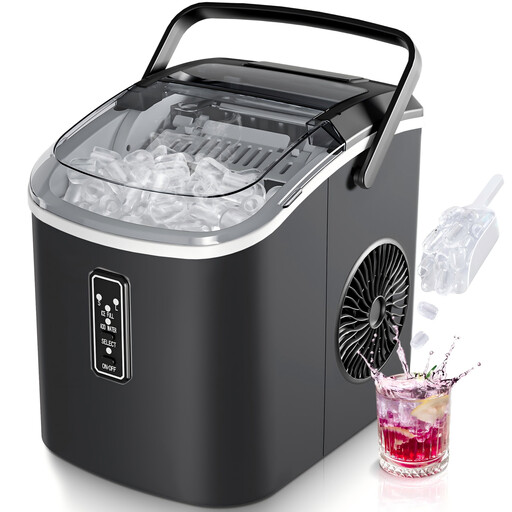
Consider this bullet-ice model if you can run repeated batches before serving and transfer the finished ice to a freezer. Joybuy lists eight bullets per 6–9-minute cycle, up to 12 kg in 24 hours, a 1.3 L tank and two ice sizes.
The listing specifies a self-cleaning cycle and cautions that high room temperatures may reduce ice-making efficiency. Check basket capacity and the space needed to operate it if either will determine your choice.
 No image available
This bullet-ice maker is another option for preparing repeated batches for drinks. Its product information specifies two ice sizes and approximately 12 kg of daily output, but gives differing cycle-time claims; confirm the timing for the item before planning around it.
The detailed instructions specify at least 15 cm of clearance on all sides. Check basket and tank capacities, as well as how you will store finished ice, before relying on it for a gathering.
 No image available
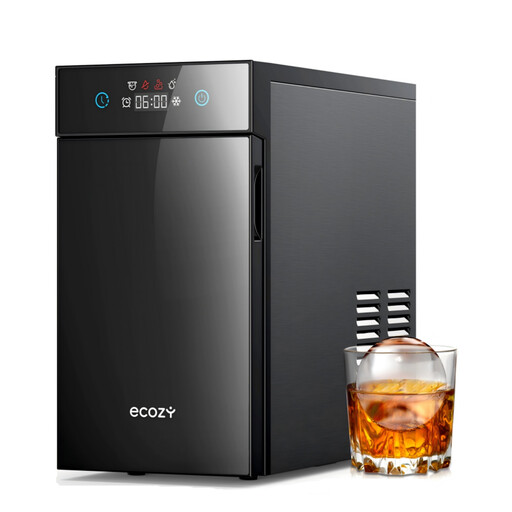
Choose this specialised format only if 60 mm spheres suit the drinks you plan to serve. The product information states one sphere per 40 minutes, up to 32 spheres per day and a basket holding approximately nine, so allow substantially more preparation time than a quick batch of bullet ice.
It specifies a 0.85 L tank and an included ice box for transfers. Check the machine’s dimensions and the box’s capacity against your worktop and storage plans.
It can make repeated batches, but do not count on its collection basket as frozen storage. Start ahead of serving time and move finished ice to a freezer; Joybuy’s COMFEE' listing specifically instructs users to transfer completed ice to prevent melting.
Not necessarily: CASO Design describes its countertop range as plug-in appliances with manually filled water tanks rather than plumbed-in machines. Check the filling arrangement and tank capacity of the exact model you are considering.
No. A self-cleaning feature does not replace the exact model’s draining and care instructions. The Daewoo SDA2931GE retailer listing, for example, instructs users to drain the reservoir after more than 48 hours of non-use; follow your own model’s manual rather than applying that schedule to every machine.
For electrical equipment placed on the Great Britain market, Department for Business and Trade guidance dated 31 March 2026 lists UKCA or CE marking; for Northern Ireland, it lists CE, or UKNI together with CE. Check the label and accompanying product information for the exact item rather than assuming that a marking alone establishes its suitability for your use.