Small-cottage weekend hosts
If you need ice for a few cold drinks and can refill the machine between batches, check its worktop footprint, basket capacity and where you will keep finished ice.


For occasional drinks in a small holiday cottage, start with a compact manual-fill ice maker that fits alongside its required ventilation space. If several guests will make drinks throughout the day, compare batch time, tank and basket capacities, and where you will put finished ice: a daily-output figure does not tell you how much the basket holds.
If you need ice for a few cold drinks and can refill the machine between batches, check its worktop footprint, basket capacity and where you will keep finished ice.
For repeated rounds of drinks at meals or gatherings, batch time, tank size and basket capacity matter more than choosing the smallest body. Check how often you will need to refill water and remove ice.
If the appliance may sit unused between visits, choose one whose tank, basket and scoop you can clean, drain and dry according to its instructions. A self-cleaning function does not replace that routine.
Set aside a ventilated indoor spot for the machine and decide where each finished batch will go before comparing production figures.
| Concern | What to check | Who this matters to |
|---|---|---|
| Ice for a group | Compare batch time, water-tank and ice-basket capacities, and a place to store finished ice. | If several guests want drinks close together, I need repeat batches without constant refilling or emptying. Around 44% of consumers put that supply need first. |
| Worktop space | Measure the appliance and allow the ventilation clearance specified for that model; check its weight if you will move it. | In a small kitchen, I need a place where the machine can run without blocking its vents. For around 33% of consumers, workable placement is the primary concern. |
| Cleaning between stays | Check the model’s instructions for cleaning, drainage and removable parts, and plan how to keep the scoop clean. | When the cottage stands empty, I want to leave the water tank and ice-contact parts clean and dry. Keeping up that routine comes first for around 23% of consumers. |
A kg-per-24-hours figure describes production over time, not the amount waiting in the basket. The IceQ ICEQIMBLK manual, for example, specifies a 600 g ice basket.
Compare daily output with basket capacity and batch time, then plan to transfer ice to a freezer or cooler if it will not be served promptly.
A machine may fit on the worktop yet lack room for ventilation. The IceQ ICEQIMBLK manual calls for 15 cm of clearance around its top, back and sides; another model may have different requirements.
Measure the intended position against the exact model’s dimensions and clearance instructions before ordering.
A cleaning cycle does not remove the need to handle water, ice, the basket and the scoop hygienically.
Follow the model’s cleaning instructions, use potable water and a clean scoop, and drain and dry the appliance before it sits unused.
The electriQ eiqicecm listing describes crushed-ice and water-dispensing functions, but also gives a 45 cm depth and a weight of about 17 kg. Check whether those functions justify the space in the cottage kitchen.
If you intend to use its threaded water inlet, check the connection requirements before choosing it.
The electriQ listing says a hose is not supplied, so using that connection may require a compatible hose or installation work.
The PB-IM01W-UK is a domestic countertop option to compare when a group will want repeated batches.
The manual-fill ICEQIMBLK is worth comparing for a small worktop and occasional drinks.
The catering-oriented HEA653 is an option to examine when its construction and support terms matter to the cottage’s use.
The eiqicecm is a feature-led option when crushed ice or water dispensing is a specific requirement.
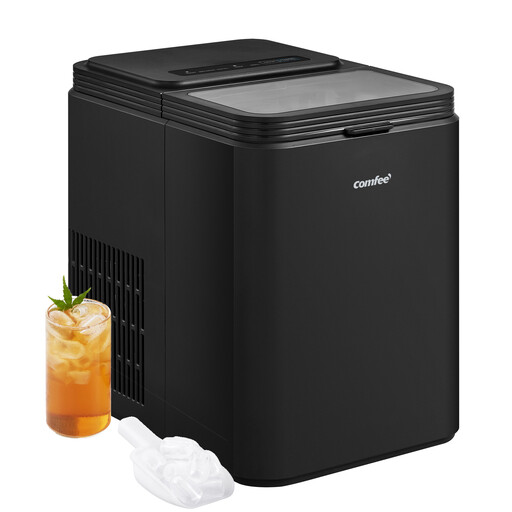
The RCI12WH1UK (E) is a domestic countertop model to compare for compact drink service.
These countertop choices suit cottages where a manual-fill machine can make batches for cold drinks. Compare their stated features with your counter space, refill routine and plan for storing finished ice.
 No image available
Consider this for batches of cold drinks when you can refill water and remove ice as it is made.
The product title states eight ice bullets per 6–9-minute batch and 12 kg in 24 hours; it also lists two ice sizes, a self-cleaning function, a scoop and a basket.
Check the model’s placement and cleaning instructions, and arrange freezer storage if you need to keep finished ice.
 No image available
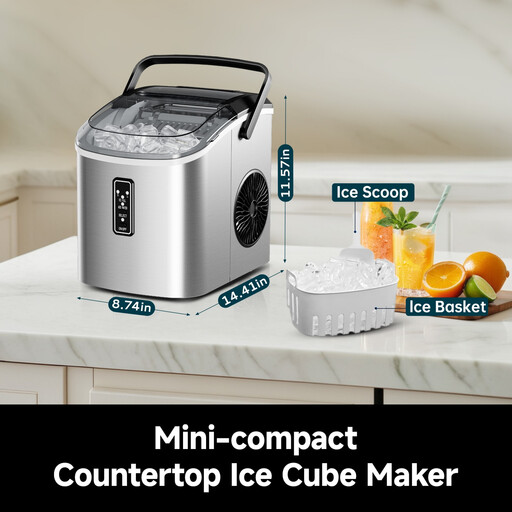
The handle makes this a model to consider if you intend to put the appliance away between cottage stays.
Its product title lists nine cubes per batch, two ice sizes, a self-cleaning function, a basket and a scoop, alongside the 12 kg/day production figure.
Confirm the expected cycle time, tank and basket capacities, and ventilation clearance in the exact model’s instructions before deciding where to place it.
 No image available
Consider this for cottage drink service if you can give it a suitable place to run and empty its basket between batches.
The product title lists nine cubes per batch, a self-cleaning function, a scoop and a basket.
Confirm its dimensions, tank and basket capacities, ventilation clearance and cleaning routine in the exact model’s instructions before purchase.
Do not rely on its basket for long-term frozen storage. The Joybuy UK page for the Comfee' RCI12WH1UK (E) instructs users to move finished ice to a freezer to prevent melting; check the instructions for the model you choose and plan where its batches will go.
Clean the machine as directed by its manual and fill it with potable water before making ice. The IceQ ICEQIMBLK manual calls for cleaning before first use, while the Caterlite CN861 manual says unused tank water should be replaced at least every 24 hours; follow the instructions for your own model after a period of inactivity.
Not without checking the exact model’s placement instructions. The IceQ ICEQIMBLK manual specifies indoor use and at least 15 cm of clearance around the top, back and sides. Keep the vents unobstructed and allow the clearance required by the machine you buy.
Use a clean scoop rather than hands or a drinking glass. East Lindsey District Council’s ice-hygiene guidance advises keeping the scoop separately in a clean place and cleaning ice-storage areas regularly.