Small-kitchen iced-coffee regular
If you make iced coffee often but have little worktop depth, you need to check the machine’s footprint and whether you can refill, open and clean it in its intended position.


For one or two iced coffees at a time, start with a manual-fill ice maker that fits your worktop after you allow for ventilation and opening the lid. Check its first-batch claim and how you will empty and clean it; a larger machine makes more sense only if you regularly need ice for several drinks, and a self-clean cycle does not replace manual cleaning.
If you make iced coffee often but have little worktop depth, you need to check the machine’s footprint and whether you can refill, open and clean it in its intended position.
If you usually make one or two drinks, the time to a first batch may matter more to you than a large stated daily output.
If you serve iced drinks to several people or make them repeatedly through the day, check both production and ready-ice storage. Greater capacity may also mean accepting a larger machine or different drainage requirements.
Measure the intended position before comparing ice-making claims: a machine that fits across the worktop still needs enough depth, height and space around it to operate and clean.
| Concern | What to check | Who this matters to |
|---|---|---|
| Footprint and clearance | Measure width, depth and height, then check the exact manual for ventilation and lid-opening space. Nisbets lists the DC439 at 270 mm wide but 365 mm deep. | If I have a shallow worktop, I need to know the machine will fit where I can open it and let it cool. Around 46% of consumers put footprint and clearance first. |
| First batch and routine output | Compare model-specific first-batch or cycle claims and reservoir capacity, not just the daily maximum. Pro Breeze states 6–9-minute intervals for the PB-IM-01; Andrew James states roughly 5–13 minutes for its domestic model, depending on cube size and room temperature. | When I want ice for my next coffee, waiting for the first batch matters more than a large 24-hour figure. Around 27% of consumers prioritise getting enough ice promptly for routine drinks. |
| Emptying and cleaning | Check how unused water drains and whether you can reach the basket and other surfaces for manual cleaning. Coventry City Council advises that self-clean cycles do not replace cleaning beyond the evaporator. | I want to empty the machine after use and clean the parts that touch my ice without a difficult routine. For around 18% of consumers, manageable upkeep is the primary concern. |
| Ice reserve | Compare ready-ice storage separately from daily production. Nisbets states up to 20 kg per 24 hours and a 0.7 kg bin for the DC439; the Polar UA037 is specified at up to 20 kg per day with 4 kg storage and uses gravity drainage. | If several people want iced drinks close together, I care about how much ice is ready at once. Around 9% of consumers put reserve capacity ahead of a smaller footprint. |
A narrow machine can still extend too far across the worktop or leave too little room above it to open the lid. Nisbets specifies the DC439 at 270 mm wide and 365 mm deep.
Measure the final position in all three dimensions and check the exact model manual for ventilation and access clearance.
A 24-hour production claim describes ice-making output, not how much ice the basket holds ready for drinks. Those figures need comparing separately.
Check the bin capacity and the model’s storage instructions; if you need to keep surplus ice frozen, plan where you will transfer it.
Coventry City Council advises that self-clean cycles clean the ice-making surface but do not remove the need to clean other parts manually.
Follow the manufacturer’s instructions for the basket, scoop and accessible surfaces, and use clean utensils to handle ice.
Similar-looking listings can differ in instructions and electrical requirements, so the model you receive matters more than a general product description.
Match the model number on the packaging to its manual, check its stated voltage and search the UK Office for Product Safety and Standards recalls and alerts by brand and model.
These examples show how footprint, output and installation differ between particular product lines; a brand name alone does not establish which machine will fit your worktop.
The PB-IM-01 is a domestic countertop option for buyers comparing a compact footprint and short stated ice-making cycles.
Its domestic ice maker is a manual-fill option that does not require a water or drainage connection.
The DC439 offers higher stated daily output without a water or drainage connection.
The UA037 is a commercial-style option to examine only where greater ready-ice storage and its installation requirements suit the location.
These countertop models are relevant to making ice for iced coffee where worktop space is tight. Check each model’s dimensions in the orientation you will use it, along with the clearance and cleaning instructions, before choosing between them.
 No image available
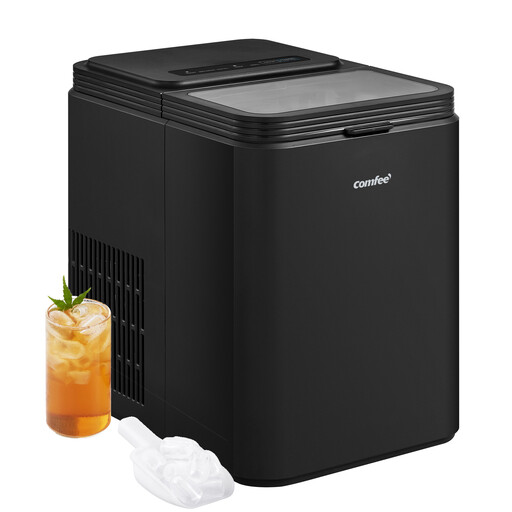
For routine iced coffees on a small worktop, compare its stated 295.7 × 213 × 295 mm dimensions with your available space, then check the manual for ventilation and lid clearance.
The product name states eight ice bullets in 6–9 minutes, two sizes, up to 12 kg in 24 hours, self-cleaning, and an ice scoop and basket. Clean accessible food-contact surfaces manually as well.
 No image available
For a manual-fill iced-coffee setup, check that the machine fits your worktop with the clearance specified in its manual, rather than judging it by its portable design alone.
The product name states nine cubes in six minutes and a self-cleaning function. Check the exact model’s filling, emptying and electrical instructions before use, and clean its accessible food-contact surfaces manually.
Allow for the stated width, depth and height plus the ventilation and lid-opening space in the exact model manual. A compact width does not guarantee a shallow machine: Nisbets lists the DC439 at 270 mm wide but 365 mm deep.
Not necessarily: Andrew James describes its domestic model as manual-fill, and Nisbets says the DC439 needs neither a water nor a drainage connection. Check the particular model, because the larger Polar UA037 uses gravity drainage.
Do not treat daily ice production and ready-ice storage as the same measure. Compare the model’s bin capacity with the amount you need for drinks close together, and follow its instructions for storing any surplus ice.
No. Coventry City Council advises that self-clean cycles clean the ice-making surface only; follow the manufacturer’s instructions to clean the other accessible parts, including the basket and scoop.
Do not assume a domestic machine is suitable for commercial service. Andrew James expressly limits its ice maker to domestic use, so check the exact model’s intended use, installation and cleaning requirements before considering it for a café.