Fish-pie cooks sharing a kitchen
You need enough room for your dish without taking over the worktop. The oven’s placement, electrical load and cleaning routine also affect other people using the kitchen.


Choose a countertop oven with a declared fan or convection mode if that function matters to your fish-pie recipe; a basic mini oven can bake a pie, but its Bake setting alone does not establish fan operation. Before buying either type, check that your dish fits the usable rack space and that the appliance has room, ventilation clearance and a suitable electrical supply in the shared kitchen.
You need enough room for your dish without taking over the worktop. The oven’s placement, electrical load and cleaning routine also affect other people using the kitchen.
You want a declared convection mode, controllable temperature and a timer to help manage a hot filling and browned topping. The appliance specifications still cannot tell you exactly how a particular pie will cook.
You mainly need a separate appliance for occasional baking and are willing to monitor the pie if the mini oven’s description does not establish a fan-convection mode.
Start with the fish-pie dish and the space available for the oven. Then decide whether a declared convection mode is essential to your recipe, and check how the appliance will be powered and cleaned when others use the kitchen.
| Concern | What to check | Who this matters to |
|---|---|---|
| Dish and worktop fit | Measure the dish, including its handles, against usable rack dimensions. Allow for the oven door and the ventilation clearances in its manual; litre capacity alone cannot confirm fit. | If my pie dish has wide handles and the counter is shared, I need to know both will fit before choosing an oven. Around 31% of consumers put dish and worktop fit first. |
| Controllable baking | Check for an explicitly declared fan or convection mode, a Bake setting, temperature control and a suitable rack position. | When I need to heat the filling through without losing track of the topping, clear controls and a stated cooking mode matter most. Roughly 31% of consumers prioritise controllable baking. |
| Shared use and cleaning | Check the appliance’s power rating against the socket or extension lead’s marked rating. Plan where it can stand safely and how shared accessories will be cleaned. | I need to leave the kitchen safe and the trays clean for the next person, especially where fish or milk allergies are a concern. About 23% of consumers place shared-use safety and cleaning first. |
| Occasional use | Check the supplied rack or tray, temperature range, timer and cooking modes. Do not assume a basic mini oven has a fan because it has a Bake setting. | If I bake a fish pie only occasionally, a straightforward secondary oven may be enough, provided I can monitor the cooking. Around 15% of consumers put that occasional-use need first. |
A litre rating does not give you the usable rack width, height or clearance around dish handles.
Measure your dish and worktop, then check the model’s rack dimensions and manual-specified ventilation clearances before buying.
Bake, grill and adjustable temperature are separate specifications from a declared fan or convection system. Without that distinction, you may choose an oven expecting a cooking mode it does not claim to have.
If fan operation matters to your recipe, confirm that the model’s specification explicitly identifies it.
Electrical Safety First warns that overloading sockets or extension leads creates a fire risk. Other appliances connected in a shared kitchen contribute to the load.
Check the oven’s rating, the extension lead’s marked rating and everything connected to it; use a suitable wall socket where possible.
Fish pie may leave fish or milk residues on equipment other people use. Food Standards Agency guidance identifies cross-contamination as a concern where food and equipment are shared.
Agree who cleans the oven accessories and preparation area after use, and take particular care with shared equipment where someone has a relevant allergy.
The Foodi DT200UK is a multifunction countertop option for cooks considering a declared convection system and two-level cooking.
The Smart Oven Air Fryer SOV860BSS4GUK1 is a countertop option for cooks who want digital controls alongside a declared convection system.
The T14044 is a 32 L mini oven with two hotplates for a kitchen where an additional hob is useful.
The reviewed 30 L oven and grill is a compact mini-oven option for occasional baking.
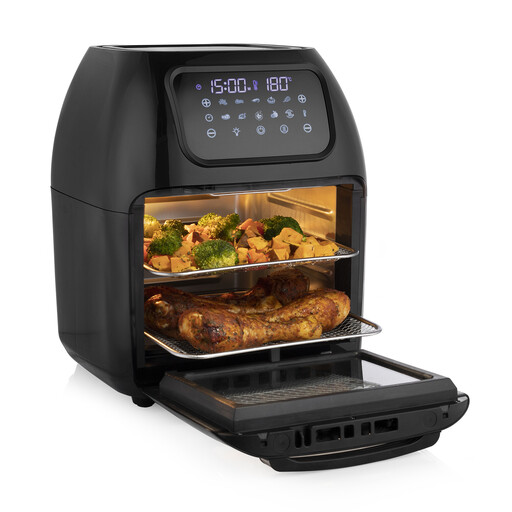
This air fryer oven is a countertop option to consider if its usable cooking space accommodates your fish-pie dish. Check its stated baking and airflow modes against your recipe, along with the space and electrical supply available in your shared kitchen.
 No image available
Consider this countertop oven for a fish-pie dish only after checking its usable rack space, cooking modes and required ventilation clearance.
The product name states an 1800 W rating, touch-screen controls, 10 programmes, dishwasher-safe parts and a non-stick coating. Check the combined electrical load if the oven will share an extension lead with other appliances.
No: a basic mini oven with a Bake setting can be considered if you are prepared to monitor the pie. If a declared fan mode is important to your recipe, check the exact model specification: Ninja lists True Surround Convection for the DT200UK and Sage lists dual-speed convection for the SOV860BSS4GUK1, while the reviewed Tower and NETTA descriptions do not establish that mode.
Only if the combined load stays within the lead’s marked rating; a suitable wall socket is preferable where available. Electrical Safety First warns against overloading extension leads, so account for every connected appliance rather than checking the oven alone.
Clean dishes, accessories, utensils and preparation surfaces between users, and agree who is responsible for doing so. Food Standards Agency guidance identifies cross-contamination as a concern; use separately identified equipment where a relevant allergy makes cross-contact especially important.
Yes, if the oven can reheat the pie thoroughly throughout rather than merely warming it. Food Standards Agency guidance describes reheating as cooking again and advises reheating only once.