Weekday lunchbox batch bakers
If you make several flatbreads at a time, usable tray area and a Bake setting matter more than an unusually high maximum temperature. Check how many of your preferred dough shapes will fit without crowding.


Choose a tray-style countertop oven if your flatbreads will fit on its usable baking surface and you want everyday cooking functions as well as baking. A larger multifunction oven makes more sense when you regularly prepare several lunch portions or other meals; a specialist high-heat pizza oven suits a crisp, strongly browned finish rather than general-purpose use. Check tray dimensions, worktop and electrical requirements, and how any perishable toppings will be kept cool until lunch.
If you make several flatbreads at a time, usable tray area and a Bake setting matter more than an unusually high maximum temperature. Check how many of your preferred dough shapes will fit without crowding.
If the same worktop appliance must also handle tasks such as toast, grilling or air frying, compare its cooking modes alongside its footprint and electrical requirements.
If you chiefly want thin, strongly browned pizza-style bread, a specialist high-heat oven may suit that priority. Consider whether you will use its specialised cooking approach often enough to give it worktop space.
Choose it when: you want a flat baking tray and several everyday cooking modes for a regular lunchbox routine.
Keep in mind: cavity capacity alone will not tell you whether your flatbread fits the usable tray.
Choose it when: flatbreads are one part of a wider meal-preparation routine and you want several oven functions.
Keep in mind: allow for its worktop footprint and ventilation clearance.
Choose it when: a thin, crisp, strongly browned pizza-style flatbread is your main goal.
Keep in mind: its specialised heat and cooking approach may be less useful for other lunch-preparation tasks.
| Concern | What to check | Who this matters to |
|---|---|---|
| Usable baking area | Compare your dough dimensions with the usable tray width and depth; check how many pieces fit per batch. | If I make several lunch portions, I need the dough to lie flat without cutting every piece smaller. Around 27% of consumers put usable baking area first. |
| Weekday versatility | Check for the cooking modes you will use and read any preheat claim under its stated test conditions. | When I prepare lunch alongside other meals, I want one appliance to handle more than flatbreads. For around 33% of consumers, everyday versatility is the primary concern. |
| Pizza-style finish | Check the stated temperature range, baking surface and supported recipes. | If a thin, strongly browned crust matters most to me, I may prefer a specialist approach over general-purpose modes. That finish comes first for around 13% of consumers. |
| Safe setup and packing | Check the plug, power and worktop-clearance instructions; plan chilled storage when toppings require it. | Before adding an oven to my worktop, I need to know I can use it safely and keep a perishable lunch cool. Around 27% of consumers prioritise those practical requirements. |
Cavity capacity describes overall space, not the width or depth available for a round or rectangular piece of dough. Russell Hobbs UK lists a tray with its 20-litre 26680 mini oven, but capacity alone cannot establish your flatbread size or batch count.
Measure the largest flatbread you plan to bake and compare it with the manufacturer’s usable tray and internal dimensions.
Russell Hobbs UK compares the 26680’s preheat with a conventional oven heating to 220°C. Its energy-saving comparison concerns 400g of frozen French fries cooked at 213°C, not homemade flatbreads.
Read each claim alongside its test conditions, then check the oven’s temperature range and the number of batches your routine requires.
Electrical Safety First warns that unweighted paper can reach a heating element and catch fire.
Follow the appliance manual for permitted liners and paper, secure them as instructed and do not leave the appliance unattended.
Electrical Safety First warns that high-load cooking appliances can overload an extension lead shared with other large appliances. Flatbreads with perishable toppings also need appropriate handling after baking.
Check the oven’s electrical instructions and worktop clearance. For foods that need chilling, follow the packed-lunch advice from East Lancashire Hospitals NHS Trust: refrigerate lunch prepared the night before and use a cool bag or ice pack.
Its Express Air Fryer Mini Oven 26680 illustrates the compact, tray-style route for weekday baking.
The DT200UK illustrates a multifunction countertop-oven route for households preparing more than flatbreads.
The Smart Oven Pizzaiolo illustrates the specialist route for pizza-style flatbreads.
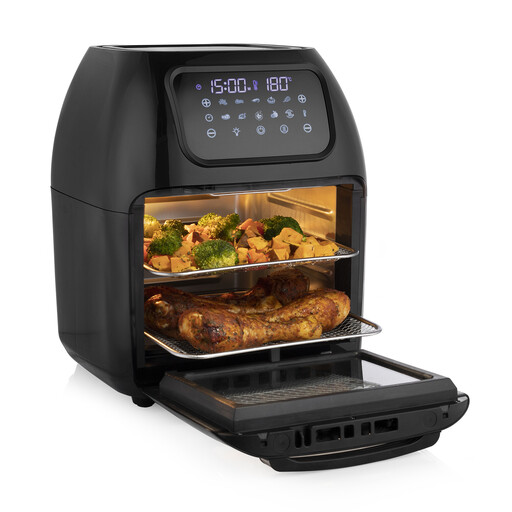
This countertop air-fryer oven is a choice to consider if you want to make flatbreads alongside other meals. Check that its cooking settings and usable baking surface suit your dough before ordering.
 No image available
Consider this model if you want an air-fryer oven for flatbreads and other cooking tasks, provided your dough fits its usable baking surface.
The product name specifies a 10L capacity, 1800W rating, touch screen, 10 programmes, non-stick coating and dishwasher-safe parts. Confirm the cooking settings, usable drip-pan or rack dimensions, UK electrical requirements and worktop clearances for your intended setup.
A tray-style air-fryer oven can suit flatbreads if the model has a suitable baking setting and the dough fits flat on its permitted tray. Electrical Safety First notes that toaster-oven-style air fryers can let food lie flat on trays; check the exact model’s usable dimensions, accessories and recipe instructions.
Check the appliance’s plug and power requirements before use. Electrical Safety First advises that plug-in ovens and grills have a UK three-pin plug and fuse, and warns against overloading an extension lead with other large appliances. If you are unsure whether your electrical setup is suitable, ask a qualified electrician.
Let the appliance cool fully, then follow its manual for cleaning the interior and removable parts. Electrical Safety First advises against immersing the main appliance in water; check the exact model’s instructions before washing any accessory in a sink or dishwasher.
Yes, but packing and storage depend on the ingredients, especially if the flatbreads have perishable toppings. East Lancashire Hospitals NHS Trust advises refrigerating packed lunches prepared the night before and using a cool bag or ice pack to keep foods that need chilling cool until lunch.