Who each format suits

Solo or small-batch wedge roasters

If you usually cook one tray, a compact convection mini oven with adjustable heat and a supplied tray is a starting point. Check the tray’s usable dimensions before deciding whether it suits your usual cut and batch size.

Flatmates sharing meal-prep space

If several people will use the appliance for separate meals, a larger fan-assisted oven or a multi-level air-fryer oven may offer a more useful layout. Agree where it will sit and who will clean it between uses.

Consumers prioritising clean-up

If a quick handover matters, look at removable drip parts and accessories that suit your household’s cleaning routine. Check the exact model’s supplied parts rather than assuming every air-fryer oven has the same arrangement.

What matters when choosing

Compact convection mini oven

Choose when: You mainly want a dedicated oven for one tray of wedges.

Trade-off: Its smaller cavity may limit cooking separate dishes together.

Larger fan-assisted countertop oven

Choose when: Housemates will regularly use the additional oven space for shared meals.

Trade-off: A combined oven-and-hotplate design also needs room for its extra cooking surfaces and their clean-up.

Air-fryer oven

Choose when: Hot-air roasting programmes and removable parts matter more to you than a conventional oven layout.

Trade-off: Racks or baskets may offer less usable flat space for a single layer of large wedges than their stated capacity suggests.

ConcernWhat to checkWho this matters to
Tray space and worktop fit Compare the supplied tray’s usable width and depth with your usual batch, then check the appliance footprint and required clearance. If I usually roast one tray, I want wedges to fit without taking over the shared worktop. Around 42% of consumers put space and tray fit first.
Roasting control and batch layout Check for adjustable heat, a convection or roast function, and rack positions that let you spread wedges in one layer. When my batch needs more room, I care about arranging the wedges without piling them up; roughly 33% of consumers prioritise roasting control and batch layout.
Clean-up and electrical setup Check which parts are removable, agree a cleaning routine, and compare the appliance rating with the intended outlet or extension rating. In a kitchen used by others, I need to clear residue and leave a safe setup for the next person. About 25% of consumers place shared-use upkeep and electrical setup first.

Buying pitfalls

  • Choosing by litre capacity alone

    A cavity’s stated volume does not tell you whether squash wedges will fit in one layer on the supplied tray.

    Ask for tray dimensions, internal space and rack positions, then compare them with the batch you intend to cook.

  • Assuming air-fryer speed claims apply to squash

    Tefal’s stated speed and energy comparisons use particular frozen-chip tests and comparator ovens. They do not establish the same result for fresh squash wedges.

    Choose by the model’s cooking layout and functions, and follow its manual when adjusting time for your food and batch.

  • Adding an oven to a crowded extension setup

    Electrical Safety First warns that overloading an extension lead or adaptor can cause overheating and a fire risk.

    Check the appliance rating against the extension’s marked limit and everything connected to it. Do not daisy-chain extensions, and fully unwind a cable reel.

  • Assuming a shared-kitchen appliance is automatically permitted

    Permission and practical arrangements can depend on the accommodation or workplace, including where an appliance may be used and stored.

    Check the relevant house rules, tenancy terms or facilities policy before ordering, and agree a safe position and cleaning routine with the people sharing the space.

Brands to consider for these oven formats

Russell Hobbs

The 22780 Mini Kitchen is a fan-assisted countertop oven with double hotplates, relevant if a shared kitchen needs both types of cooking space.

  • Russell Hobbs UK specifies a 30 L oven, an adjustable 60°C–230°C thermostat, a tray and a grill rack for the 22780.
  • Its hotplates add surfaces to accommodate and clean; decide whether the household will use them before giving up worktop space.

Tefal

Its Optimo OF445840 compact convection oven and Easy Fry FW605840 air-fryer oven illustrate two different roasting layouts.

  • Tefal UK specifies a 19 L Optimo OF445840 with a baking tray and a 20 L Easy Fry FW605840 with three cooking levels and two racks.
  • The number of cooking levels does not establish how much flat space a wedge batch has. Tefal’s test-specific speed and energy statements should not be applied to fresh squash.

Breville

The Halo Rotisserie Air Fryer Oven VDF127 is relevant if removable components are important in a shared-kitchen routine.

  • Breville UK specifies a 10.6 L capacity, three cooking levels, a detachable door, a slide-out drip tray and dishwasher-safe accessories for the VDF127.
  • Check whether its supplied racks and basket give your usual wedges enough single-layer space.

Joybuy roasting options

These products cover a 10 L air-fryer oven and an 11 L divided-basket air fryer for hot-air roasting. If you want a conventional mini oven and baking-tray layout, assess that format separately; for either option below, check the usable cooking area against your squash-wedge batch.
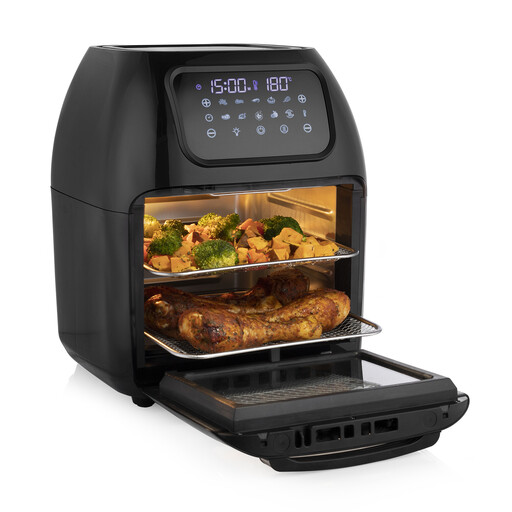
Tristar Multi Crispy FR-6964 air-fryer oven

Tristar Multi Crispy FR-6964 air-fryer oven, 10 L

Consider this air-fryer oven if you want a dedicated hot-air cooking appliance with dishwasher-safe parts for shared clean-up.

The listed variant is 10 L and 1800 W, with touch-screen controls and 10 programmes. Confirm that its cooking surface fits your wedges in one layer, and check the electrical setup against the stated rating.

View on Joybuy
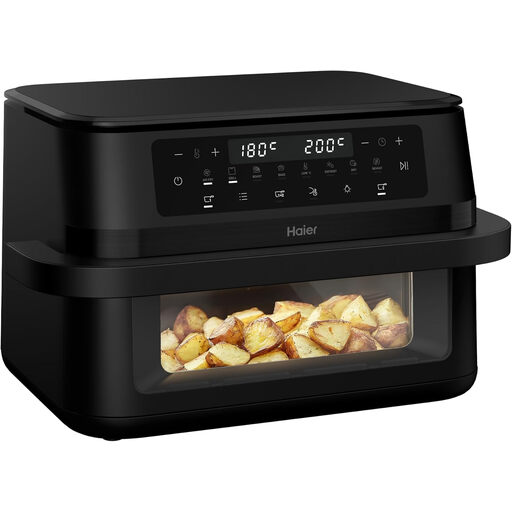
Haier Flex HAF3ADW air fryer with divider

Haier Flex HAF3ADW XL air fryer, 11 L with divider

Consider the removable divider if housemates want to prepare separate foods, while checking how much usable basket area remains for wedges.

The listed variant has a viewing window, roast function, Sync function and dishwasher-safe parts. Check its manual for placement clearances and its electrical rating before use.

View on Joybuy

Frequently asked questions

Can I use an extension lead for a countertop oven?

Check the oven’s electrical rating and the extension’s marked maximum rating before connecting it, accounting for every appliance on the extension. Electrical Safety First advises against overloading or daisy-chaining extension devices and says cable reels should be fully unwound; a suitable direct wall socket avoids sharing an extension where one is available.

Does a countertop oven need a PAT test every year?

There is no universal legal requirement for annual portable appliance testing. The Health and Safety Executive says workplace electrical equipment that could cause injury must be maintained safely, but the regulations do not prescribe annual testing; check any applicable workplace or accommodation policy for its own requirements.

What should I check before using an oven in a rented shared home?

Check your tenancy or house rules for personal cooking appliances, then confirm a suitable place to plug in, use, cool and store the oven. In England, government guidance on landlords’ electrical-installation inspections concerns the fixed installation; it does not establish that a particular tenant-owned countertop oven is suitable for the space.

How should we leave the oven after roasting wedges?

Let it cool and clean the tray, rack and interior as directed by the model manual before the next person uses it. Agree who handles that clean-up, keep ventilation clear and do not leave the appliance operating unattended; Electrical Safety First warns against blocked ventilation and unattended electrical appliances.