Bedside-carafe routine users
You prepare water in the kitchen to carry or pour into a bedside carafe. A manageable serving vessel matters more to you than hot-water presets.


For filling a bedside carafe in a small kitchen, start with a no-plumbing countertop purifier that has a removable serving jug. A larger hot or chilled dispenser makes more sense if you will regularly use it for other drinks, but tank capacity alone will not tell you whether it fits your worktop. Check the serving volume, appliance dimensions and replacement-filter routine before choosing.
You prepare water in the kitchen to carry or pour into a bedside carafe. A manageable serving vessel matters more to you than hot-water presets.
You want an electric purifier without plumbing changes, but need to protect limited worktop space. Compare full appliance dimensions: reservoir capacity does not establish the footprint.
Several people may use the appliance beyond bedtime, making a larger reservoir or hot and chilled dispensing worth considering alongside the carafe routine.
Decide how you will serve and carry the water, then check placement and whether other household uses justify a larger dispenser.
| Concern | What to check | Who this matters to |
|---|---|---|
| Filling and carrying water | Compare the removable jug or pitcher with your carafe capacity; for direct dispensing, check outlet clearance. | I want to prepare a bedtime carafe without awkward transfers. Around 36% of consumers would put the serving routine first. |
| Small-kitchen fit | Measure the worktop, cupboard height, socket position and space needed to remove the tank. | My limited worktop must still be usable after the purifier is in place. Roughly 29% of consumers would make appliance fit their primary concern. |
| Refill frequency | Compare feed-tank capacity with your daily use, keeping it distinct from the serving-jug capacity. | If several people will draw water throughout the day, I would rather refill the tank less often. Around 21% of consumers would prioritise that need. |
| Water temperatures | Decide whether you will regularly use hot or chilled dispensing as well as room-temperature water. | Our household would use the purifier for drinks beyond the bedside carafe. About 14% of consumers would put those temperature options first. |
A larger feed tank may mean fewer refills, but it does not necessarily make the carafe easier to fill.
Start with the amount you want to prepare and how you will carry it. Consider a larger dispenser if other people or temperature functions will see regular use.
The Drinking Water Inspectorate advises checking your water company's quality report before buying a domestic filter. A private supply needs its own assessment rather than reliance on a countertop appliance alone.
Identify whether your home uses mains water or a private supply, and seek advice from the relevant water company or local authority about a specific concern.
Maintenance schedules are model-specific. AquaTru UK states that the Carafe pre-carbon filter should be replaced every six months; that interval should not be applied to another model.
Check the compatible replacement set, its documented schedule and its availability for the exact purifier you choose.
Tank volume does not tell you the appliance's height, footprint or clearance needed for filling and cleaning.
Measure the intended position and compare it with the exact model's dimensions and access requirements before ordering.
AquaTru UK lists its no-installation Carafe line with a 2.5 L tap-water tank and a 1.9 L glass serving jug.
Waterdrop lists the no-plumbing K19-H countertop reverse-osmosis dispenser with a 5 L feed-water tank, selectable volumes and hot water up to 95°C.
Philips lists the ADD6921DG/10 countertop reverse-osmosis dispenser with a 6 L tap-water tank and ambient, hot and chilled dispensing.
These countertop reverse-osmosis models offer pitchers for preparing water to carry to a bedside carafe. Both also have temperature features, so weigh those extras against the space and upkeep your routine calls for.
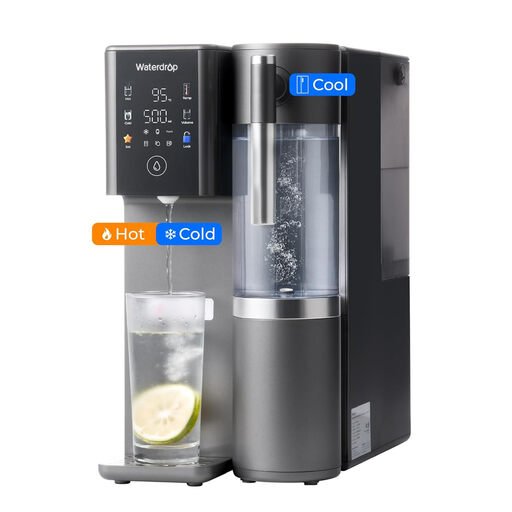 Image unavailable
Consider this model if you want to prepare water in a detachable pitcher to carry to your bedside carafe; check whether its stated 1.1 L pitcher suits your usual batch.
The product name lists six temperature settings. Measure your worktop and confirm the exact model's replacement-filter requirements before buying.
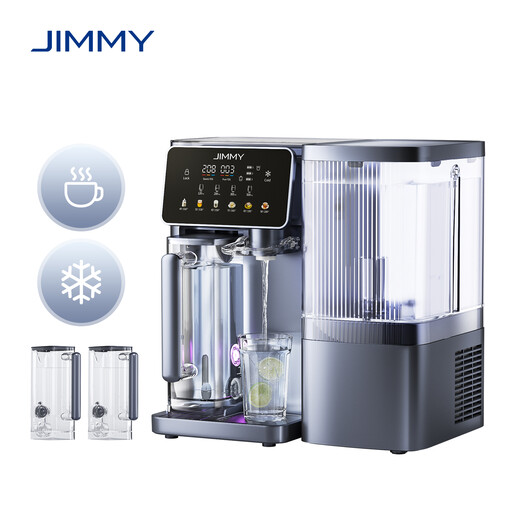 Image unavailable
The two included 1 L pitchers offer a way to carry prepared water, while the stated 5.5 L tank may suit a household that refills the appliance for other drinks too.
The product name also lists hot and cold dispensing. Confirm the appliance dimensions and compatible replacement filters; take care with the hot-water function and follow the listed guidance for children's use.
Do not assume that a purifier is necessary. The Drinking Water Inspectorate advises obtaining your water company's drinking-water quality report before buying a domestic filter; investigate any specific taste, plumbing or local-supply concern on its own terms.
No: seek an assessment of the private supply rather than relying on the appliance alone. The Drinking Water Inspectorate's guidance for England and Wales describes local-authority monitoring of private supplies; ask the relevant local authority about the route that applies to your property. The cited private-supply regulations for England should not be assumed to apply throughout the UK.
Compare the documented filter set and schedule for each exact model, not a general interval for countertop purifiers. AquaTru UK says its Carafe pre-carbon filter should be replaced every six months; confirm the corresponding instructions and replacement availability for any other model you consider.
It is useful mainly if you will also make hot drinks with the dispenser. Waterdrop lists hot water up to 95°C for the K19-H, while Philips lists hot, ambient and chilled dispensing for the ADD6921DG/10; neither hot function is needed simply to prepare room-temperature bedside water.