Personal-carafe office users
If you mainly fill one bedside carafe from the office kitchen, a vessel you can carry and a manageable counter footprint matter more than features intended for a whole team’s drinks.


For filling one bedside carafe from a shared office kitchen, consider a no-plumbing countertop purifier with a vessel you can carry, provided the office permits a plug-in appliance. Check counter space, the amount needed between refills and who will clean the unit and change its filters; a hot-water dispenser makes more sense only if colleagues also need that function. In England and Wales, the Drinking Water Inspectorate says additional domestic treatment is not needed as a general health-protection measure, so start by identifying the office’s actual reason for filtering.
If you mainly fill one bedside carafe from the office kitchen, a vessel you can carry and a manageable counter footprint matter more than features intended for a whole team’s drinks.
If you help choose or look after a communal appliance, establish who will refill it, clean its water-contact parts and replace its cartridges. The Health and Safety Executive advises that workplace electrical equipment should be suitable for its use and maintained safely.
If taste or odour prompts the purchase, decide what you want the filter to address. For a sudden strong taste or smell, the Drinking Water Inspectorate advises contacting the water company; a suspected building-pipe issue also calls for attention to its cause.
Decide whether the purifier is chiefly for one carafe or for a shared drinks point, then check how its vessel, upkeep and electrical use would work in the office.
| Concern | What to check | Who this matters to |
|---|---|---|
| Carafe filling and counter fit | Check whether the purified-water vessel can be carried, its capacity in litres and the unit’s dimensions. | If I am filling one bedside carafe, I want to carry the water from the office kitchen without giving up too much counter space. Around 33% of consumers put this carafe-first need ahead of the other concerns here. |
| Shared upkeep and safe use | Check the cleaning and cartridge instructions, office approval and a suitable socket; assign responsibility for upkeep. | When several colleagues use the same unit, I need to know who will keep it clean and working safely. For roughly 42% of consumers, that shared-use responsibility is the primary concern. |
| Reason for filtering | Identify the taste, odour or building-pipe concern; check claims against the exact model and filter. | If the water tastes unusual or I am concerned about the building’s pipes, I want to address that particular issue rather than assume every purifier solves it. About 25% of consumers place this filtering purpose first. |
For public supplies in England and Wales, the Drinking Water Inspectorate says additional domestic treatment is not needed as a health-protection measure. That does not resolve a particular office-building plumbing concern.
Identify the reason for filtering before choosing a system. If water develops a sudden strong taste or smell, contact the water company rather than assuming a countertop appliance addresses the cause.
A larger feed tank does not tell you how conveniently purified water can be carried to one carafe. AquaTru UK lists a 2.7 L purified-water tank for its Classic, while Waterdrop lists a 5 L feed tank for its K19; those capacities describe different parts of the appliances.
Work out how much purified water is needed between refills, then check the vessel you would actually carry and measure the available counter space.
The Drinking Water Inspectorate warns that neglected cleaning and cartridge changes can allow deposits to build up and create conditions for bacterial growth.
Give one person responsibility for following the exact model’s cleaning and replacement instructions, with a schedule colleagues can consult.
Replacement cartridges and staff time for cleaning, refilling and checking the unit remain part of shared use.
Some countertop dispensers have hot-water presets up to 95°C, according to Waterdrop and Tappwater. That function calls for suitable placement and clear arrangements for colleagues using it.
If the task is only to fill a bedside carafe, decide whether ambient water is enough. If the office also wants hot drinks, confirm its appliance rules, electrical arrangements and safe-use procedures before choosing hot output.
AquaTru UK lists no-installation countertop reverse-osmosis models with purified-water vessels, relevant when the water must be carried from the office kitchen.
Waterdrop’s countertop range includes no-plumbing dispensers aimed at shared drink preparation as well as water filtering.
Tappwater’s Countertop RO SMR combines no-installation reverse osmosis with remineralisation and temperature presets.
Sans describes a no-plumbing countertop purifier with a glass jug that fills automatically.
These countertop reverse-osmosis models offer pitcher or portable-tank arrangements alongside temperature options. For bedside-carafe filling, check how water would be carried from each unit and whether its other functions suit shared-office use.
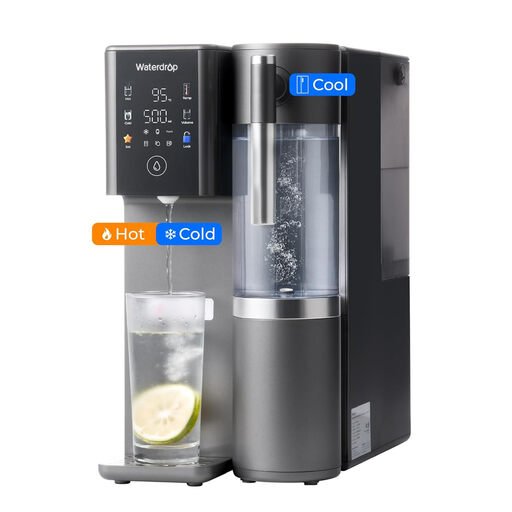 No image available
For filling a carafe away from the counter, check how the portable pure-water tank is carried and poured. The product name lists six temperature settings; confirm the unit’s fit, cleaning routine and office arrangements for any hot-water use before choosing it.
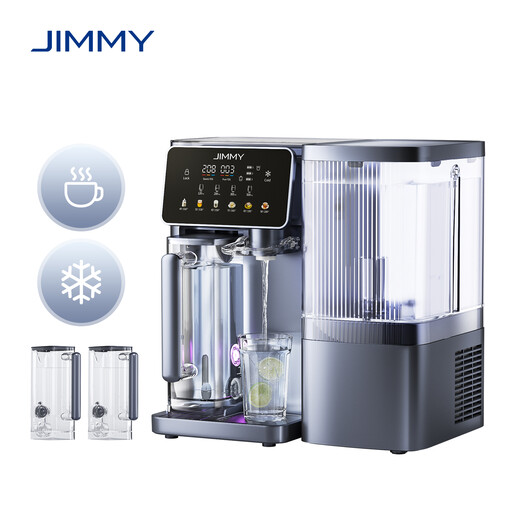 No image available
For a shared counter where pitcher-sized servings are useful, confirm whether the two listed 1 L pitchers can be detached and carried to the bedside carafe. The product name lists a 5.5 L tank, seven-stage filtration and hot and cold output; check counter dimensions, cleaning instructions and the office’s arrangements for hot water.
Not solely for general health protection from public mains water in England and Wales: the Drinking Water Inspectorate says additional domestic treatment is not needed for that purpose. Taste, convenience or a specific building-pipe concern may still influence the decision; contact the water company if a strong taste or smell appears suddenly.
Get approval for the appliance and its location, check that the electrical supply suits it, and assign responsibility for refilling, cleaning and filters. The Health and Safety Executive advises that workplace electrical equipment should be suitable for its use and maintained in a safe condition; follow the office’s own procedures.
Follow the exact model’s cleaning and cartridge-change instructions and keep a shared schedule with a named owner. The Drinking Water Inspectorate warns that neglecting those instructions can allow deposits to build up and create conditions for bacterial growth.
Ambient water is the more direct choice if filling the carafe is the only task. Hot dispensing may serve a separate office drinks need, but check whether colleagues want it and whether placement and safe-use arrangements are suitable; Waterdrop and Tappwater list presets up to 95°C on the models discussed here.