Family breakfast cooks
If you need filtered water for rice while others want drinks, compare the water you can collect for the meal with the time available to refill. Feed-tank size alone does not tell you how much filtered water is ready to use.


For a family breakfast that includes cooking rice, choose a countertop reverse-osmosis (RO) dispenser with measured hot-water portions if collecting and heating water would interrupt preparation. A carafe-format RO unit is worth considering when a removable serving jug matters more, but check whether its usable output covers the cooking batch and drinks. If the reason for buying is a particular water-quality concern, the Drinking Water Inspectorate advises asking your mains-water supplier, or your local authority for a private supply, about testing rather than relying on an appliance to identify the issue.
If you need filtered water for rice while others want drinks, compare the water you can collect for the meal with the time available to refill. Feed-tank size alone does not tell you how much filtered water is ready to use.
If a plumbed-in system is impractical, a countertop format avoids that installation decision. Measure the available worktop and consider whether you would use a removable serving vessel or dispense directly into a cooking container.
If you have a specific concern about incoming water, establish whether it comes from a mains or private supply before choosing a filter. The Drinking Water Inspectorate directs mains-water consumers to their supplier and private-supply consumers to their local authority for testing advice.
Choose between a serving carafe and a hot-water dispenser by considering how much filtered water breakfast preparation requires and how you will collect it.
Consider it when: You want to carry a filtered-water jug to the table or cooker. AquaTru UK lists a 1.9 L glass jug for its Carafe.
Allow for: Its listed 2.5 L tap-water tank and 1.9 L jug may mean refilling during a larger family breakfast; check your required cooking and drinking volumes.
Consider it when: Selectable hot-water portions would fit your preparation routine. Waterdrop lists four measured portions for the K19-H, while Frizzlife lists three portions and continuous dispensing for the WB99-H.
Allow for: A powered heating appliance needs suitable worktop and socket access, and dispensing hot water does not replace the rice-cooking steps required by your recipe.
| Concern | What to check | Who this matters to |
|---|---|---|
| Water for the whole breakfast | Distinguish feed-tank capacity from filtered-water output; check the vessel size and dispensing rate for your intended batch. | If I am filling a rice cooker while preparing drinks, repeated refills could interrupt the meal. Around 33% of consumers put having enough filtered water with fewer interruptions first. |
| Hot-water workflow | Compare the exact model’s temperature and portion settings with your recipe and cookware instructions. | When breakfast preparation is busy, I want to measure hot filtered water without using a separate kettle, while still cooking the rice as directed. For around 27% of consumers, that workflow is the primary need. |
| Incoming-water concern | Identify the water supply and seek relevant testing advice before comparing model-specific reduction claims. | If I am worried about a particular issue in my water, I need to establish what it is before choosing an appliance. That concern comes first for around 20% of consumers. |
| Space and upkeep | Measure worktop clearance and check the exact replacement cartridge and its stated service interval. | In a small kitchen, I need room to fill and use the unit and a manageable filter-replacement routine. Around 20% of consumers chiefly prioritise that practical fit. |
A refillable tank holds incoming water; its stated capacity does not establish how much filtered water you can collect before cooking breakfast.
Check feed-tank size, filtered-water vessel size and any stated output or dispensing rate separately for the exact model.
A product claim does not identify an issue with your own supply. The Drinking Water Inspectorate advises contacting the water supplier about mains-water concerns and the local authority about private-supply testing and risks.
Investigate the concern first, then compare the exact model’s documented claims and test conditions with the issue identified.
Waterdrop lists water up to 95°C for the K19-H, while Frizzlife lists settings up to 100°C for the WB99-H. Those settings do not determine the cooking time or method required by a recipe.
Match the available portions and temperatures to preparation, then follow the rice and cookware instructions for cooking.
A countertop RO unit needs the cartridge specified for its model, so the replacement routine matters alongside its tank and dispensing features.
Identify the cartridge, check its availability and stated replacement interval, and follow the manufacturer’s care instructions.
The AquaTru UK Carafe is a countertop RO format with a removable glass serving jug and no plumbing installation.
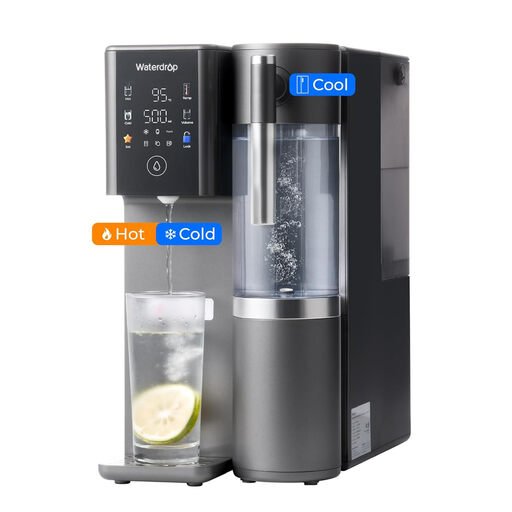
Waterdrop’s UK K19-H is a countertop RO dispenser for households considering measured hot-water portions.
Frizzlife’s UK WB99-H combines countertop RO dispensing with selectable hot-water settings and a portable pitcher.
These countertop RO dispensers offer hot-water functions for breakfast preparation. Compare their stated vessels and controls with the water your rice recipe requires; neither product should be treated as interchangeable with the AquaTru, Waterdrop K19-H or Frizzlife models discussed above.
 No image available
Consider this countertop RO dispenser if you want hot filtered water during breakfast preparation. Its product title lists six temperature settings; confirm the exact settings for the WD-A2 before relying on one for a recipe.
Check how much filtered water you can collect for a cooking batch and which replacement cartridge the WD-A2 requires.
 No image available
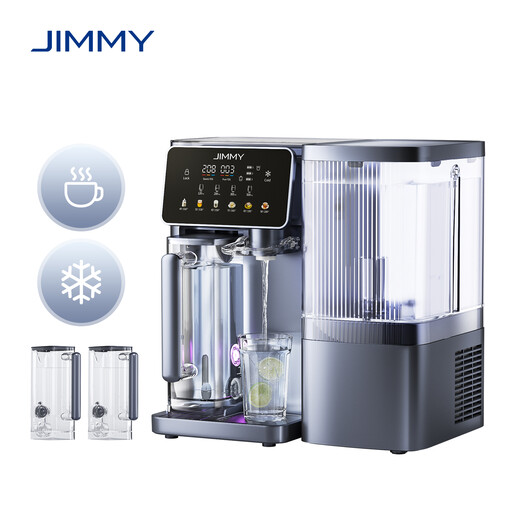
Consider the R9 Pro if you want hot-water dispensing and separate pitchers for breakfast preparation and serving. Its product title lists a 5.5 L tank and two 1 L pitchers; the tank figure does not establish filtered output per cycle.
Check the exact dispensing settings and replacement cartridge against your routine. Follow the product’s warning that children need adult guidance when operating the hot-water appliance to avoid burns.
A countertop purifier is not a general requirement for cooking rice with mains water. If you have a particular concern about your supply, the Drinking Water Inspectorate advises approaching your water supplier for information or testing advice rather than assuming that an appliance resolves it.
Seek advice about the supply before relying on a countertop purifier. The Drinking Water Inspectorate identifies the local authority as the first point of contact for private-supply testing and identified risks; an appliance does not replace assessment of the incoming water.
Find the cartridge specified for the exact purifier and check its availability and stated service interval. Waterdrop’s UK K19-H information, for example, states up to 12 months or 1,100 gallons for its K19RF filter; that specification belongs to the K19-H and should not be applied to a different model.
Hot-water dispensing can be one preparation step, but it does not replace the cooking method required by your rice and cookware. Waterdrop lists water up to 95°C for the K19-H and Frizzlife lists settings up to 100°C for the WB99-H; check your chosen appliance’s portions and temperature, then follow the recipe and cookware instructions.