What matters when choosing
Choose the treatment route first: heating, footprint and upkeep then determine whether a particular appliance will work in your kitchen.
Heated RO with remineralisation
Choose it when: You want RO treatment and adjustable hot water from one plug-in countertop unit.
Allow for: RO reject water, filter changes and a mineral output that may not match your coffee machine's guidance.
Ambient RO with a separate kettle
Choose it when: You already have a suitable way to heat water and want countertop RO without a second heater.
Allow for: A separate heating step, replacement filters and reject-water handling.
Non-RO filtered hot water or coffee
Choose it when: Combining filtered dispensing with part of your coffee routine matters more than RO treatment.
Allow for: A different filtration method; do not assume its reduction claims match those of an RO unit.
| Concern |
Buying checks |
Who this matters to |
| Coffee water and minerals |
Check whether filtration is RO or non-RO, whether minerals are added after RO, and your coffee machine's water guidance. The Specialty Coffee Association notes the importance of alkalinity to coffee acidity. |
If I am adjusting water to suit my coffee, I need to consider hardness and mineral balance rather than pursue the lowest TDS reading. Around 36% of consumers put that water-profile question first. |
| Worktop fit |
Measure the unit and the clearance for removing its tank or filter; decide which existing appliance it would replace. |
When counter space is tight, I want fewer appliances without making refilling awkward; around 29% of consumers make space and consolidation their primary concern. |
| Hot-water routine |
Compare the stated temperature settings and dispense volumes with your brewing method. A 95°C maximum is not a boiling setting. |
If I prepare single cups throughout the day, selectable hot water matters more to me than adding another kettle step. Roughly 21% of consumers prioritise that dispensing routine. |
| Filters and wastewater |
Check the exact cartridge interval, cleaning instructions and, for RO, where reject water collects and how to empty it. |
I would rather plan cartridge changes and tank care before committing to a refillable unit; for about 14% of consumers, ongoing upkeep is the deciding concern. |
Joybuy countertop choices for coffee water
These choices cover two countertop RO dispensers and one non-RO filtered hot-water dispenser. Compare the filtration method with your water needs, then check how each unit fits your coffee routine and available space.
 No image available
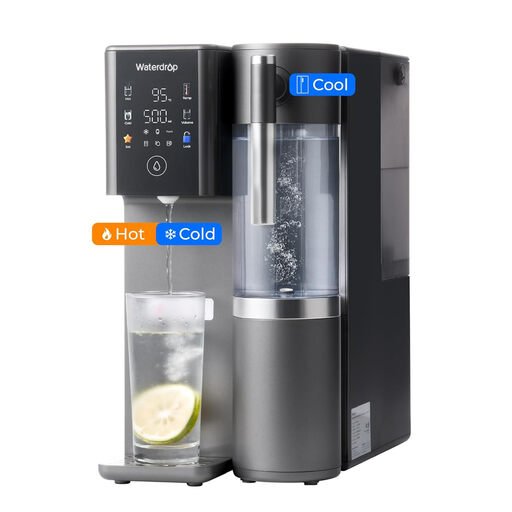
Waterdrop WD-A2 Countertop Reverse Osmosis System
Consider this no-install RO dispenser if you want filtered water and selectable dispensing for coffee without plumbing.
The listing describes six temperature settings, a detachable 1.1 L pitcher and dimensions of 40.37 × 20.83 × 39.88 cm. Check the precise temperature range, replacement-filter schedule, reject-water routine and resulting water profile against your brewing needs.
View on Joybuy
 No image available
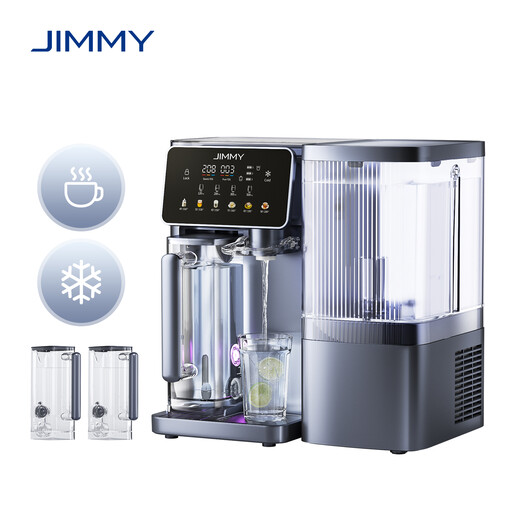
JIMMY R9 Pro Countertop Smart RO Water Purifier, Dual 1 L Pitchers
This RO model suits a kitchen where hot, cold and ambient dispensing would be useful, provided the unit and its refill access fit.
The Joybuy listing states a 5.5 L tank, two 1 L pitchers and dimensions of 553 × 346 × 440 mm. Check the model's filter schedule, reject-water instructions and coffee-machine water requirements; treat the listing's filtration and UV wording as product claims rather than proof of a particular outcome.
View on Joybuy
 No image available
Caso Design HW 770 Turbo Ambient & Hot Water Dispenser with Filter, 01889
Consider this filtered dispenser if selectable hot water and a narrower worktop footprint matter more to you than RO treatment.
The listing states 13 settings from 40°C to 100°C, 100–400 mL presets or continuous flow, a removable 2.7 L tank and dimensions of 30.5 × 15.0 × 27.0 cm. It is not an RO unit; check the filter's documented claims, replacement interval and the water guidance for your coffee equipment.
View on Joybuy
Common questions
Do I need a countertop purifier to make mains tap water safe?
For public supplies in England and Wales, the Drinking Water Inspectorate says additional home treatment is not needed as a health-protection measure. You might still choose filtration for taste or coffee preparation. If your water is cloudy or smells unusual, or you have concerns about a private supply, contact your water company or local council rather than relying on a countertop unit as the sole response.
Will a low TDS reading mean better coffee?
No: a low TDS reading alone cannot establish that water suits your coffee or machine. NSF treats TDS reduction as one RO performance area, while the Specialty Coffee Association highlights alkalinity's effect on perceived coffee acidity. Check the resulting water profile and your equipment maker's guidance.
How often do countertop appliance filters need changing?
Follow the interval for the exact cartridge and appliance, accounting for both time and stated water throughput where applicable. Waterdrop states up to 12 months or 1,100 gallons for specified replacement filters, while Aqua Optima recommends 30 days or up to 100 L for its Evolve+ cartridge; actual use and feed-water conditions also matter.
Can countertop RO treat water from a private supply?
Do not rely on a household countertop RO unit as a substitute for assessing an unknown private supply. NSF describes its point-of-use RO scope in relation to water that is microbiologically safe and of known quality, and GOV.UK directs people with private-supply concerns to their local council. Seek appropriate local advice and testing before selecting treatment.


