Busy family tea makers
If several people want tea at once, an instant-hot dispenser with a reservoir and selectable portions may fit better than filtering a carafe immediately before each round.


For several cups of tea in quick succession, choose an instant-hot countertop dispenser if its reservoir and maximum temperature suit your household. A cartridge-filtered dispenser may suit a focus on tea taste and limescale; choose an RO carafe if you want that filtration approach and can filter ahead, then use a separate kettle. The Waterdrop K19-H and BRITA Cube are specified to heat water to up to 95°C, so neither provides a full boil.
If several people want tea at once, an instant-hot dispenser with a reservoir and selectable portions may fit better than filtering a carafe immediately before each round.
If tea taste or limescale is the main concern, compare the exact cartridge or model claims. A limescale-focused cartridge and an RO system should not be assumed to address hardness in the same way.
If you want a countertop RO process and a removable serving carafe, filtering water ahead of breakfast and heating it separately may suit your routine.
Decide whether you need hot filtered water on demand or can heat it separately. Then compare the filtration approach and the space and upkeep each appliance requires.
Choose it when: Repeated hot servings and an RO process both matter; Waterdrop describes its K19-H as a no-plumbing option with a 5 L feed tank.
Accept the trade-off: The K19-H reaches up to 95°C rather than a full boil, and its filters need replacing.
Choose it when: Hot water for tea and a limescale-focused cartridge matter more to you than an RO process; BRITA specifies a 4 L tank for its Cube.
Accept the trade-off: The BRITA Cube uses cartridge filtration, not RO, and heats to up to 95°C.
Choose it when: You can prepare filtered water ahead of time and prefer to serve it from a removable carafe.
Accept the trade-off: AquaTru specifies a 10–15 minute filtration time for its Carafe; you must heat the water separately for tea.
| Concern | What to check | Who this matters to |
|---|---|---|
| Several hot drinks | Check reservoir capacity, portion settings and maximum water temperature against the drinks you make. | When everyone wants tea close together, I want to avoid waiting between cups or repeatedly refilling the tank. Around 37% of consumers put rapid, repeated servings first. |
| Filtration approach | Check the exact model's filtration claims and filter schedule; for an RO unit, check how it handles reject water. | If a particular RO process is my priority, I am willing to plan around its filter and water-handling requirements. For around 27% of consumers, that filtration approach comes first. |
| Tea taste and limescale | Compare the exact cartridge or model claims with your local water information and any scale you notice. | I am mainly trying to address the taste of my tea or the inconvenience of scale, rather than seeking the broadest list of filtration claims. Around 18% of consumers make those tea-water concerns their first priority. |
| Space and upkeep | Measure the available worktop space and check the replacement-filter plan for the model you choose. | In a crowded kitchen, I need the appliance, refilling and filter changes to fit an ordinary morning routine. Keeping that workload manageable comes first for around 18% of consumers. |
The Drinking Water Inspectorate says public water supplies in England and Wales are regularly tested and that additional home treatment is not needed as a health-protection measure. Preferences about taste or hardness are different reasons to consider a filter.
Identify what you want to change. If you suspect a supply or building-pipe problem, contact your water company and investigate the cause rather than relying on a countertop filter as the fix.
Waterdrop specifies up to 95°C for the K19-H, and BRITA specifies up to 95°C for the Cube. That is below a full boil and may not match the instructions for every tea.
Check the chosen model's maximum temperature and presets. Keep a separate kettle in the plan if a full boil is essential to you.
Replacement filters and, for some RO designs, reject-water handling affect how convenient an appliance remains after purchase. Waterdrop specifies a separate waste-water tank for its M6HG.
Check the exact replacement-filter type and interval, and find out whether the model has a waste-water tank or another reject-water arrangement.
A limescale-focused cartridge and a reverse-osmosis system have different stated purposes and operating arrangements. A general water-filter label does not establish a particular hardness-reduction result.
Match the exact cartridge or model claim to your tea-water concern, then check the capacity, preparation time and maintenance that come with that choice.
Its K19-H and M6HG are countertop RO options for households seeking hot filtered water without plumbing.
The Cube is a cartridge-filtered hot-water dispenser for tea drinkers considering a limescale-focused option rather than RO.
The Carafe is a no-installation countertop RO option for households content to heat their filtered water separately.
Sans presents a countertop RO-and-UV model with hot-water dispensing and a removable glass jug.
These countertop dispensers and RO purifiers are relevant if you want filtered water and hot-water dispensing for family tea. Compare each model's stated tank size and controls with your routine, and check its filter requirements before choosing.
 No image available
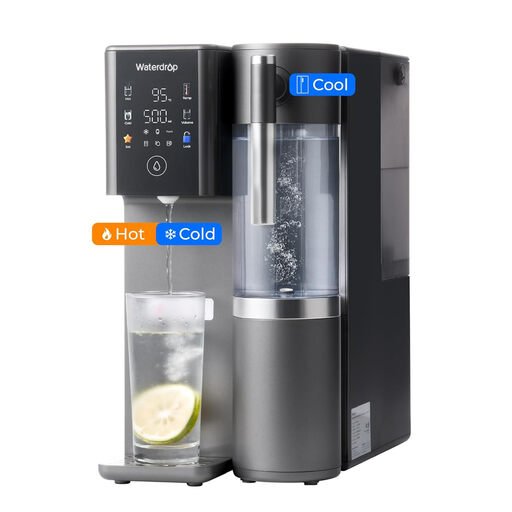
Consider this dispenser if you want filtered hot water with a choice of settings for different drinks.
Its listed features include a 2.7 L tank, ambient-water dispensing and 13 temperature settings. Check the filter type and replacement plan for this exact model.
 No image available
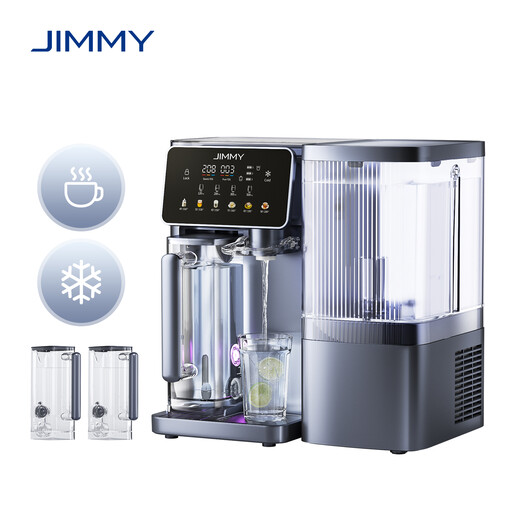
Consider the WD-A2 if you want a countertop RO system that also dispenses water for hot drinks.
The product name specifies six temperature settings. Confirm the feed-tank capacity, the temperatures available and the replacement-filter plan against your family's breakfast routine.
 No image available
Consider this model if several people need filtered water and you want hot dispensing alongside separate pitchers.
Its product name lists a 5.5 L tank, two 1 L pitchers, seven-stage filtration, UV treatment and hot and cold dispensing. Check its temperature settings and replacement-filter plan before relying on it for your usual teas.
 No image available
Consider this dispenser if a 4 L tank better fits the number of drinks your household makes at breakfast.
Check its temperature-setting values and the exact filter type and replacement plan to see whether it suits your tea and water concerns.
Not as a routine health-protection measure for public supplies in England and Wales: the Drinking Water Inspectorate says water companies must supply wholesome water suitable for drinking and that additional home treatment is not needed for that purpose. A filter may still suit a taste or hardness preference. If you suspect a problem with your supply or building pipes, investigate that concern directly; check local official guidance if you live elsewhere in the UK.
No. The Waterdrop K19-H and BRITA Cube are specified to heat water to up to 95°C, below a full boil. Check the temperature requirements of the teas you make and retain a kettle if you need boiling water.
Choose a reservoir by counting the drinks you make close together and deciding how often you are willing to refill it. For scale, AquaTru specifies a 2.5 L input tank and 1.9 L carafe for its Carafe, BRITA a 4 L tank for the Cube, and Waterdrop a 5 L feed tank for the K19-H. A carafe system also requires you to allow time for filtration and separate heating.
The arrangement depends on the model. Waterdrop specifies separate 4 L tap-water and 1.5 L waste-water tanks for its M6HG, along with a stated 3:1 pure-to-drain ratio. Check the tank or reject-water instructions for any other RO model you are considering.
Check the replacement-filter type and interval for the exact model, plus any tank-cleaning or reject-water tasks. Waterdrop states a replacement interval of up to 12 months or 1,100 gallons for the named K19 filter; AquaTru states that replacement timing varies by filter stage for its Carafe system. Those schedules should not be applied to other models.