Small offices without plumbing access
A refillable countertop unit can provide filtered water for tea without altering pipework, as long as someone can refill its tank and replace its filters.


A refillable filter-and-heater suits a small office that wants hot water for tea without plumbing, provided staff can refill it and manage filter changes. For frequent tea rounds, consider a mains-fed dispenser if installation is feasible; a separate reverse-osmosis (RO) carafe and kettle makes more sense when storing filtered water matters more than dispensing it hot from one appliance.
A refillable countertop unit can provide filtered water for tea without altering pipework, as long as someone can refill its tank and replace its filters.
When several people need water during the same busy period, the number of refills becomes a practical concern. A mains-fed office dispenser is worth considering where installation is possible.
If taste and limescale are the main reasons for filtering, compare the stated filter medium, heating controls and cartridge routine rather than assuming RO is required.
Consider it when: A small office wants RO filtration and selectable hot-water dispensing without plumbing work.
Trade-off: Staff still have to refill the tank and keep up with filter changes.
Consider it when: Convenient tea preparation and limescale-focused filtration matter more than choosing an RO process.
Trade-off: Its filtration claims should not be treated as interchangeable with those of an RO model.
Consider it when: The office already has a suitable kettle and wants to store filtered water separately.
Trade-off: Filtering and heating are separate steps, which may be awkward for simultaneous tea rounds.
Consider it when: Repeated tank refills would interrupt a busy shared kitchen.
Trade-off: The office must assess installation, servicing and the water options of the particular system.
For a shared office making tea, start with the busiest serving period, then decide whether the filtration method and maintenance routine suit the reason for buying.
| Concern | What to check | Who this matters to |
|---|---|---|
| Hot-water serving | Check the available temperatures and dispensing volumes against the cups and teas used in the office. | When I organise regular tea rounds, I want hot water dispensed in useful portions without a separate heating step. Around 42% of consumers put that serving workflow first. |
| Refills and throughput | Compare feed-tank capacity with demand during the busiest tea period; check whether mains-fed installation is possible. | If several colleagues make tea close together, I need a setup that will not repeatedly stop for refilling. For around 33% of consumers, refill workload is the primary concern. |
| Setup and filter upkeep | Confirm worktop space, plug suitability, filtration method and the exact replacement-cartridge plan. | In a kitchenette where plumbing changes are impractical, I need a unit that fits and a filter routine someone can manage. That is the main priority for around 25% of consumers. |
A plug-in unit may avoid plumbing work, but its feed tank still needs refilling. Frequent interruptions can undermine the convenience of on-demand hot water.
Estimate how many cups staff make during the busiest 30–60 minutes using the intended cup size. If refilling would be impractical, compare a mains-fed office system.
A limescale-focused filter-and-heater and an RO purifier are different routes. A convenient hot-water function does not establish that a model meets a particular filtration requirement.
Check the named model’s filter type, documented claims, compatible cartridge and stated limitations against the office’s reason for filtering.
Shared use needs a clear maintenance owner. Waterdrop warns that over-used filters can reduce filtration performance on its K19-H system.
Confirm the exact compatible filter, its stated replacement interval and who will order and fit it.
In Great Britain, regulation 22 of the Workplace (Health, Safety and Welfare) Regulations 1992 requires an adequate supply of wholesome drinking water that is readily accessible, along with suitable drinking vessels. Buying a particular dispenser does not itself establish that these requirements are met.
Plan where staff will access water, provide suitable vessels and maintain an adequate supply while the appliance is being serviced.
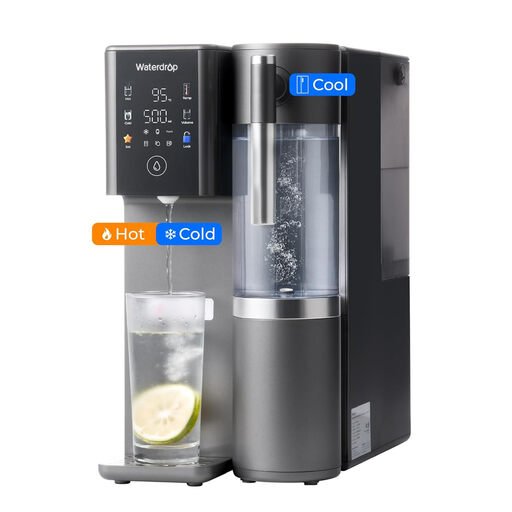
Waterdrop presents the K19-H as a refillable countertop RO unit combining filtration and hot-water dispensing.
Frizzlife presents the WB99-H as a countertop RO model with adjustable hot-water dispensing and an integrated pitcher.
BRITA offers distinct routes relevant to office tea: the refillable Cube filter-and-heater and mains-fed commercial countertop dispensers.
AquaTru offers the Carafe as a compact countertop RO route for offices that can heat tea water separately.
These countertop RO models bring filtration and hot-water dispensing into one appliance. For a shared office, compare their stated tank arrangements with tea-round demand and confirm the temperature controls and filter routine before choosing.
 No image available
Consider this countertop RO and hot-water option when staff want to dispense tea water without using a separate kettle.
The product name specifies six temperature settings. Check the exact temperatures, feed-tank capacity and compatible replacement filter against the office’s tea rounds.
 No image available
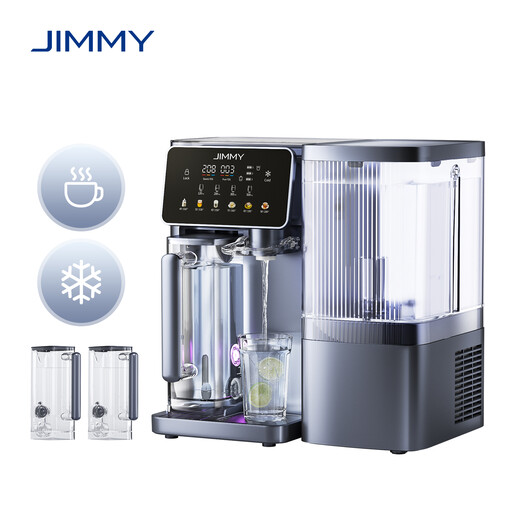
Consider this hot-and-cold countertop RO option if a tank and separate pitchers suit how colleagues serve water.
The product name specifies a 5.5 L tank, two 1 L pitchers and seven-stage filtration. Confirm the temperature settings, dispensing volumes and compatible replacement filters before buying; take care around hot-water dispensing.
No. In Great Britain, regulation 22 of the Workplace (Health, Safety and Welfare) Regulations 1992 requires an adequate, readily accessible supply of wholesome drinking water and suitable drinking vessels. A purifier may form part of that provision, but the employer must still ensure the overall supply meets those requirements.
No: it suits an office only if staff can manage refills during its busiest tea periods. Compare the intended cup sizes and frequency of use with the named model’s feed tank; if interruptions would be frequent and installation is feasible, consider a mains-fed office dispenser.
No. BRITA describes the Cube’s MAXTRA filtration as a different route from the RO filtration stated for the Waterdrop K19-H and Frizzlife WB99-H. Choose according to the office’s actual reason for filtering, and check the claims and cartridge for the exact model.
Assign a person or service provider before purchase and use the cartridge specified for the exact appliance. For example, Waterdrop states a 12-month lifespan for its K19RF replacement filter for the K19-H; that interval should not be applied to other models.
No. Check the particular appliance’s operating instructions, placement and hot-water controls against who can access the kitchenette. Safety features described for one commercial model should not be assumed to be present on another countertop unit.