Hosts making several cups at once
If visitors tend to ask for tea together, on-demand hot water, selectable portions and a tank that is practical to refill may matter more than a separate filtered-water reservoir.


For several cups of tea, choose an instant-hot countertop reverse-osmosis (RO) dispenser if you want filtered water heated and portioned without plumbing. A countertop RO purifier with a separate kettle suits you if a filtered-water reservoir matters more than immediate hot water; a heated, limescale-focused dispenser suits a preference for convenient tea preparation rather than RO filtration. Compare usable capacity, maximum temperature and replacement filters before deciding.
If visitors tend to ask for tea together, on-demand hot water, selectable portions and a tank that is practical to refill may matter more than a separate filtered-water reservoir.
If taste or kettle residue is the main concern, look at the cartridge’s stated purpose and how often it needs replacing. A limescale-focused dispenser is a different filtration route from RO.
A purifier with a separate filtered-water reservoir suits people who can prepare water ahead of a visit and use their own kettle, rather than needing hot water directly from the purifier.
Choose it when: You want filtered hot water dispensed for successive cups without a separate kettle.
Allow for: Tank refills, RO reject water and a maximum temperature that may be below a kettle’s full boil.
Choose it when: You prefer a filtered-water reservoir and want to control heating with your own kettle.
Allow for: Filtration time, reservoir capacity and space for both appliances.
Choose it when: Hot-water convenience and the cartridge’s stated taste and limescale functions are your priorities.
Allow for: A filtration method that should not be treated as equivalent to RO.
| Concern | What to check | Who this matters to |
|---|---|---|
| Serving several guests | Check usable tank capacity and the available temperature and portion settings; a feed-tank figure is not the same as filtered-water capacity. | If friends all want tea at once, I need enough water for successive servings without interrupting the round to refill. Around 36% of consumers put quick, repeated servings first. |
| Taste and limescale | Check the exact cartridge’s stated taste and limescale functions, and whether the temperature settings suit the teas you serve. | When taste or scale in hot-water equipment bothers me most, I want filtration aimed at those concerns rather than assuming I need RO. Roughly 29% of consumers make taste and limescale their primary concern. |
| RO without plumbing | Check the model’s filtration method, filtered-water capacity and production time before planning a tea round. | If RO filtration is my priority, I can prepare water ahead of visitors arriving and heat it separately. Around 21% of consumers prioritise this no-plumbing filtration route. |
| Space and upkeep | Measure the available counter space and check compatible filter availability and replacement intervals. | With limited counter space, I need an appliance I can place, refill and maintain comfortably. About 14% of consumers put placement and upkeep first. |
BRITA describes microcarbon and ion-exchange filtration for its Cube, while Waterdrop and AquaTru describe RO systems. Their filtration claims should not be treated as interchangeable.
Decide which filtration approach you want, then check the claims for the exact model and cartridge.
Waterdrop describes a 5 L feed tank for the K19-H, AquaTru a 2.7 L pure-water capacity for the Classic, and BRITA a 4 L tank for the Cube. Those figures do not all describe ready-to-use filtered water.
Work out your usual number and size of servings, then identify which capacity the manufacturer is quoting.
Filter schedules vary by model and filter stage. Waterdrop states up to 12 months or 1,100 gallons for a compatible K19 filter; AquaTru specifies six months for the Classic pre-carbon filter and two years or 4,540 litres, whichever comes first, for its RO filter.
Check the compatible cartridge, its stated replacement limits and whether you can obtain it before choosing the appliance.
A domestic purifier’s general filtration description does not establish what treatment a particular private water supply needs.
Arrange water-quality testing and seek advice from the relevant local authority or a qualified water-treatment professional before selecting treatment.
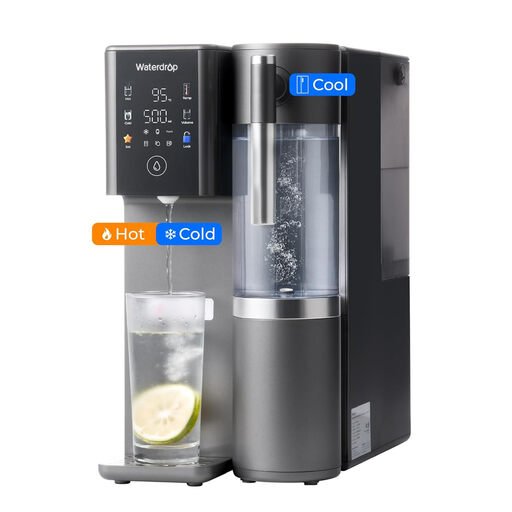
The K19-H combines countertop RO filtration with hot-water dispensing for buyers who do not want a plumbed-in appliance.
The Classic is a countertop RO option for preparing filtered water separately from the kettle.
The Cube is a heated filtered-water dispenser for tea preparation where the cartridge’s taste and limescale functions are the main interest.
These countertop choices include RO purifiers and filtered hot-water dispensers. Check each model’s heating and filtration details against how you make tea; a hot-water dispenser should not automatically be treated as an RO purifier.
 No image available
Consider the WD-A2 if countertop RO filtration matters to you, but confirm that this variant dispenses hot water before relying on it for tea.
The product title lists six temperature settings; check the actual temperatures and usable water capacity for your servings.
 No image available
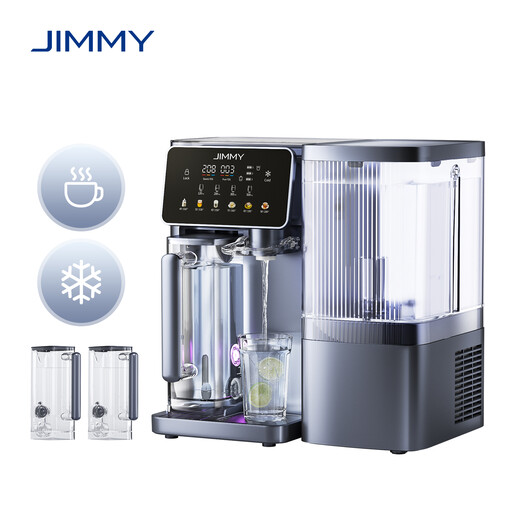
This hot-and-cold RO model may suit a tea round where you want water available in separate pitchers as well as from the dispenser.
The title lists a 5.5 L tank, two 1 L pitchers and seven-stage filtration. Confirm the temperature and dispensing-volume settings, plus the compatible filter schedule, for your use.
 No image available
Consider this filtered hot-water dispenser if temperature choice matters more to you than selecting an RO purifier.
The title lists a 2.7 L capacity and 13 temperature settings. Check the filter type, replacement cartridge and installation requirements if filtration is central to your choice.
 No image available
Its stated 4 L capacity is worth considering when planning several servings, provided its heating and filtration suit your tea-making needs.
The title identifies a hot-water dispenser with a water filter. Confirm the filter type, replacement interval and available temperature settings before choosing it for a particular filtration or brewing requirement.
Not necessarily. Water UK reported 99.97% compliance with drinking-water regulations for UK public supplies in 2024; for this tea-making decision, taste, limescale and dispensing convenience may be the more relevant reasons to consider an appliance.
It can for teas whose preparation instructions suit the dispenser’s available temperatures and serving sizes. Waterdrop lists a 95°C maximum for the K19-H, and BRITA lists the same maximum for the Cube, so check your tea’s instructions rather than assuming either appliance delivers a full boil.
Follow the limits for the exact model and filter stage. Waterdrop states up to 12 months or 1,100 gallons for its compatible K19 filter; AquaTru specifies six-month pre-carbon replacement for the Classic and an RO-filter limit of two years or 4,540 litres, whichever comes first.
Have the supply assessed before choosing a countertop purifier as treatment. Ask the relevant local authority or a qualified water-treatment professional about testing and what the supply requires; a general appliance filtration claim cannot answer that question for your water.
Confirm the plug, instructions and compliance information for the exact appliance and delivery location with the seller. GOV.UK guidance on the Electrical Equipment (Safety) Regulations 2016 covers equipment placed on the Great Britain market; check the applicable documentation separately for delivery to Northern Ireland.