No-plumbing cottage users
If you rent or use a cottage seasonally, a tank-fed unit avoids permanent pipework. Waterdrop describes its K19-H as a fill-and-plug-in model, while AquaTru lists its Classic as requiring no installation.


For a holiday cottage where plumbing changes are impractical, consider a tank-fed countertop unit. Choose an instant-hot reverse-osmosis (RO) dispenser if you want filtration and hot water in one appliance, a softening-filter hot dispenser if tea taste and limescale are the main concerns, or countertop RO with your existing kettle if built-in heating is unnecessary. If the cottage has a private water supply, base treatment decisions on property-specific tests and advice from the relevant authority, not on an appliance claim or its total dissolved solids (TDS) display.
If you rent or use a cottage seasonally, a tank-fed unit avoids permanent pipework. Waterdrop describes its K19-H as a fill-and-plug-in model, while AquaTru lists its Classic as requiring no installation.
If you make several hot drinks, compare the available temperatures and serving volumes with the mugs or teapot you use. Waterdrop lists selectable volumes and output up to 95°C for the K19-H; Philips describes on-demand hot water for its countertop dispenser range.
If the cottage draws from a well, borehole or spring, establish the supply's testing and treatment requirements before relying on a portable appliance. The Drinking Water Inspectorate and the relevant authorities in Scotland and Northern Ireland provide guidance for private supplies in their respective jurisdictions.
Choose it when: You want filtered hot water for tea from one plug-in, tank-fed unit.
Accept: Tank refills and filter changes; check the maximum temperature if your tea preparation calls for boiling water. Waterdrop states that its K19-H reaches up to 95°C.
Choose it when: RO filtration is the reason for buying and you are content to keep heating water separately. AquaTru describes its Classic as a no-installation RO unit.
Accept: You will still need the kettle each time you make hot tea.
Choose it when: Tea taste and limescale are your main concerns and you want hot water on demand. Philips describes its ADD5906S/05 as using Micro X-Clean Softening+ filtration.
Accept: Softening filtration is not RO; check the exact cartridge and its replacement requirements rather than assuming the two methods address the same substances.
| Concern | What to check | Who this matters to |
|---|---|---|
| Hot water for tea | Check the maximum temperature and whether serving volumes suit your mugs or teapot. | If I make tea repeatedly, I want water at a suitable temperature without heating a full kettle each time. Roughly 31% of consumers put quick, suitably portioned tea water first. |
| Filtration needs | Identify the water source and the substances you need to address before comparing filtration methods; arrange supply-specific checks for private water. | With an uncertain cottage supply, I need to understand the water before choosing treatment. For roughly 31% of consumers, addressing source-water quality is the primary concern. |
| Taste and limescale | Check whether the exact model uses a softening cartridge or RO, and which replacement cartridge it takes. | When scale in the kettle or the taste of tea is what bothers me, I would focus on those issues rather than assume I need RO. Around 23% of consumers make taste and limescale their main priority. |
| Cottage upkeep | Check how the tank is refilled and cleaned, plus the exact filter's replacement and flushing instructions. | If I visit only occasionally, I want a movable unit whose upkeep I can manage between stays. About 15% of consumers place ease of use and maintenance first. |
A display reading does not replace testing or a risk assessment for a cottage's particular supply. The Drinking Water Inspectorate's private-supply guidance addresses drinking-water standards beyond a single display measure.
If the cottage is not on mains water, obtain current supply information and ask the relevant local authority or regulator what testing and treatment are needed.
Philips describes Micro X-Clean Softening+ filtration for the ADD5906S/05, whereas Waterdrop describes a six-stage RO system for the K19-H. A hot-water function does not identify the filtration method.
Start with the water issue you want to address, then check the exact model's filter type and cartridge.
Replacement and flushing affect how much work is involved in using a countertop unit. Waterdrop states a 12-month service life for its K19RF cartridge and gives model-specific flushing instructions.
Check the compatible replacement filter and follow its instructions before drinking water dispensed after installation or a filter change.
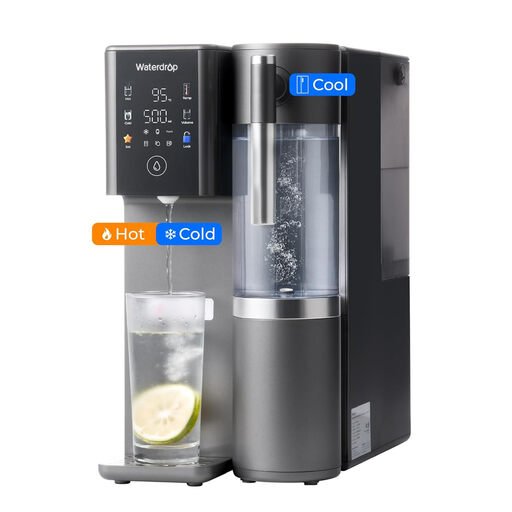
Waterdrop states that the K19-H dispenses water up to 95°C and has a 5 L feed tank. That maximum is below a full boil, and the tank needs refilling.
Compare the available temperature with the teas you make and keep a kettle if your preparation method requires boiling water.
These brands illustrate different countertop approaches; the filtration method and upkeep depend on the exact model.
Its UK-listed K19-H combines countertop RO with instant-hot dispensing and requires no plumbing, according to Waterdrop.
AquaTru UK describes its Classic as a no-installation countertop RO unit for use alongside a separate kettle.
Its ADD5906S/05 is a countertop hot-water dispenser with Micro X-Clean Softening+ filtration, as described by Philips.
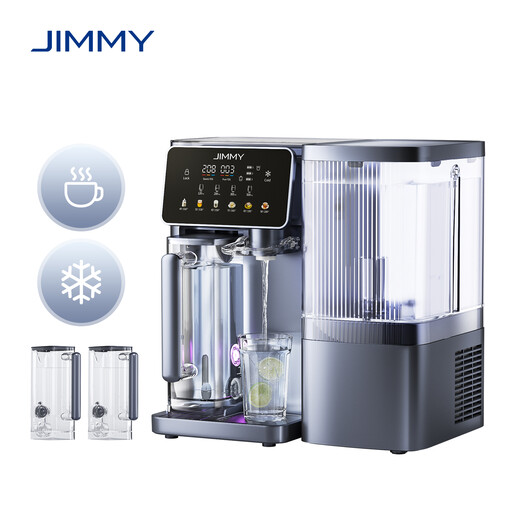
These countertop RO units offer two ways to filter water for cottage tea. Check the WD-A2's hot-water operation before relying on it in place of a kettle; the JIMMY R9 Pro is listed with instant hot water.
 No image available
Consider this countertop RO unit if filtering tea water is the priority and you can use a separate kettle if needed.
The product name identifies a portable water tank. Confirm whether this exact Home and Cold variant dispenses hot water before choosing it for tea without a kettle.
 No image available
Consider this model if you want countertop RO and a listed instant-hot function in the same appliance for cottage tea.
Its product name specifies seven-stage filtration, a 5.5 L tank and two 1 L pitchers. Check the available hot-water temperatures against the teas you make and the compatible filters against your upkeep needs.
Yes, if the exact model is designed as a tank-fed, no-installation appliance and you have a suitable electrical socket. Waterdrop says its K19-H works by filling the tank and plugging it in, while AquaTru lists its Classic as requiring no installation; check the model's manual and worktop requirements before use.
Not if your preparation method requires boiling water and the appliance stops below that temperature. Waterdrop specifies a maximum of 95°C for the K19-H, so check the temperature settings of the exact model and retain a kettle where a full boil is needed.
Do not assume that an appliance alone addresses the requirements of a private supply. The Drinking Water Inspectorate says private supplies in England and Wales must meet applicable drinking-water regulations; East Devon District Council states that private-supply holiday accommodation in its area requires a five-yearly risk assessment and annual sampling. Scotland and Northern Ireland have separate arrangements, so seek property-specific testing and treatment advice from the relevant authority.
Follow the instructions for the exact appliance and cartridge before drinking the dispensed water. For Waterdrop K19 replacement filters, Waterdrop says not to drink the first 3 L and recommends flushing a further 9 L; those volumes should not be applied to other models.