Choose an instant-hot dispenser if several guests will want hot drinks in quick succession; choose a removable-carafe reverse-osmosis system if you would rather prepare chilled table water ahead of time. Compare ready-to-serve capacity, preparation time and filter maintenance, not just the size of the feed tank. For public supplies in England and Wales, the Drinking Water Inspectorate says additional domestic treatment is not needed as a health-protection measure.
Who each format suits
Hosts making several hot drinks
If guests want tea, coffee or hot chocolate one after another, look at dispensing controls and how often the appliance needs refilling. An instant-hot model may remove the separate kettle step, but check its temperature and serving-volume settings.
Hosts serving chilled table water
A removable carafe lets you prepare water before guests arrive, chill it and carry it to the table. Compare the carafe’s capacity with the amount of water you expect to serve, and allow for filtration time.
Hosts choosing reverse osmosis
If you specifically want a reverse-osmosis format, compare the exact model’s filtration claims alongside its refill, reject-water and filter-maintenance routine. A countertop reverse-osmosis unit and an instant-hot filtered dispenser need not serve the same purpose.
What matters when choosing
Decide whether the break calls for consecutive hot drinks or water prepared for the table. Then check how much water is ready to serve at once, rather than treating feed-tank size as serving capacity.
| Concern | What to check | Who this matters to |
|---|
| Serving several guests |
Compare ready-to-serve capacity and the refill steps needed between portions. |
If guests want drinks close together, I want to avoid pausing to refill or prepare another batch. Around 42% of consumers put uninterrupted serving first. |
| Hot drinks without a kettle |
Check the maximum temperature and selectable dispensing volumes for the exact model. |
When tea or coffee is the main event, I want hot water available as each guest asks for it. Roughly 33% of consumers prioritise integrated hot-drink preparation. |
| Chilled table water |
Check purified-water capacity and whether a removable carafe can be chilled before serving. |
I would rather bring a prepared carafe to the table, even if filtering takes advance planning. About 25% of consumers place this style of serving and compact counter placement first. |
Buying pitfalls
-
Judging serving capacity by the feed tank alone
AquaTru lists a 2.5 L tap-water tank but a 1.9 L purified-water carafe for its Carafe model. Its Classic model lists a 4 L tap-water tank and 2.7 L purified-water tank. The amount ready to pour is therefore a separate figure to check.
Estimate the number and size of drinks you will serve, then compare purified-water capacity, filtration time and refill steps for the model you are considering.
-
Putting off cleaning or filter changes
The Drinking Water Inspectorate warns that neglected maintenance can allow deposits to build up and bacteria to grow. Replacement schedules also differ by appliance and filter stage.
Follow the exact model’s cleaning instructions and check the replacement trigger and compatible cartridges before choosing it.
-
Assuming every purifier can prepare hot drinks
A carafe-style reverse-osmosis unit prepares batches of filtered water, whereas Waterdrop K19 and BRITA Cube have manufacturer-stated hot-water functions. A non-heating carafe unit leaves hot drinks to a separate kettle.
If hot drinks are central to the break, check temperature and dispensing controls. If chilled table water matters more, check whether the carafe can be refrigerated.
-
Using a purifier instead of investigating a water problem
A domestic filter does not identify the cause of discolouration or unusual particles. The Drinking Water Inspectorate advises addressing problems in a property’s pipes or fittings at their source.
Contact the water company about a suspected supply issue and investigate building plumbing where relevant before deciding whether a purifier meets your needs.
Brands to consider
Waterdrop
Waterdrop’s countertop reverse-osmosis range includes instant-hot models for serving drinks without a plumbed-in installation.
- Waterdrop lists a 5 L feed tank and preset 240–600 mL dispensing volumes for the K19.
- Check the exact model’s reject-water ratio, available serving volume and filter-change routine; specifications for one Waterdrop model do not establish those of another.
AquaTru
AquaTru offers countertop reverse-osmosis formats with either a purified-water tank or a removable glass carafe.
- AquaTru lists a 2.7 L purified-water tank for Classic and a 1.9 L carafe for Carafe, giving hosts two different ways to prepare water ahead.
- AquaTru states a 10–15 minute filtration time for these models, so allow time for another batch if the prepared water runs out.
BRITA
BRITA Cube is an instant-hot filtered-water dispenser rather than a countertop reverse-osmosis format.
- BRITA lists a 4 L tank and five temperature settings for Cube, with heating up to 95°C.
- The Cube manual specifies domestic and small-office use, regular cleaning and a cartridge-replacement indication after 28 days.
Joybuy product choices
These countertop reverse-osmosis models offer hot-water options for guest drinks. Before choosing between them, check usable purified-water capacity and the refill routine for a full serving session.
 No image available
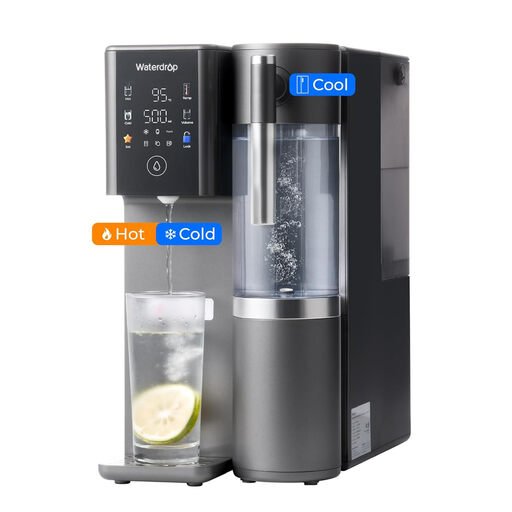
Waterdrop WD-A2 Countertop Reverse Osmosis System
Consider the WD-A2 if selectable water temperatures matter when preparing different guest drinks.
The product name specifies six temperature settings, a portable pure-water tank and a 3:1 pure-to-drain ratio.
Check how much purified water is ready to serve at once, along with the refill and filter-change instructions.
View on Joybuy
 No image available
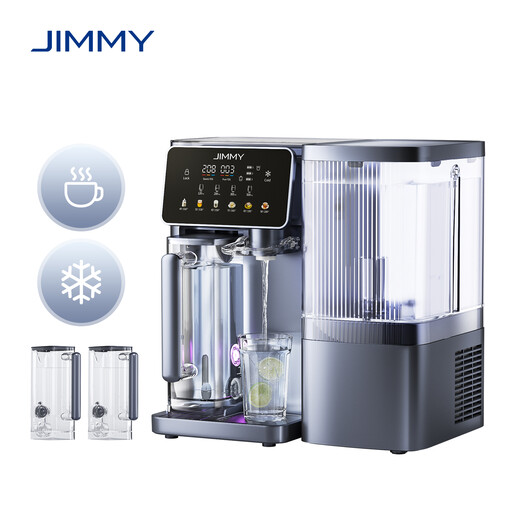
JIMMY R9 Pro Countertop RO Water Purifier
Consider the R9 Pro if you want hot and cold water options and separate pitchers for preparing guest drinks.
The product name specifies a 5.5 L tank, two 1 L pitchers and seven-stage filtration with UV.
Do not treat the tank figure as ready-to-serve purified capacity; check the usable volume, dispensing controls and filter-change instructions.
View on Joybuy
Questions about serving and upkeep
Do I need a purifier because tap water is unsafe?
Not as a general health-protection measure for public supplies in England and Wales, according to the Drinking Water Inspectorate. A countertop appliance can instead be a choice about taste, serving convenience or a particular filtration format; that public-supply guidance should not be extended to private supplies.
What if my tap water is discoloured?
Investigate the cause rather than assuming a countertop filter will fix it. The Drinking Water Inspectorate advises contacting the water company about local supply concerns and addressing problems in a building’s pipes or fittings where relevant.
How closely do I need to follow the cleaning and filter schedule?
Follow the instructions for the exact appliance and each filter stage. The Drinking Water Inspectorate warns that missed maintenance can allow deposits and bacteria to build up and removed material to leach back into drinking water.
Can I use an instant-hot dispenser for a commercial event?
Check the intended use of the specific model before using it for an event. BRITA’s Cube manual limits that appliance to domestic and small-office use and says it should not be used commercially; this does not establish the limits of other models.
Does filtered hot water replace boiling during an official notice?
No: follow the instructions in the official boil-water notice. The BRITA Cube manual says advice to boil tap water also applies to filtered water, so a dispenser’s filtration or temperature setting should not be treated as an exemption.


