What matters when buying?
Start with the drinks guests actually request, then assess the treatment route and the work involved in refilling and maintaining the appliance. Published tank capacity helps with planning, but it does not tell you how many servings your particular office will get between refills.
| Concern |
What to check |
Who this matters to |
| Guest drinks and temperature |
Confirm whether the exact model dispenses chilled water, hot water or both, and whether its volume settings suit your cups and glasses. |
If guests request both cold water and hot drinks, I need the right options without preparing each drink elsewhere. Around 36% of consumers put guest-service speed and temperature choice first. |
| Treatment and drink quality |
Decide whether you want RO treatment or a cartridge filter for a specific taste or limescale concern; check claims for the exact model. |
When taste or a particular treatment route drives my decision, temperature settings alone will not settle it. Treatment and drink-quality assurance come first for around 36% of consumers. |
| Refilling and upkeep |
Compare the feed-water reservoir with peak demand, then check the replacement-filter model and assign cleaning and filter-change tasks. |
I do not want staff repeatedly leaving a meeting to refill the appliance or losing track of filter changes. For around 28% of consumers, reducing refill and upkeep work is the primary need. |
Countertop options on Joybuy
These countertop RO options address offices considering hot and cold drinks without a plumbed dispenser. Compare their stated configurations with your guest demand, then check the refill and filter routine for the exact appliance.
 No image available
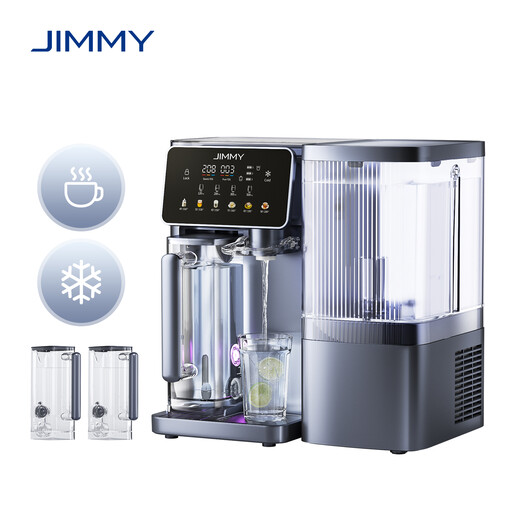
JIMMY R9 Pro countertop RO purifier, 5.5 L tank and two 1 L pitchers
Consider this model if guests need hot and cold drinks and staff can manage a manually filled countertop appliance.
The product name specifies a 5.5 L tank, two 1 L pitchers, seven-stage filtration and an LED touchscreen. Check the cleaning instructions, replacement-filter arrangements and how the tank and pitchers would work during your busiest meeting.
View on Joybuy
 No image available
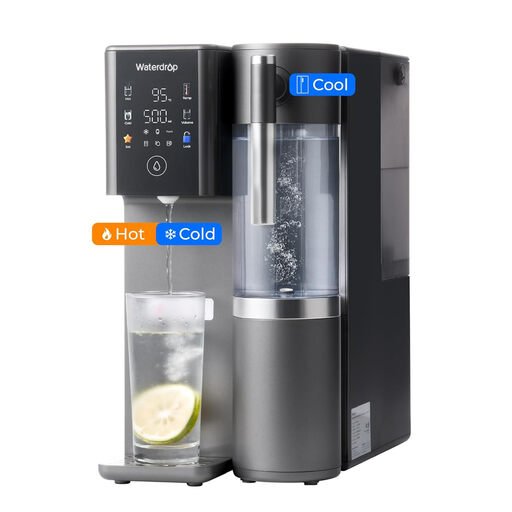
Waterdrop WD-A2 countertop RO system, six temperature settings
Consider this model if selectable hot and cold drinks matter more than choosing an appliance by reservoir size alone.
The product name specifies six temperature settings. Before planning service for a group, confirm the feed-water capacity, the cold-water temperature under your operating conditions and the replacement-filter arrangements; a detachable pitcher’s capacity should not be treated as the feed-water capacity.
View on Joybuy
Frequently asked questions
Does a shared office have to provide drinking water?
Yes. Regulation 22 of the Workplace (Health, Safety and Welfare) Regulations 1992 requires an adequate supply of wholesome drinking water for people at work in Great Britain. Northern Ireland’s Workplace (Health, Safety and Welfare) Regulations 1993 contain a corresponding requirement; choosing a countertop purifier does not replace providing the required supply.
Does an office need a reverse-osmosis purifier?
A countertop RO purifier is not specified by the workplace drinking-water provisions cited above. Choose RO if its treatment route addresses an identified need, while keeping the requirement for an adequate supply of wholesome drinking water separate from the appliance decision.
How should we plan filter changes?
Use the replacement guidance for the exact appliance and filter, and assign someone to monitor use. Waterdrop states up to 12 months or 1,100 gallons for a K19 replacement filter, whereas Aqua Optima states 100 L for Aurora’s Evolve+ filter; those manufacturer figures should not be transferred to another model.
Can a dispenser take care of the building’s water-safety arrangements?
No countertop dispenser, by itself, establishes how the premises water system is managed. UK Health Security Agency guidance says organisations should review their water-management arrangements and addresses regular flushing during periods of low use.
When is a plumbed dispenser worth considering?
Consider one when serving guests or staff would make repeated manual refilling disruptive. BWT describes filtered dispensers for office settings and states that they need a potable-water connection and a standard power socket; confirm the installation and servicing responsibilities for your site.


