For an afternoon bottle refill, a cartridge-filter dispenser suits a preference for taste and limescale-related filtration in a compact refill point; choose countertop reverse osmosis (RO) if that filtration method is itself a priority, and a hot-and-chilled RO model if you will regularly use chilled water. Whichever route you consider, check that your bottle fits, how much water the appliance dispenses, and the work involved in refilling and maintaining it. For public supplies in England and Wales, the Drinking Water Inspectorate does not consider additional home treatment necessary for health protection.
Who these purifiers suit
Daily reusable-bottle refillers
If you want an afternoon refill without plumbing work, consider the reservoir, the space beneath the dispenser and whether its measured fills suit your bottle before paying for temperature functions you may rarely use.
Filtration-method-led buyers
If your main reason for buying is the treatment method, distinguish cartridge filtration aimed at taste and limescale-related use from RO. Check the claims and maintenance instructions for the exact model rather than assuming all electric purifiers treat water alike.
Frequent chilled-water users
If you regularly want a cold bottle refill, an appliance that explicitly dispenses chilled water may be worth considering. Hot-water dispensing or RO filtration alone does not establish that a model chills water.
What matters when buying
Cartridge-filter dispenser
Consider it when: You want a plug-in refill point focused on taste and limescale-related use rather than RO treatment.
Trade-off: Cartridge filtration is a different treatment route from RO, and cartridges and cleaning remain part of the routine.
Countertop RO dispenser
Consider it when: You specifically want RO and, where a model offers them, measured dispensing choices for repeatable bottle fills.
Trade-off: Plan for feed-tank refills, replacement filters and model-specific reject-water handling.
Hot-and-chilled RO station
Consider it when: You will regularly use chilled bottle water as well as other dispensing temperatures.
Trade-off: Check whether the appliance size and upkeep are justified if a simple ambient refill would usually do.
| Concern |
What to check |
Who this matters to |
| Repeatable bottle filling |
Check reservoir capacity, clearance beneath the spout and whether available dispense volumes suit your bottle. |
If I refill the same bottle each afternoon, I want it to fit and fill without repeated adjustments; around 36% of consumers put refill convenience first. |
| Filtration approach |
Identify whether your goal concerns taste and limescale-related use or a particular RO method; check the exact model's stated treatment claims and conditions. |
When the way water is filtered drives my purchase, I need to choose that method deliberately rather than rely on the word purifier; for around 29% of consumers, filtration approach is the primary concern. |
| Ongoing upkeep |
Check the correct replacement filter, cleaning instructions and, for RO, the model's stated pure-to-drain ratio. |
I need a routine I can keep up with, including filter changes and reservoir care; upkeep comes first for around 21% of consumers. |
| Water temperature |
Confirm the stated dispensing temperatures and whether chilled water is explicitly offered. |
If my afternoon refill needs to be cold, ambient or hot dispensing will not meet that preference; temperature options are the leading concern for around 14% of consumers. |
Mistakes to avoid
-
Using a purifier to sidestep a water-quality concern
For public supplies in England and Wales, the Drinking Water Inspectorate does not present additional home treatment as necessary for health protection. A new smell or change in appearance needs attention rather than simply being masked by an appliance.
Choose a dispenser for a defined taste, convenience or filtration preference. If public-supply water looks or smells unusual, GOV.UK advises contacting your water company.
-
Overlooking filter changes and cleaning
Incorrect maintenance can create hygiene problems, according to the Drinking Water Inspectorate. Cartridge and RO models have their own replacement parts and instructions.
Before choosing a model, identify its exact replacement filter and read its cleaning and replacement guidance.
Replacement filters and the time needed for cleaning are recurring ownership demands.
-
Assuming every RO dispenser uses water alike
Countertop RO appliances can produce reject water. Waterdrop states a 3:1 pure-to-drain ratio for its C1H; that model-specific figure should not be assigned to another dispenser.
Compare the exact model's stated ratio, the conditions behind it and how you will manage its reservoirs.
-
Confusing hot dispensing with chilled water
Waterdrop's K19-H page lists temperatures from room temperature to 95 °C, while Philips explicitly lists chilled dispensing for the ADD6921DG/10. Hot-water capability does not establish chilled-water capability.
If a cold afternoon refill matters to you, check that chilled dispensing is specified for the precise model you intend to buy.
Brands to consider for these dispenser types
BRITA
Its Cube is a cartridge-filter countertop dispenser to consider when a compact, installation-free refill point matters more than choosing RO.
- BRITA lists a 4 L tank, heating up to 95 °C and dimensions of 20.2 × 28.5 × 35.9 cm for the Cube.
- Its MAXTRA PRO Limescale Expert cartridge is not an RO process. Follow the Cube manual's cartridge-replacement and cleaning instructions.
Waterdrop
Its K19-H is relevant if you want a non-plumbed countertop RO dispenser with selectable amounts for a bottle.
- Waterdrop lists 240, 360, 480 and 600 mL dispensing choices and a 5 L feed tank for the K19-H.
- Allow for feed-tank refills and the correct replacement filter. Waterdrop's 3:1 pure-to-drain figure for the separate C1H model should not be assumed to apply to the K19-H.
Philips
Its ADD6921DG/10 is relevant when chilled bottle water will be a regular use, alongside ambient and hot dispensing.
- Philips lists countertop RO filtration, three dispensing temperature options and a 6 L tap-water tank for this model.
- Consider its worktop space, cleaning routine and model-specific replacement consumables before choosing a multi-temperature appliance for bottle refills.
Countertop RO choices on Joybuy
These countertop RO dispensers offer cold-water options for an afternoon refill. Compare their bottle fit and maintenance requirements with your own routine; the models in this section are not the BRITA, Waterdrop K19-H or Philips models discussed above.
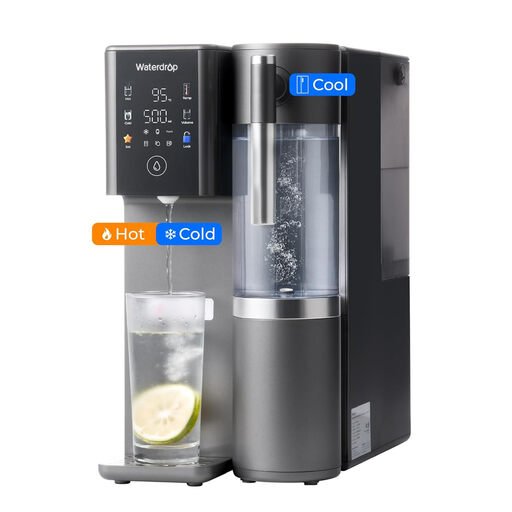 Image unavailable
Waterdrop WD-A2 Countertop Reverse Osmosis System
Consider this model if you want a countertop RO refill point with cold-water options. Its product name lists six temperature settings and a portable water tank; confirm the temperatures, dispensing amounts and clearance against your usual bottle. Check the exact replacement-filter requirements and how the stated 3:1 pure-to-drain ratio applies in use.
View on Joybuy
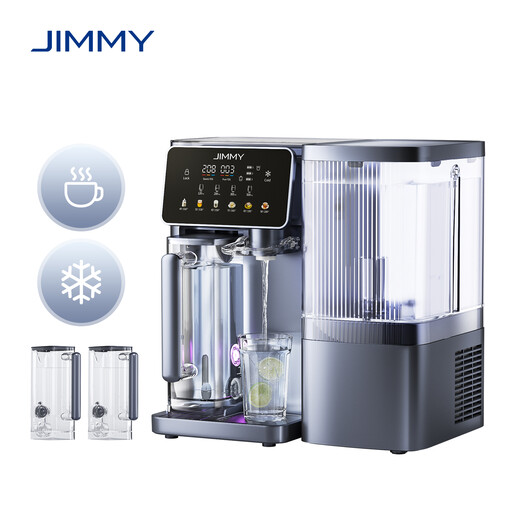 Image unavailable
JIMMY R9 Pro Countertop Smart RO Purifier, 5.5 L Tank and Two 1 L Pitchers
Consider this model if you want a countertop RO appliance with hot and cold options and separate pitchers for prepared water. The product name lists seven-stage filtration, a 5.5 L tank and two 1 L pitchers. Confirm that your bottle fits beneath the dispenser, then check the exact filter-change routine and RO water-use information.
View on Joybuy
Common questions
Do I need a countertop purifier to make public tap water safe?
For public supplies in England and Wales, the Drinking Water Inspectorate says additional home treatment is not needed as a health-protection measure. You may still prefer a dispenser for taste or convenience; that guidance should not be extended to a private supply or used to dismiss a change in your water's appearance or smell.
What if my tap water becomes cloudy, discoloured or smells unusual?
Raise a new appearance or smell concern rather than relying on a purifier to conceal it. GOV.UK advises contacting your water company for a public supply or your local council for a private supply; faults in your own pipes or fittings also need to be addressed at their source.
How important are cleaning and filter changes?
Follow the cleaning and replacement instructions for the exact appliance. The Drinking Water Inspectorate warns that neglected maintenance can allow deposits to build up and create conditions for bacteria; another model's filter interval is not a substitute for your manual.
Can I fill my bottle now and drink the filtered water later?
Follow the storage instructions for your particular dispenser and keep the reusable bottle clean. For the BRITA Cube, its manual says to store filtered water in a cool place and use it within 24 hours; do not assume that instruction applies unchanged to every RO model.


