What matters when choosing
Start with whether the purifier must replace your kettle, then decide whether limescale-focused filtration or RO treatment addresses your main reason for buying.
Instant-hot, limescale-focused filtration
Choose when: Hot water on demand and managing scale matter more to you than RO treatment.
Trade-off: Check the cartridge schedule; a limescale-focused cartridge should not be assumed to offer an RO membrane’s reduction claims.
RO with instant-hot dispensing
Choose when: You want countertop RO treatment and filtered hot water from the same appliance.
Trade-off: RO produces a concentrated waste stream, according to the Drinking Water Inspectorate; compare each model’s water-to-drain information and replacement filters.
RO purifier and separate kettle
Choose when: You are content to heat purified water separately and value a portable carafe.
Trade-off: The AquaTru Carafe is described as a purifier with a carafe, not an instant-hot dispenser, so tea still involves two appliances.
| Concern |
What to check |
Who this matters to |
| Tea temperature and speed |
Confirm that heating is built in and compare the dispensing temperature with your tea’s instructions. The UK Tea & Infusions Association gives 90–98°C for black tea. |
If I make black tea throughout the day, I want filtered water at a suitable temperature without boiling a kettle each time; around 36% of consumers put tea-ready hot water first. |
| Hardness and limescale |
Check your supplier’s local hardness information and whether the exact cartridge is designed for limescale reduction. |
When scale builds up in my kettle, I want to address that problem before choosing a more involved treatment system. Roughly 29% of consumers make scale management their primary concern. |
| RO reduction claims |
Check the exact model’s stated substances, test basis and filter configuration, alongside its water-to-drain information. |
If I specifically want RO treatment, I need to understand what the particular filter claims to reduce and the waste-water trade-off; about 21% of consumers prioritise that need. |
| Space and upkeep |
Compare dimensions, tank or carafe capacity, cleaning instructions and compatible replacement filters. |
In a small kitchen, I need refilling and filter changes to fit my available space and routine. For around 14% of consumers, manageable space and upkeep come first. |
Brands to consider
These product lines illustrate different ways to filter water for tea; the heating and filtration features vary by model.
BRITA
The BRITA Cube combines filtered water with on-demand heating for tea drinkers focused on convenience and limescale.
- BRITA states that the Cube heats water up to 95°C and uses a MAXTRA PRO Limescale Expert cartridge.
- It is not described as an RO system; check the cartridge replacement requirements rather than assuming RO-type reduction claims.
Waterdrop
The K19-H is a countertop RO option for buyers who also want hot-water dispensing without permanent installation.
- Waterdrop describes six-stage RO filtration and hot water up to 95°C for the K19-H.
- Check replacement filters and the model’s water-to-drain information before choosing it for regular tea making.
AquaTru
The AquaTru Carafe offers countertop RO filtration with a serving carafe for households happy to heat tea water separately.
- AquaTru describes a no-installation, four-stage RO system with a 1.9 L glass carafe.
- The cited Carafe material does not describe instant-hot dispensing, so retain a kettle or another way to heat the water.
Frizzlife
The WB99-H is a countertop RO option for buyers interested in adjustable hot-water settings and a portable pitcher.
- Frizzlife states a heated-water range of 45°C–100°C and markets the WB99-H with remineralisation and filter-life monitoring.
- Check the exact replacement-filter set and waste-water arrangement; remineralisation should not be treated as a proven health benefit.
Joybuy countertop RO options
These countertop RO choices are relevant if you want filtration and are considering hot-water dispensing for tea. Check the heating details for the exact variant before relying on either appliance to replace a kettle.
 No image available
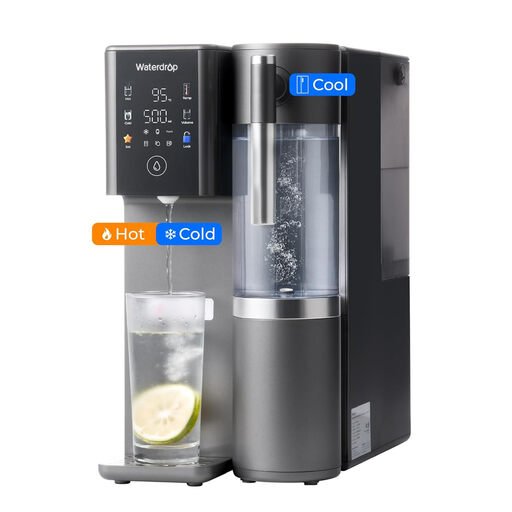
Waterdrop WD-A2 Countertop Reverse Osmosis System
Consider this countertop RO model if you want to check whether one appliance can also provide hot water for tea; confirm hot-water dispensing for the exact WD-A2 variant before relying on it instead of a kettle.
The product title specifies six temperature settings and a stated 3:1 pure-to-drain ratio. Check the compatible replacement filters and the conditions for that ratio.
View on Joybuy
 No image available
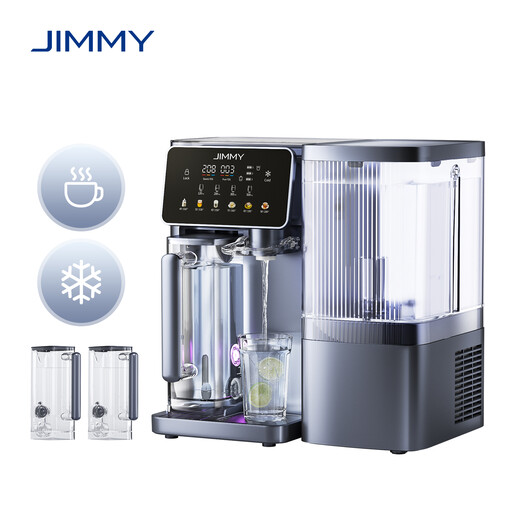
JIMMY R9 Pro Countertop RO Water Purifier
Consider this model if countertop RO filtration and instant hot-water dispensing suit your routine; check its selectable and outlet temperatures against the tea you make.
The product title specifies seven-stage filtration, a 5.5 L tank, two 1 L pitchers, instant hot and cold dispensing, an LED touch screen and a UV sterilisation feature. Check the compatible filters and replacement schedule.
View on Joybuy
Common questions
Is 95°C hot enough for black tea?
It falls within the UK Tea & Infusions Association’s 90–98°C range for black tea. Follow the instructions for your particular tea, especially if you also make teas with different temperature recommendations.
Do I need a purifier if I use public mains water?
Not necessarily: taste, limescale and the convenience of hot-water dispensing may be your reasons for buying one. The Drinking Water Inspectorate describes standards for public drinking water; a purifier is not a substitute for reporting a concern about your supply. If water is unclear or has an unusual smell, follow GOV.UK advice to contact your water company, or your local council for a private supply.
Should I choose RO because my kettle scales up?
Check your local hardness before choosing RO solely for scale. The Drinking Water Inspectorate links hard water with kettle scaling; compare a limescale-focused filter with RO against your specific needs and the upkeep each involves.
Does a countertop RO purifier produce waste water?
Yes. The Drinking Water Inspectorate explains that RO produces treated water and a more concentrated waste stream. Compare the exact model’s stated pure-to-drain ratio and how its waste water is handled.
How do I maintain a countertop purifier?
Follow the exact appliance manual for cleaning, tank care and filter changes. BRITA says the Cube gives automatic filter-replacement reminders; regardless of reminders, use the replacement instructions for your own model and cartridge.


