Who each route suits

Housemates combining their daily dishes

If plates, bowls, mugs and cutlery build up across the household, assess a six-place tabletop machine first. Russell Hobbs lists a six-place model, but its capacity is useful only if your crockery fits and the kitchen can accommodate its water, drainage and electrical connections.

Renters without a practical permanent inlet

A model with an internal tank can be filled manually rather than connected permanently to a tap. The three-place tank models described by Russell Hobbs and HAVA suit lighter loads; allow for filling the tank, draining the machine and sharing its limited space.

Households with a difficult kitchen layout

If worktop space, the sink or a suitable socket is the sticking point, settle the installation plan before comparing programmes. Electrical Safety First advises placing a dishwasher near a wall socket and avoiding an extension lead.

What matters when choosing

Six-place, tap-connected tabletop model

Choose when: Several housemates regularly combine their everyday crockery and the kitchen can support a lasting countertop position.

Trade-off: The greater stated load capacity depends on a workable tap connection and takes up shared worktop and sink space.

Smaller model with a water tank

Choose when: Avoiding a permanent inlet matters more than washing several people’s dishes in one load.

Trade-off: The documented three-place models require manual filling when used from their tanks, while drainage and mains power still need planning.

Concern What to check Who this matters to
Installation Measure the available worktop and confirm the inlet, drain route and nearby wall socket. Check the tenancy agreement before altering any fittings. If the only usable worktop is beside a busy sink, I need the machine and its connections to fit without obstructing everyone else; around 36% of consumers would put installation feasibility first.
Load capacity Compare place settings, basket layout and maximum plate diameter against the crockery you use every day. When plates and mugs accumulate across housemates, I want fewer loads and less turn-taking; roughly 29% of consumers would make daily-load capacity their primary concern.
Tank use Confirm tank volume, whether a tap connection is optional and where wastewater will go. Without a workable permanent inlet, I need to fill the machine myself and can accept a smaller load; around 21% of consumers would put plumbing-free use first.
Noise and upkeep Compare stated noise, programme-specific energy and water use, and the model’s filter and refill instructions. Once the basic setup works, I want to know how the machine will fit around other people’s routines; roughly 14% of consumers would prioritise noise and routine upkeep.

Mistakes to avoid

  • Assuming countertop means connection-free

    A tabletop machine still needs a stable position, drainage and power. A tap-connected model also needs an inlet that works with the shared sink.

    Check the exact inlet fitting, where the waste hose will drain and whether the appliance can remain in place without blocking food preparation.

    Russell Hobbs states that a standard kitchen-tap adapter is not included with the RH6TTDW0D1W, so that fitting may need to be arranged separately.

  • Choosing by place settings alone

    A stated capacity does not tell you whether your largest dinner plates will fit. Russell Hobbs lists a 25 cm plate limit for the RH6TTDW0D1W and 22.8 cm for the RH3TTDW0D1W.

    Measure a plate you regularly use, then check the exact model’s stated limit and basket layout.

  • Expecting a tank to handle every shared load

    The documented tank-fed models have three-place capacity. For several housemates’ accumulated crockery, that may mean more loading and repeated cycles.

    If daily loads are consistently larger, compare a six-place tabletop model where a tap connection is feasible; consider a larger dishwasher if the shared load regularly exceeds tabletop capacity.

  • Using a crowded extension lead

    Electrical Safety First advises avoiding extension leads for dishwashers, and UK Government fire-safety guidance warns against overloading sockets in shared or rented accommodation.

    Plan for a suitable nearby wall socket and follow the appliance’s installation instructions rather than relying on a chain of adaptors.

Relevant brands for reference

Russell Hobbs

Its documented tabletop range offers a useful contrast between a six-place tap-connected model and a three-place model with an internal tank.

  • Russell Hobbs specifies six place settings, a 25 cm plate limit and 47 dB for the RH6TTDW0D1W.
  • The RH6TTDW0D1W needs a suitable tap connection. Its three-place tank alternative has a smaller stated load and a stated noise level of 58 dB.

HAVA

The R09 is a three-place tabletop option for kitchens where manual tank filling is more practical than a permanent water inlet.

  • HAVA lists a 5 L internal tank, an optional tap connection and an integrated water softener for the R09.
  • Its stated three-place capacity calls for a realistic plan if several people expect to share one daily load.

Comfee

The CDWMT201DW-UK is a compact tank-fed route with an optional tap inlet.

  • The Joybuy product page describes a 5 L tank, six programmes and a 29-minute rapid cycle.
  • Its stated capacity is around two to three place settings, so compare it against the actual shared load rather than assuming it can clear everyone’s crockery at once.

Joybuy countertop dishwasher choices

This six-place countertop model is worth assessing when the household wants more room for everyday shared crockery. Confirm its installation arrangements and fit before deciding whether it suits your kitchen.
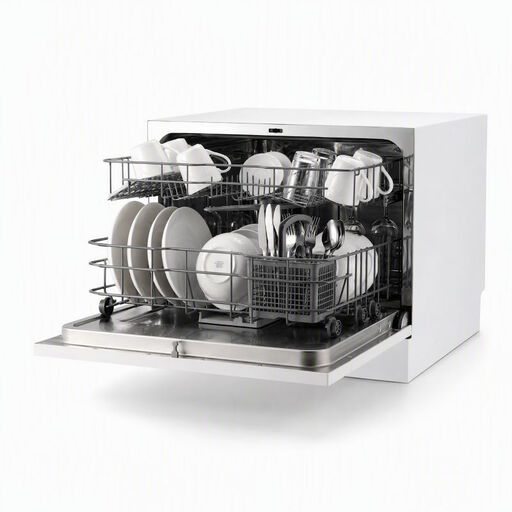
ochama Mini Tabletop Dishwasher, six place settings

ochama Mini Tabletop Dishwasher, six place settings

Its stated six standard place settings make it a model to assess for a shared load of everyday crockery. The product title lists a 30-minute quick wash, a 24-hour delayed start and eight functions; check which programme suits the dishes you normally wash. Before ordering, confirm the water-inlet and drainage methods, appliance dimensions, maximum plate diameter, electrical requirements and stated noise level for this exact model.

View on Joybuy

Common questions

Is a countertop dishwasher big enough for a shared kitchen?

A six-place tabletop model is a sensible starting point when the combined daily load is mainly ordinary plates, bowls, mugs and cutlery and the household can run cycles as needed. The documented three-place tank models suit lighter loads; if cookware and dishes from several meals regularly accumulate, assess a larger dishwasher too.

Can every countertop dishwasher run without a tap connection?

No. Some models require a compatible tap, while models with internal tanks can be filled manually and may also offer a tap option. Either way, check the exact model’s drainage instructions, worktop requirements and electrical connection.

Can I plug a countertop dishwasher into an extension lead?

Plan to use a suitable nearby wall socket instead: Electrical Safety First advises avoiding extension leads for dishwashers. Follow the model’s installation instructions, and stop using an electrical connection that shows signs of overheating or damage.

What should renters in England check before installation?

Check your tenancy agreement and speak to the landlord or managing agent before changing taps, fittings or electrical connections. GOV.UK guidance for England says the electrical-safety regulations for private and social rented sectors require qualifying landlords to arrange inspection and testing of electrical installations by a qualified person at least every five years; exceptions include some accommodation shared with a landlord or their family. That rule does not, by itself, settle whether permission is needed for a particular countertop appliance.