Shared-kitchen plate washers
If several people contribute dinner plates and cutlery, check that the largest plates fit and that the basket can hold a normal shared load. The place-setting label is only a starting point.


Choose the water-supply arrangement before comparing programmes: a tank-fed dishwasher avoids a fixed inlet connection, while a connected model needs suitable water and drainage access. For shared-kitchen dinner plates, measure your largest plate and confirm that it fits the exact model; place-setting capacity alone cannot answer that question. Worktop space, drainage and the timing of shared use then determine whether the machine is practical.
If several people contribute dinner plates and cutlery, check that the largest plates fit and that the basket can hold a normal shared load. The place-setting label is only a starting point.
If changing the tap connection is impractical, a built-in tank offers a way to fill the machine without a fixed inlet. You still need an appropriate place for the drain hose to discharge.
If the sink and worktop are busy at mealtimes, consider where the machine and hoses will sit, when cycles can run and whether its stated noise level suits the household.
For shared-kitchen dinner plates, establish how the dishwasher will be filled and drained, then check plate clearance and the space available for a normal load.
Choose when: A fixed tap connection is impractical or the machine needs to be movable.
Allow for: Manual filling and a secure route for wastewater, even without a fixed inlet.
Choose when: The kitchen has a suitable water connection, drainage access and stable worktop space for a regular load.
Allow for: Inlet and drain hoses near a shared sink; six place settings do not establish plate clearance.
Choose when: Several sharers need a larger stated capacity and the kitchen can accommodate the required connections.
Allow for: More appliance clearance. Cookology lists its eight-place CTTD8WH as taller and deeper than its six-place CTTD6WH.
| Concern | What to check | Who this matters to |
|---|---|---|
| Plate fit and load capacity | Measure your largest dinner plate and compare it with the exact model’s stated clearance or loading diagram. Check whether bowls must fit in the same load. | When plates and cutlery from a shared meal need washing together, I need the largest plate to clear the rack without using up impractical amounts of space. Around 46% of consumers would put plate fit and load capacity first. |
| Filling and drainage | Check the required water connection or tank-filling method, then plan a secure drain-hose destination and appliance position. | If the tap cannot be altered, I need a filling method the household can use while keeping wastewater under control. Installation flexibility would come first for around 36% of consumers. |
| Disruption to shared space | Compare stated noise, cycle options and whether the machine or hoses obstruct the sink. Agree when it can run. | Where others cook and use the sink nearby, I want cycles and hose placement that do not interfere with them. Around 18% of consumers would make shared-space disruption their primary concern. |
A place-setting rating describes capacity, not maximum plate diameter. A COMFEE' six-place listing on Amazon states a 250 mm plate limit, which should not be applied to other models.
Measure your largest plate, including its rim, and compare it with clearance information or a loading diagram for the exact dishwasher.
A built-in tank avoids a fixed water inlet, but used water still has to go somewhere. HAVA says its R01 drains through an outlet hose to a sink or bucket.
Choose the drain destination before buying and check that the hose can stay secure without obstructing shared sink access.
A machine that fits the counter may still be impractical if its inlet and drain hoses cannot reach suitable connections. Cookology specifies a ¾-inch threaded cold-water connection and suitable drainage for its CTTD8WH.
Check the exact model’s connection type, hose route, socket position and external dimensions together.
A dishwasher occupies communal worktop space and needs electricity and drainage. Whether it may be used in a rented shared kitchen depends on the property’s arrangements rather than portability alone.
Check the tenancy terms and household rules, and ask the landlord or managing agent where permission is required.
HAVA’s R01 is a tank-fed tabletop option for a kitchen where a fixed inlet is impractical.
Cookology lists connected tabletop models with six or eight place settings, suited to different load and space requirements.
Listings for COMFEE' cover both a six-place countertop machine and a separate tank-fed mini model.
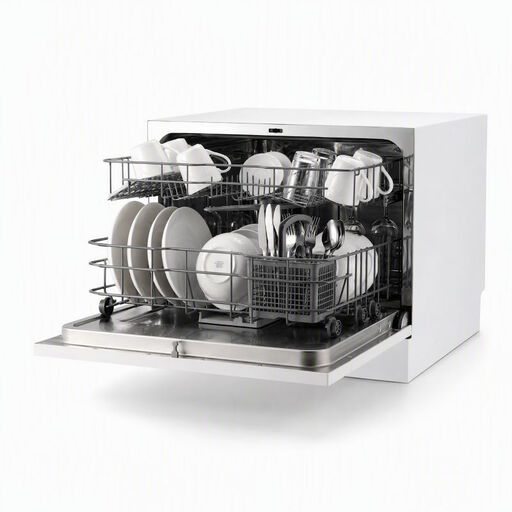
This six-place countertop model is relevant if you want to wash dinner plates in a shared kitchen. Confirm your plate clearance, available worktop space, water supply and drainage arrangement before choosing it.
 No image available
A countertop option to consider for a shared dinnerware load, provided your largest plates fit and the filling and drainage arrangements suit the kitchen.
The product name specifies six standard place settings, a 30-minute quick wash and a 24-hour delayed start. Check the appliance dimensions and stated plate clearance before choosing a position for it.
Yes, if the exact model has a built-in tank for manual filling. HAVA UK describes this option for its R01, but the machine still needs an electrical connection and a secure route for its outlet hose.
Not necessarily: place settings do not specify maximum plate diameter. A COMFEE' six-place listing on Amazon states a 250 mm limit; measure your largest plate and check the clearance for whichever model you intend to buy.
It needs the water supply and drainage specified for that model. For example, electriQ says its EQDWTTW needs connected inlet and drain hoses; check their route as well as whether they would obstruct the shared sink.
Check the tenancy terms and household arrangements before installing or using one, and seek permission where required. Portability alone does not establish whether the appliance, its worktop position or its hose route is permitted in a particular property.
Agree who removes food debris, empties the machine and cleans its filter, then follow the exact model’s manual for detergent and routine care. Cookology’s CTTD6WH manual says installation and repair should be carried out by a qualified technician.