What matters when choosing?
For a shared kitchen, decide whether users can manage manual refilling and ice removal before comparing daily-output claims. Then check how the machine will be cleaned and where it can operate without obstructing the worktop.
Compact manual-fill machine
Choose it when: Plumbing is unavailable and users can refill the reservoir and transfer ice as needed.
Accept: A small basket and manual intervention can interrupt the supply of ready ice, even when the stated daily output is high.
Larger mains-fill machine
Choose it when: Frequent demand justifies more stored ice and a permanent position with suitable water and drainage arrangements.
Accept: Installation needs and a larger, heavier appliance make it less convenient to move or store.
| Concern |
What to check |
Who this matters to |
| Cleaning and fresh water |
Check the model’s water-change and cleaning instructions, removable parts and any self-clean cycle. |
If several of us serve ice, I want a routine that keeps the water, basket and scoop cared for between uses. Roughly 36% of consumers would put shared upkeep first. |
| Ice during busy periods |
Compare basket storage with stated daily output, and check when refilling or ice removal is needed. |
When drinks are made close together, I need ice ready for the next person, not just a promising 24-hour figure. Around 29% of consumers would prioritise supply during busy periods. |
| Space and setup |
Measure the footprint, lid-opening space and the exact model’s ventilation clearance; check water and drainage requirements. |
With little spare worktop and no plumbing connection, I need a machine we can actually site and use. About 21% of consumers would make space and setup their main concern. |
| Operating disruption |
Check any published noise figure and consider where the machine will run; perceived sound can vary with placement and room acoustics. |
If the kitchen is close to desks or conversations, I do not want operation to be distracting. Roughly 14% of consumers would put low disruption first. |
Joybuy product choices
These compact countertop choices suit shared kitchens making batches of drink ice where users can take responsibility for removing ice and cleaning the machine. Check basket capacity and the exact model’s instructions against your busiest period before choosing.
 No image available
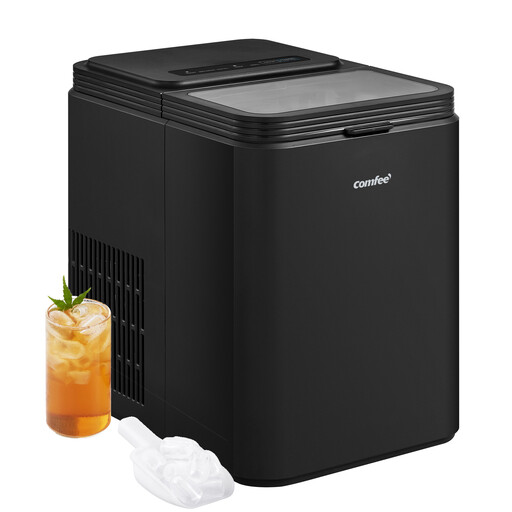
COMFEE' RCI12BL1UK(E) countertop ice maker
Consider this model if the group can transfer ice regularly rather than relying on a large ready supply.
The listing states up to 12 kg in 24 hours, eight bullet-ice pieces in 6–9 minutes, two ice sizes and a 1.3 L water tank.
Its removable ice container holds a stated 0.4 kg; a scoop and self-cleaning function are listed. Follow the exact model’s instructions for water changes and cleaning.
Joybuy
 No image available
EUHOMY portable self-cleaning countertop ice maker
Consider this model for small batches where a portable machine and a shared refill-and-cleaning routine suit the kitchen.
Its product title states nine cubes in six minutes and lists a scoop, basket and self-cleaning function. Check the basket and water-tank capacities if several people will need ice close together.
Joybuy
Frequently asked questions
Is a manual-fill ice maker enough for a shared kitchen?
It can be enough for occasional cold drinks if users can refill it and remove ice promptly. Compare ready-to-serve storage with demand: Nisbets lists the DC439 at up to 20 kg per day but gives its basket capacity as 0.7 kg.
Does self-cleaning mean no one has to clean the machine?
No. Follow the exact model’s cleaning instructions and agree who will do the work. The ICEQ instruction manual calls for fresh water, regular water changes, unplugging before cleaning and washing removable parts before first use.
How much space should I leave around an ice maker?
Use the clearance specified for the exact model, allowing room to open the lid and remove ice too. One ICEQ countertop manual requires at least 15 cm at the top, back and each side for ventilation; other machines may have different requirements.
What if the shared kitchen serves ice commercially?
If the operation is starting or taking over a food business, the Food Standards Agency says it must be registered with the local authority at least 28 days before trading or food operations begin. A household or workplace kitchen is not classified by its shared use alone; ask the local authority about the particular commercial operation.
Which product marking should I check in Great Britain?
Check the marking requirements applicable to the exact product. GOV.UK says CE marking continues to be recognised alongside or instead of UKCA marking for products covered by its Great Britain guidance. Great Britain means England, Scotland and Wales here; do not assume the same conclusion applies in Northern Ireland.


