For everyday cold drinks, a manual-fill bullet-ice maker is a practical choice if its first-batch time, basket capacity and worktop footprint suit your routine. If the appearance of ice matters more, check an exact model that makes clear ice; if you want finished slushies rather than separate ice, consider a frozen-drink machine instead. Whichever ice maker you choose, allow for refilling, removing finished ice and cleaning beyond any self-cleaning cycle.
Who is a countertop ice maker for?
Households making everyday cold drinks
If you make iced coffee, soft drinks or cocktails at home, a manual-fill machine lets you make separate ice without a plumbing connection. Consider how soon you need the first batch and where the appliance will sit.
Hosts serving several people
For parties or barbecues, compare repeated-batch output with the smaller amount the basket holds at once. You may need to remove ice between batches and keep it in a freezer until serving.
Regular users who prioritise cleaning
Look for a cleaning and draining routine you can manage, with reachable parts and a way to serve ice hygienically. A self-cleaning function does not replace manual cleaning.
What matters when choosing one?
Manual-fill bullet-ice maker
Choose when: You want separate ice for household drinks and can refill the tank and remove ice as batches finish.
Allow for: The basket holds less than the machine's rated 24-hour output, and cleaning still takes some manual work.
Clear-ice countertop maker
Choose when: The appearance and exact shape of ice matter for served drinks; check the stated format of the model you are considering.
Allow for: Clear ice does not, by itself, establish a faster batch time or greater ready-to-serve capacity.
Frozen-drink maker
Choose when: You chiefly want finished slushies or other frozen drinks rather than loose ice for glasses.
Allow for: It does not provide a supply of separate cubes for iced coffee, soft drinks or an ice bucket.
| Concern | What to check | Who this matters to |
|---|
| Ice supply |
Compare first-batch time, ice per cycle and basket capacity separately from rated output per 24 hours. |
When I serve several drinks close together, I need repeat batches without mistaking a daily rating for ice already in the basket. Around 31% of consumers put rapid supply first. |
| Worktop fit and refilling |
Check dimensions against the space available, including the exact model's ventilation clearance; consider access to its tank and drain. |
If I have limited counter space or put the machine away between uses, I need it to fit and be manageable to fill and empty. Around 31% of consumers make fit and handling their primary concern. |
| Cleaning and handling |
Check how to drain the machine and reach the basket, scoop and surfaces that need manual cleaning. |
With frequent use or shared drinks, I want a cleaning routine I can keep up and a clean way to serve the ice. For around 23% of consumers, hygiene and maintenance come first. |
| Ice format |
Confirm the exact model's ice shape and available sizes rather than assuming every machine makes the same cubes. |
For cocktails or drinks served in particular glasses, I care about the ice's appearance and size. Around 15% of consumers prioritise ice format and presentation. |
Buying mistakes to avoid
-
Treating daily output as a full basket of ice
A 24-hour rating describes production over time, not the amount waiting to be served. The basket can fill after much smaller batches.
Compare cycle time and basket capacity with the daily rating. If you are serving a group, plan when to remove ice and transfer it to a freezer.
-
Expecting self-cleaning to do everything
Coventry City Council advises that self-cleaning cycles clean the ice-making evaporator surface, while other areas still need manual cleaning.
Follow the model's cleaning and draining instructions, and serve ice with a clean scoop or tongs rather than hands or drinking glasses.
-
Choosing a frozen-drink machine for loose ice
A machine designed to make a finished frozen drink does not supply separate ice for individual glasses or an ice bucket.
Choose an ice maker when loose ice is the main requirement; consider a frozen-drink machine when slushies or similar drinks are what you chiefly want.
-
Overlooking the space around the machine
A countertop ice maker needs room for its air inlets and outlet as well as its body. The required clearance depends on the exact model's instructions.
Measure the intended position, check its ventilation guidance and confirm that the appliance's electrical requirements suit the available supply. Do not use a damaged cable or plug.
Relevant brands to consider
Pro Breeze
The PB-IM-01 is a manual-fill countertop model presented for household drinks, with two selectable bullet-ice sizes.
- Pro Breeze states up to 15 kg per day and a 6–9-minute ice-production time for this model.
- Its product description gives a 2 L tank, while its specification line says 1.5 L. Confirm the capacity for the exact variant before buying.
Andrew James
Its checked countertop ice maker is intended for domestic use without a plumbing or drainage connection.
- Andrew James states that it makes batches of nine cubes in approximately 5–13 minutes, depending on cube size and room temperature, and has two size choices.
- The brand specifies domestic rather than industrial or commercial use for this model.
Tower
The T19053 is a portable, manual-fill model aimed at household gatherings.
- Tower states a 1.2 L tank, nine bullets every 8–9 minutes and a 0.5 kg removable ice bucket.
- Compare that bucket capacity with the stated 10–12 kg output per 24 hours: they describe different amounts of ice.
Klarstein
The ClearCube 10046159 is a countertop option for shoppers seeking clear ice for served drinks.
- Klarstein states clear-ice production of up to 13 kg per 24 hours for this model.
- Check the exact model's ice format and capacity; the ClearCube's features should not be assumed across other Klarstein machines.
Countertop ice makers on Joybuy
These countertop machines are choices for making separate ice for cold drinks. Compare the stated batch details and ice format for each model, particularly if you need a quick first batch or a particular shape.
 No image available
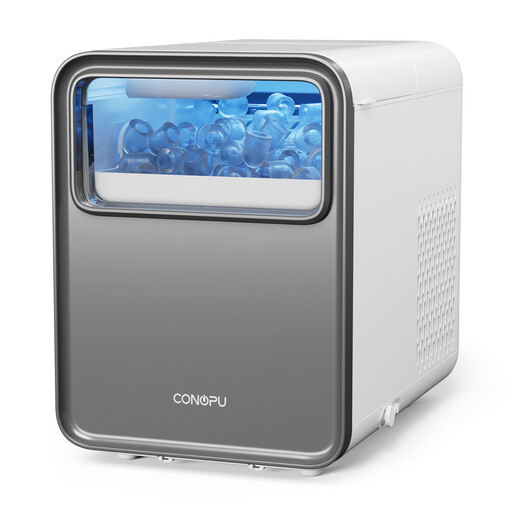
CONOPU Self-Cleaning Countertop Ice Maker, 2 Bullet-Ice Sizes
For drinks made in repeated batches, this model lists nine ice pieces per batch, up to 12 kg per 24 hours, two bullet-ice sizes, and a basket and scoop.
Its batch-time statements differ, so confirm the timing for this model. Check its plug and voltage requirements before use.
Joybuy
 No image available
EUHOMY Countertop Ice Maker with Scoop and Basket
For making separate ice for drinks at home, this model includes a scoop and basket and lists a self-cleaning function.
Confirm its batch time, tank and basket capacities, and plug and voltage requirements before choosing it for your routine.
Joybuy
 No image available
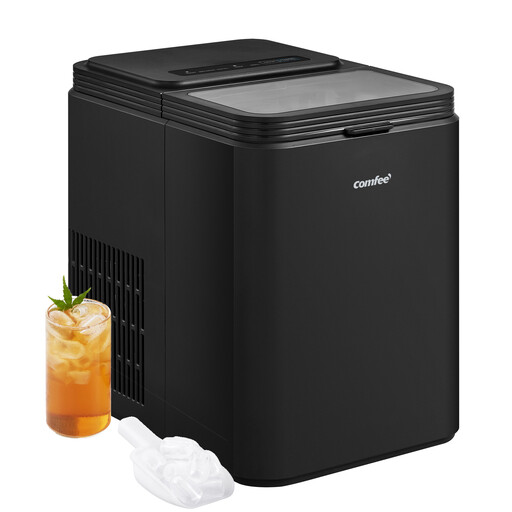
Comfee' RCI12BL1UK(E) Countertop Ice Maker
For cold drinks and small gatherings, this model lists eight ice bullets in 6–9 minutes, two sizes, and up to 12 kg per 24 hours.
A scoop and basket are included. Confirm its electrical requirements; the daily output is not the amount held ready in the basket.
Joybuy
 No image available
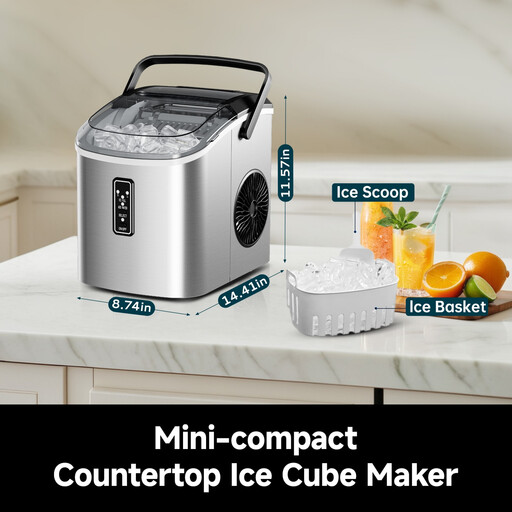
EUHOMY Ice Maker with Handle, Basket and Scoop
For serving separate ice with cold drinks, this model is presented with a handle, basket, scoop and self-cleaning function.
Check the exact model's ice shape and production time before relying on it for a quick first batch; confirm its dimensions and electrical requirements too.
Joybuy
 No image available
Comfee' RCI12WH1UK(E) Countertop Ice Maker
For repeated batches of ice for drinks, this variant lists eight ice bullets in 6–9 minutes, two sizes, and up to 12 kg per 24 hours.
It includes a scoop and basket. Check basket capacity, worktop dimensions, and plug and voltage requirements for the exact variant.
Joybuy
Frequently asked questions
Does a countertop ice maker need plumbing?
Not if you choose a manual-fill model such as the Andrew James ice maker described above. You will still need a suitable socket, space to refill it and a way to drain remaining water as its instructions require.
Does self-cleaning replace washing the basket and scoop?
No. Coventry City Council advises that self-cleaning cycles clean the evaporator surface where ice is made, not every area that needs attention. Follow the manufacturer's instructions for cleaning accessible surfaces and serving parts.
What water should I use for ice in drinks?
Use drinking-quality water and follow the appliance manual. East Cambridgeshire District Council advises food businesses to use potable water for ice and to handle the finished ice as food; household users should also check their model's water instructions.
Can a domestic countertop ice maker be used in a café?
Check the exact appliance's intended use before using it in a food business: Andrew James labels its checked model for domestic, not commercial, use. GOV.UK states that food businesses must make and follow a food-safety management system, which makes ice production and handling part of the business decision.


