Small-batch cottage bakers
If you mainly want a few cheese scones, look for an oven that can follow the BBC Good Food recipe’s fan setting and accommodate its preheated-tray method. Check the usable tray area before choosing a compact model.


Choose an appliance with a genuine fan or convection-bake setting that includes the recipe’s 180°C fan temperature, and check that it can take a suitable preheated baking tray. A compact convection mini oven can suit a small batch; consider a larger countertop oven for broader baking, or a convection combi microwave when the cottage also needs reheating and other cooking functions. In either case, check tray space, worktop fit and how easily guests can select the right mode.
If you mainly want a few cheese scones, look for an oven that can follow the BBC Good Food recipe’s fan setting and accommodate its preheated-tray method. Check the usable tray area before choosing a compact model.
Guests need clear controls and instructions as well as a suitable baking mode. Electrical Safety First advises landlords to register appliances they provide so they can receive recall information; placement and ongoing condition matter too.
If one appliance needs to bake and handle other meals, a convection combi microwave is worth considering. Check its external dimensions rather than assuming that combining functions will free up enough worktop space.
Consider it when: you mainly bake small batches and prefer a dedicated oven with straightforward controls.
Allow for: a smaller usable tray area; confirm that the particular model offers fan baking rather than bake mode alone.
Consider it when: the cottage needs room for broader baking or roasting, beyond an occasional small scone batch.
Allow for: more worktop space and the model’s required heat clearances; a Bake function alone does not confirm a fan setting.
Consider it when: the same appliance needs to bake scones and reheat or prepare other cottage meals.
Allow for: mode-specific cookware rules and the need to select convection, not microwave-only heating, for this recipe.
For this cottage kitchen, decide which need comes first, then check the particular appliance against the recipe and the available space.
| Concern | What to check | Who this matters to |
|---|---|---|
| Fan-baking conditions | A genuine convection or fan-bake mode including 180°C, and instructions for preheating a suitable tray. | I want to follow BBC Good Food’s 180°C fan cheese-scone recipe without guessing whether a microwave setting will do the same job. Around 31% of consumers put recipe-compatible baking first. |
| Worktop and batch fit | External dimensions and clearances; usable tray dimensions for the intended batch. | When preparation space is limited, I need the oven to fit safely while still holding the scones I plan to bake. For around 25% of consumers, space and batch fit are the primary concern. |
| Other cooking tasks | Whether convection baking is separate from microwave heating, and which accessories are approved for each mode. | If this is the cottage’s main countertop appliance, I also want it to handle everyday meals. Roughly 19% of consumers prioritise those additional functions. |
| Guest operation and safety | Clear mode instructions, stable placement, manufacturer clearances and a way to receive appliance recall notices. | When different guests will use the oven, I need them to recognise the baking setting and know what to do if something is wrong. Straightforward, safe guest use comes first for around 25% of consumers. |
BBC Good Food’s cheese-scone method calls for 180°C fan and a preheated tray. Microwave-only heating does not provide that oven setting.
Check for a stated convection or fan-bake mode whose temperature range includes 180°C before considering the other functions.
Cavity volume does not tell you the usable shape of a tray or whether scones can be spaced on it.
Check the supplied tray or rack dimensions, the intended batch size and the appliance’s placement clearances.
A combi appliance requires guests to distinguish convection baking from microwave and grill modes. Cookware instructions can differ between modes.
Leave concise, model-specific instructions identifying the scone setting, approved accessories, hot-surface precautions and fault contact.
An appliance that stays in guest accommodation needs appropriate positioning, instructions and attention if a fault is reported. Applicable accommodation-safety duties depend on the property and its location.
Keep the manufacturer’s instructions, register the appliance for recall notices as Electrical Safety First advises, and include it in the property’s relevant safety and maintenance arrangements.
These manufacturer-described models illustrate different appliance formats; check the exact model and its instructions before choosing one for the cottage.
Tefal describes the 19L Optimo OF445840 as a mini oven with convection among its cooking modes.
De'Longhi lists the EO12012 as a 12L electric oven with a 100–220°C thermostat.
Panasonic describes the NN-CD58RS as a 27L air-fryer microwave with convection cooking from 30–220°C.
Ninja describes the DT200UK as a large countertop oven with Bake among its functions.
These countertop combination microwaves are options to consider if the cottage needs other cooking functions alongside baking. Before relying on either for cheese scones, confirm a convection setting that includes 180°C and an approved tray arrangement for preheating.
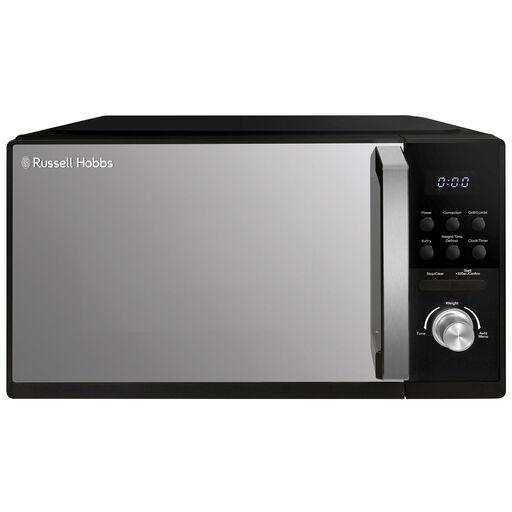 No image available
Consider this model when the cottage needs a combination microwave for more than baking alone. Its stated capacity is 25L. For the scone recipe, check the convection temperature range and whether an approved tray can be preheated; also check the worktop clearances.
 No image available
Consider this model if air-fry and microwave use matter alongside the planned baking. Its title specifies 900W microwave power, a 1000W grill, smart app control and 10 cooking presets. Check that its convection range includes 180°C, which accessories are approved for a preheated scone tray, and the space needed around it.
BBC Good Food specifies 180°C fan or 200°C conventional, with a large baking tray heated in the oven first. Its stated baking time is 15–20 minutes; follow the chosen appliance’s instructions for preheating and tray position.
Not necessarily: cavity volume does not establish usable tray area. Check the tray or rack dimensions and how the planned batch fits, as well as the space the appliance needs on the worktop.
Yes, if it offers a suitable convection-oven mode and an approved way to use the recipe’s preheated tray. Select convection rather than microwave-only heating, and follow that model’s cookware instructions; Panasonic states that the NN-CD58RS convection range includes 180°C.
Check that the appliance is suitable for the space, is in safe condition and has instructions guests can follow. Electrical Safety First advises landlords to register supplied appliances for recall notices. Bath and North East Somerset Council advises that newly supplied electrical equipment in rented accommodation should meet applicable electrical-equipment requirements and carry appropriate UKCA or CE marking; check the duties relevant to the property’s location and arrangement.