Small-tray vegetable roasters
If you mainly cook one small tray of carrots or other vegetables, the space available on the rack and the heat controls matter more than cavity capacity alone.


For a small tray of roasted carrots, check usable tray space, cooking controls and safe worktop placement before comparing cavity capacity. A compact conventional mini oven suits a simple roasting routine; a multifunction mini oven or air-fryer format makes more sense if you will use its other modes and its tray or container fits your portions.
If you mainly cook one small tray of carrots or other vegetables, the space available on the rack and the heat controls matter more than cavity capacity alone.
If you also want to bake, grill, toast or air fry, check which modes and accessories the exact model includes—and whether you have room to store them.
If a full oven is unavailable or inconvenient, measure the proposed position for a countertop appliance and check its placement and electrical instructions before buying.
Choose a cooking format you will use beyond this one dish, then check whether the exact appliance fits your tray, worktop and electrical setup. The three formats differ in what they provide: a compact conventional oven offers basic oven controls, a larger convection mini oven adds rack positions and modes, and an air-fryer mini oven adds a basket for another style of cooking.
Consider it when: A single small tray and basic temperature and timer controls cover your routine.
Trade-off: A compact cavity does not confirm that your tray fits; check the rack dimensions and whether the exact model has convection if circulating air matters to you.
Consider it when: You want a supplied baking tray, several rack positions and modes for other oven tasks, as listed for the Tefal Optimo OF445840.
Trade-off: Check that a larger appliance and its accessories fit your worktop and storage space; listed modes do not establish how evenly it browns food.
Consider it when: You would regularly use air frying as well as roasting or baking.
Trade-off: Check the exact model’s basket and tray dimensions and cleaning instructions; accessories vary between models.
| Concern | What to check | Who this matters to |
|---|---|---|
| Small-tray roasting control | Compare your tray with the usable rack or supplied tray dimensions. Check the exact model’s cooking modes and temperature controls. | If I mainly roast one tray of carrots, I need room for that tray and controls suited to the cooking method I want. Roughly 42% of consumers would put tray fit and roasting control first. |
| Worktop and electrical fit | Measure the appliance footprint, follow its placement instructions and review its plug and power requirements. | With little worktop space, I need a position where the oven can be used as its manual directs and connected safely. For around 33% of consumers, placement and electrical fit would be the primary concern. |
| Useful extra functions | Check which modes and accessories the exact model includes, and how you would clean and store them. | If I will cook more than carrots, I want the additional modes to suit meals I actually make. Extra cooking functions would come first for roughly 25% of consumers. |
Cavity capacity does not tell you whether your usual roasting tray fits: rack arrangements and supplied accessories differ between models.
Measure the tray you plan to use and compare it with the manufacturer’s usable rack, tray or basket dimensions.
Electrical Safety First warns that an oven or grill used alongside other large appliances may overload an extension lead and create a fire risk.
Follow the appliance’s power instructions. If you are unsure whether the proposed electrical setup is suitable, consult a qualified electrician.
Cuisinart labels the TOA60U as discontinued, while the De'Longhi EO12012 page showed that model as out of stock. Another model may differ in dimensions, accessories or controls.
Use those models to identify features you want, then check the exact model and variant you intend to buy.
A manufacturer’s description of cooking modes does not establish browning consistency or energy use. Which? assesses oven performance, ease of use and energy efficiency as separate aspects of its mini-oven testing.
If one of those outcomes will decide your purchase, consult current independent testing for the exact model as well as its stated specifications.
The EO12012 illustrates a compact conventional mini oven: De'Longhi lists a 12L cavity, grill and bake functions, a 100–220°C thermostat and a 120-minute timer.
Tefal lists the Optimo OF445840 as a 19L convection mini oven with eight functions, six cooking heights, a baking tray and a 120-minute timer.
The TOA60U illustrates an air-fryer mini oven with roast, bake, grill and toast functions in a 17L appliance.
These choices cover an air-fryer oven and a portable, container-based air fryer with a Roast function. Compare their cooking spaces and controls with your intended carrot batch; neither is presented here as a conventional mini oven.
 No image available
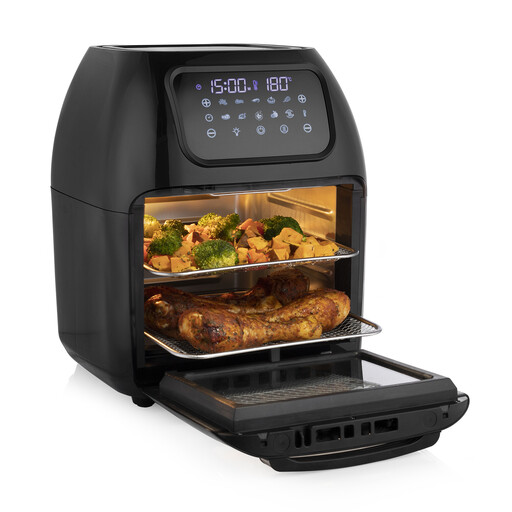
Consider this air-fryer oven if you want a countertop format for roasting alongside other cooking programmes.
The listed variant has a 10L capacity, 1800W power, touch controls and 10 programmes. Check the usable dimensions of its accessories against your usual roasting tray, and follow the exact model’s placement instructions.
 No image available
Consider this container-based alternative if its Roast function suits the portions you plan to cook rather than a tray-based mini-oven routine.
The listed variant is 1700W and includes two removable glass containers with lids. Check the containers’ usable dimensions and the exact model’s cooking controls and placement instructions before choosing it for your carrots.
No: a conventional mini oven with a suitable roasting mode can also be considered. If circulating-air cooking is important to you, confirm that the exact model lists convection; Tefal lists it for the Optimo OF445840, whereas De'Longhi describes upper and lower heating elements for roasting in the EO12012.
Do not assume an extension lead is suitable. Electrical Safety First warns that an oven or grill may overload one when used with other large appliances; follow the oven’s power instructions and ask a qualified electrician if the electrical setup is uncertain.
Use the placement instructions for the exact model rather than a generic clearance figure. Tefal’s Optimo manual says air must flow freely around that appliance, so account for its required position when measuring your worktop.
Let the appliance cool fully, then follow its manual for the cavity and removable accessories. Electrical Safety First advises cleaning only after cooling; Tefal’s Optimo instructions describe cleaning removable parts with a damp cloth and washing-up liquid.
Registration can help the manufacturer contact you if a safety recall affects your appliance. Electrical Safety First recommends registering appliances for that reason.