Large-room stereo listeners
You want a defined left/right presentation for vocals and instruments, and have space for two speakers, cable runs and, if choosing passive speakers, an amplifier.


Choose a passive floorstanding pair if you have room to position two speakers and are willing to add a compatible amplifier. If straightforward streaming and fewer separate components matter more, consider a powered wireless speaker; choose a stereo pair if physical left/right separation is important. For country music, check vocals and acoustic instruments in your listening space rather than assuming a speaker suits the genre by name.
You want a defined left/right presentation for vocals and instruments, and have space for two speakers, cable runs and, if choosing passive speakers, an amplifier.
You mainly stream music and would rather set up a powered speaker than assemble separate hi-fi components. If you also use another source, its connection needs to be checked.
Furniture or walkways restrict where speakers can stand. Wall distance and the position of your usual seat therefore deserve attention before you choose a cabinet design.
Decide whether you can accommodate two positioned speakers and an amplifier before comparing connection options. Neither format establishes vocal clarity or suitable coverage in your particular room on its own.
Consider it when: you can place two speakers around a main listening seat and want a conventional left/right system.
Allow for: a compatible amplifier, speaker cables and space to adjust placement.
Consider it when: streaming with fewer separate components is your priority.
Allow for: the required network or app setup; one enclosure cannot be positioned as a separated left/right pair.
| Concern | What to check | Who this matters to |
|---|---|---|
| Stereo coverage | Check whether two speakers and the main seat can form a workable listening triangle. KEF UK suggests starting with the speakers 1,800–2,400 mm apart for a two-speaker setup. | If I listen from a main seat, I want vocals centred and instruments spread across the room. Around 37% of consumers put stereo coverage first. |
| Streaming and sources | Check the speaker’s supported connections against your playback devices, including any analogue source and its preamp needs. | I mostly stream and would rather avoid assembling several components, but I still need my other sources to connect. For around 27% of consumers, simple playback is the primary concern. |
| Vocal and instrument clarity | Where possible, compare familiar vocal-led tracks at your usual listening level; do not treat a driver specification as a listening result. | When a singer, guitar and fiddle play together, I want to follow each part without turning the music up. Clarity comes first for around 18% of consumers. |
| Placement | Measure the available wall distance and consult the exact model’s guidance. KEF UK notes that rear-ported speakers can be sensitive to placement behind the cabinet. | My furniture limits where speakers can stand, so a layout I can actually use matters more than an arrangement I cannot fit. Around 18% of consumers make placement their first concern. |
KEF UK specifies a 15–250W amplifier requirement for the passive R7 Meta. The speakers cannot replace the compatible amplification and connections needed for playback.
List your sources and check the exact speaker and amplifier guidance before choosing components.
Allow space and connections for an amplifier and speaker cables; some source setups may also need a streamer or turntable preamp.
According to KEF UK’s placement guidance, a rear port makes wall distance worth testing, not an automatic reason to rule a speaker out.
Measure the available space, follow the exact model’s guidance and assess bass balance in the intended position.
A single enclosure cannot sit at two separated left/right positions. Sonos offers a stereo-pair configuration for two Five speakers.
If separated stereo matters, plan where two compatible speakers would go before ordering.
That arrangement needs a second matching speaker and a suitable place for it.
A genre description does not tell you how clearly vocals will come through from your seat or how bass will behave near your walls.
Where you can, compare familiar vocal-led and acoustic tracks, then weigh what you hear against your room layout and source equipment.
A passive floorstanding option represented here by the 603 S3. Bowers & Wilkins describes it as the largest model in its 600 Series and suitable for larger rooms.
A passive stereo route represented by the three-way R7 Meta floorstander.
A powered streaming route represented by Five, which Sonos positions for larger rooms.
A horn-loaded passive floorstanding option represented by the RP-8000F II.
These choices include powered tabletop or portable speakers and a passive bookshelf pair. For this large-room decision, check their placement, system requirements and suitability for your listening area rather than treating them as interchangeable with floorstanders.
 No image available
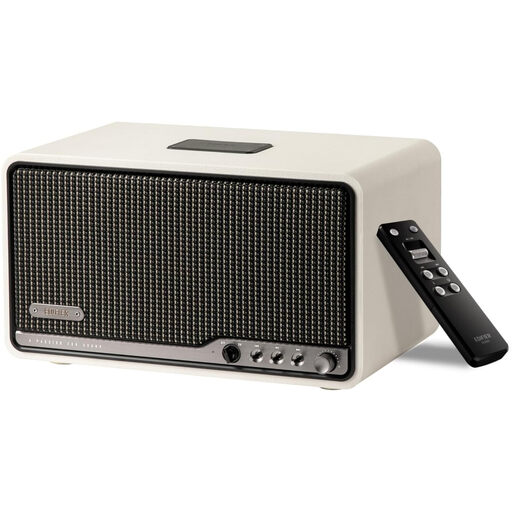
Consider this tabletop wireless format if you prefer fewer separate components. Check whether it suits the size and seating layout of your room; if you plan a separated stereo arrangement, confirm the quantity needed.
 No image available
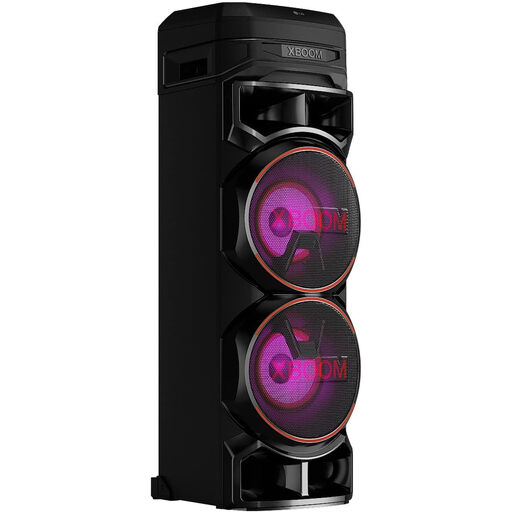
This single-speaker Bluetooth format may suit a simpler music setup. Check its fit in your living room and listen for vocal and acoustic-instrument clarity before relying on its party-speaker positioning; a two-speaker arrangement needs another compatible unit.
 No image available
Consider these for a conventional passive stereo setup if you have, or plan to choose, a compatible amplifier. The stated configuration includes a 6.5-inch mid-bass driver, 28 mm soft-dome tweeter, rear bass reflex, 8-ohm impedance and 10–120W power range. Check placement near the rear wall and whether this bookshelf format suits your large room.
Passive models do: KEF UK specifies a 15–250W amplifier requirement for the R7 Meta. Check the exact speaker’s connection type and amplifier guidance rather than assuming every floorstander has the same setup.
Yes, through Five’s 3.5 mm line input, provided the turntable’s output is suitable. Sonos Support says a turntable without a built-in phono preamp needs an external preamp; check the cable needed for your source output too.
Not as an absolute rule. KEF UK advises testing rear-wall placement because it can affect bass; its general placement guidance offers 300–1,000 mm as a starting range, subject to the speaker and room.