Creative small-bin organisers
If you want symbols, frames or varied text on small craft drawers and bins, a mobile-app workflow may suit you. Brother UK describes app-based label design for the PT-P300BT.


Choose an app-connected label maker if you want decorative layouts and are happy to design labels on a phone. Choose a standalone QWERTY model if you want to type and reprint bin labels directly at the workbench. Before choosing either, measure the flat space on your bins and check the compatible tape: wider labels are useful only where they fit and serve your labelling needs.
If you want symbols, frames or varied text on small craft drawers and bins, a mobile-app workflow may suit you. Brother UK describes app-based label design for the PT-P300BT.
If supplies move between bins and labels need frequent changes, direct typing and saved labels may matter more than decorative layouts. DYMO UK lists a QWERTY keyboard and memory for up to nine labels on its LabelManager 210D+ and 360D.
If larger bin fronts need more prominent category labels, compare tape widths before choosing a printer. Brother UK specifies a maximum of 24 mm for the PT-P710BT, while DYMO UK specifies 19 mm for the LabelManager 360D.
Start with where you will create and change labels, then measure a few representative bin fronts before settling on a tape width.
| Concern | What to check | Who this matters to |
|---|---|---|
| Direct relabelling | Look for a built-in keyboard and saved-label memory; check the power method if the printer will stay at the bench. | When supplies move between bins, I want to change a label without finding a phone. Around 42% of consumers put direct, repeat labelling first. |
| Creative layouts | Check device and app compatibility, how labels are edited, and the printer’s maximum tape width. | For small craft drawers, I want symbols or frames to distinguish contents at a glance. Roughly 33% of consumers prioritise phone-led label design. |
| Larger-bin labels | Measure the usable flat panel, then check supported tape widths and the exact cassette family. | If category names need more space on larger bins, I want tape that fits the front without crowding it. About 25% of consumers make wider-label suitability their primary concern. |
Tape-width limits differ by model: Brother UK lists up to 12 mm for the PT-P300BT and 24 mm for the PT-P710BT, while DYMO UK lists up to 12 mm for the LabelManager 210D+ and 19 mm for the 360D.
Measure the flat labelling area on a few bins, then check both the printer’s supported widths and its cassette family.
A cassette in the wrong width or family may be unusable with the printer you choose.
Brother UK lists six AAA batteries for the PT-P300BT and a rechargeable battery for the PT-P710BT. DYMO UK lists six AA batteries or an optional AC adapter for the LabelManager 210D+, while the 360D is rechargeable.
Choose a power arrangement that fits how often and where you will label bins, and check what comes with the exact retail bundle.
A replaceable-battery model needs replacement batteries; the 210D+ requires an optional adapter if you want to power it that way.
Manufacturer durability descriptions do not establish how a particular tape will adhere to your bin’s material or texture, especially if the surface is dusty or cleaned regularly.
Check the chosen tape’s material and adhesive guidance. Clean and dry a small area, then try one label on the actual bin before making a full set.
GOV.UK advises that batteries and electrical products should be taken to appropriate recycling collection points rather than put in household rubbish.
Use a suitable battery collection point for removable batteries and an electrical-waste collection route for the device.
Brother UK lists compact app-connected P-touch models alongside models that allow wider labels and computer connectivity.
DYMO UK’s LabelManager models are relevant if you prefer an integrated keyboard and D1 cassette labels for organising storage.
Epson LabelWorks provides a point of comparison for wireless and wider-format label-making workflows.
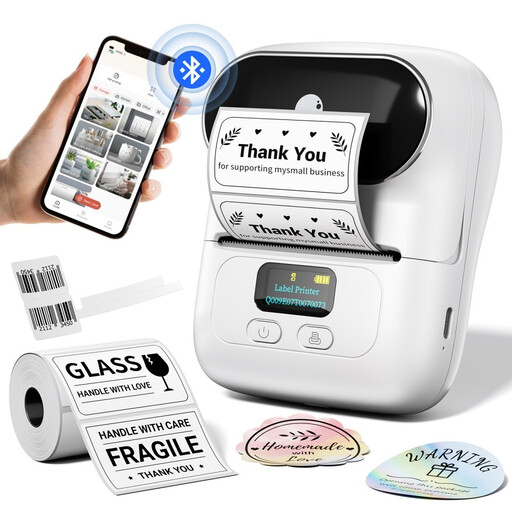
These label printers offer two ways to prepare craft-room bin labels: phone-led creation with the Phomemo M110, or computer-based editing at a fixed workbench with the Brother QL-600B. For either one, check that compatible label media fits your bins and adheres to their surfaces.
 No image available
Consider this for labels you want to create on a phone or tablet using the Bluetooth app workflow described in the listing.
Measure your bin fronts and check compatible roll widths and adhesive suitability before making a set of labels.
 No image available
Consider this for labels prepared at a fixed computer workbench, using the wired USB and P-touch Editor workflow described in the listing.
Check the compatible DK roll, its fit on your bin fronts and its suitability for the bin surface.
Not necessarily: choose the width by measuring a representative flat bin front and considering how much text the label needs. Brother UK specifies tape up to 24 mm for the PT-P710BT, while DYMO UK specifies up to 19 mm for the LabelManager 360D; a wider-capable printer is not automatically useful for a narrow drawer.
Choose phone-connected design if symbols, frames or varied layouts matter and you are comfortable using an app. For typing beside the bins without a phone, a standalone keyboard is more relevant: DYMO UK lists QWERTY keyboards and memory for up to nine labels on the LabelManager 210D+ and 360D.
Check the exact cassette or roll family, supported widths and label material for the printer you choose. DYMO UK identifies D1 labels for its LabelManager range, but supported widths vary by model; whichever system you choose, test a label on your bin surface before producing a full set.
Take the device and its removable batteries to appropriate electrical-waste and battery collection routes rather than putting them in household rubbish, as GOV.UK advises. Check your local collection arrangements for where to take each item.