Organic tea drinkers
If the oat drink is mainly for black tea, a stated tea use is more relevant than a claim about frothing coffee. Oatly names tea as a use for its Barista Organic drink.


For the tea at a cream tea, Oatly Barista Organic is a choice if you want an organic oat drink whose maker explicitly recommends it for tea. Choose an everyday organic oat drink if you prefer a simpler formula, but check the particular carton for tea-use guidance, gluten-free labelling and added nutrients where those matter to you. Neither type replaces the cream served with scones.
If the oat drink is mainly for black tea, a stated tea use is more relevant than a claim about frothing coffee. Oatly names tea as a use for its Barista Organic drink.
Oat drink goes in the tea. If the scones also need a dairy-free topping, choose that separately rather than expecting a barista drink to replace clotted cream.
Organic status, gluten-free labelling and added nutrients answer different questions. Check each one that matters on the particular carton rather than treating an organic claim as covering all three.
Start with what will go in the tea, then check the pack for any ingredient, labelling or serving requirements.
| Priority | What to check | Your needs |
|---|---|---|
| Use in tea | Look for an explicit tea-use statement. Coffee-frothing guidance alone does not tell you how a drink will taste or look in your chosen tea. | I want an oat drink for the cup of tea, not just a formula marketed for coffee. Oatly specifically names tea as a use for Barista Organic. |
| Organic label | Check that the particular product is labelled organic, rather than relying on plant-based wording or its place in a shop category. Defra says UK foods labelled organic must contain at least 95% organic agricultural ingredients. | Organic status matters to me, so I want to check the carton I am buying. |
| Role at the table | Choose an oat drink for tea and a separate topping if the scones also need a dairy-free alternative to clotted cream. | I am serving a dairy-free cream tea and need to account for both the drink and the topping. |
| Gluten and oats | Check for an explicit gluten-free label if required; organic does not mean gluten-free. Read the oat-allergen information separately. | Gluten-free labelling matters for my choice, or someone I am serving needs to avoid oats themselves. Minor Figures says its Barista Oat (Organic) may contain gluten. |
| Added nutrients | Read the individual nutrition panel for fortification. NHS guidance on vegan diets discusses fortified foods and nutrients including calcium, iodine, vitamin B12 and vitamin D. | If I use oat drink regularly instead of dairy, I want to know what the particular product contains, not assume its organic status answers that question. |
| Pack size | Check how many cartons are in the pack and the storage instructions on each one. | For an occasional cream tea, I would rather check whether a multipack suits how much I will use. |
An oat drink can go in tea, but it does not serve the same role as the cream on a scone.
If the whole cream tea must be dairy-free, choose a separate topping as well as the drink.
An organic label is not a substitute for reading the nutrition panel, particularly if oat drink regularly replaces dairy.
Check the particular product for fortification and consider it in the context of your wider diet; NHS vegan-diet guidance discusses fortified foods and relevant nutrients.
Organic and gluten-free are separate labels. Minor Figures states that its Barista Oat (Organic) may contain gluten, while oats themselves remain relevant to oat allergy.
If gluten avoidance is required, check for an explicit gluten-free label. If oats must be avoided, an oat drink is not the appropriate ingredient.
A product described chiefly for coffee may not suit the flavour or appearance you want in your particular tea.
Look for stated tea use, or try a single carton with the tea you plan to serve before choosing a multipack.
These brand examples concern particular organic oat drinks, not every product each brand makes.
Oatly offers Barista Organic alongside an everyday Organic Oat Drink.
Plenish positions its organic Barista Oat drink around frothing for coffee.
Minor Figures presents Barista Oat (Organic) as a coffee-oriented oat drink.
Rude Health’s Organic Oat Barista is presented for frothing and coffee use.
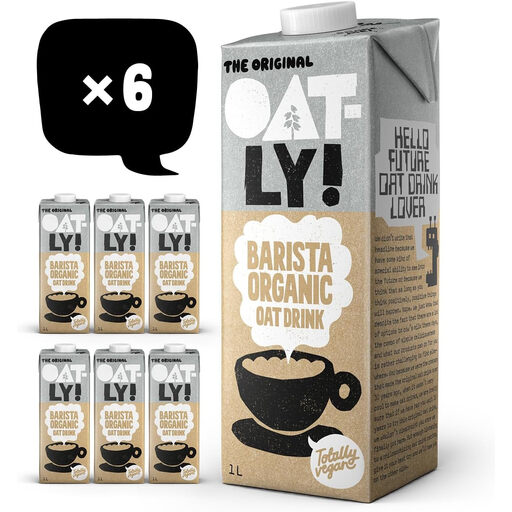
This six-carton organic barista oat drink is an option for adding to tea at a cream tea; a dairy-free topping for the scones is a separate choice.
 No image available
Oatly names tea as a use for its Barista Organic oat drink. This pack contains six 1L cartons; check whether that quantity suits an occasional cream tea. It is an oat drink, not a clotted-cream alternative. Check the individual carton if gluten-free labelling or added nutrients matter to you.
No. Use oat drink in the tea; if the scones also need a dairy-free topping, choose that separately. A barista oat drink should not be treated as a like-for-like replacement for clotted cream.
Oatly says its Barista Organic oat drink can be used in tea, coffee and hot chocolate. For another product, check its own use guidance rather than assuming a coffee-frothing claim applies to tea.
No. Check the nutrition panel of the particular drink for fortification. If you use oat drink regularly in place of dairy, NHS vegan-diet guidance discusses fortified foods and nutrients including calcium, iodine, vitamin B12 and vitamin D.
No. Look for an explicit gluten-free label if you require one; organic status does not establish it. The Food Standards Agency’s UK guidance sets a limit of no more than 20 mg/kg gluten for food labelled gluten-free. Oats themselves remain a separate consideration for anyone who must avoid them.
No. Defra’s UK organic-labelling guidance says foods labelled organic must contain at least 95% organic agricultural ingredients. Check the particular product’s label rather than assuming that every ingredient is organic.