Curry and soup cooks reducing fat
If coconut milk is a regular cooking ingredient, the main choice is between a concentrated block and a ready-to-use reduced-fat liquid. Check both total fat and saturates for the quantity going into the dish.


For curries made with less fat, start with a labelled reduced-fat cooking coconut milk rather than treating a creamed coconut block as an equivalent ingredient. Blue Dragon lists 68.0g fat per 100g of its block, while Tesco Groceries lists 8.8g per 100ml for Amoy Reduced Fat Coconut Milk and 8.9g per 100ml for Pride Light; those figures use different measurement units, so check how much of each ingredient your recipe actually uses. A measured piece of block can still suit a recipe that calls for its concentrated texture.
If coconut milk is a regular cooking ingredient, the main choice is between a concentrated block and a ready-to-use reduced-fat liquid. Check both total fat and saturates for the quantity going into the dish.
A block can thicken a sauce or be dissolved to make coconut milk. Adding water changes the concentration of the finished liquid, but it does not remove the fat contributed by the piece of block used.
Read the statement on the exact pack rather than assuming coconut products have the same ingredients. Ocado’s listing for KTC Creamed Coconut, for example, declares sulphur dioxide/sulphites.
Choose the cooking format your recipe needs, then read the nutrition information for the amount you expect to add.
| Priority | What to check | Your needs |
|---|---|---|
| Fat and saturates | Read both figures on the pack. Blocks may give values per 100g and canned liquids per 100ml; use the quantity added to your recipe rather than comparing those units as though they were identical. | I want coconut flavour in a curry while keeping track of the fat and saturates contributed by the portion I use. |
| Nutrition labels | Check the nutrition panel as well as any reduced-fat wording. Traffic-light labelling, where present, is another way to read the pack; check which nutrient each colour describes. | I use food labels to help choose ingredients. In the Food Standards Agency and Ipsos Northern Ireland’s 2024 survey, 49% of 611 people interviewed said they actively used traffic-light labelling when shopping for food; that figure describes general label use, not coconut-milk preferences. |
| Recipe format | Check whether the recipe calls for ready-to-use cooking milk, a piece of creamed coconut for thickening, or a block dissolved in water. Blue Dragon’s instructions use 100g of block with 400ml of boiling water to make coconut milk. | For a sauce that needs a concentrated coconut ingredient, I can measure a piece of block. For a recipe calling for cooking coconut milk, I want a liquid I can add directly. |
| Ingredients | Read the ingredient and allergen statements on the current pack, especially when choosing between brands or formats. Ocado’s KTC Creamed Coconut listing declares sulphur dioxide/sulphites. | When an ingredient or allergen matters to me, I need the details for the particular product I am buying, not an assumption about coconut milk as a category. |
| After opening | Check the pack’s refrigeration, container and use-by instructions before opening it. Plan how much the recipe needs and how you will use any remainder. | If I only need part of a can, I want to know how its remaining contents must be stored. |
Creamed coconut is concentrated. Blue Dragon lists 68.0g fat and 61.3g saturates per 100g of its block; Tesco Groceries lists 8.9g fat and 6.9g saturates per 100ml for Pride Light. The different units and formats matter when working out what goes into a recipe.
For a curry where reducing fat is the priority, consider a labelled reduced-fat cooking milk first. Choose a block when the recipe needs it, and measure the piece you add.
A reduced-fat description compares a product with a stated standard product; it does not give the saturated-fat content of your portion. The reviewed light and reduced-fat cans listed by Tesco Groceries and Ocado contain between 6.9g and 8.2g saturates per 100ml.
Read the saturates figure alongside total fat and decide how much coconut milk the dish will use.
Ingredients, allergen statements and directions after opening can differ between products. Ocado’s KTC creamed-coconut listing declares sulphites, so a category name alone is not enough for an ingredient check.
Check the exact pack before buying and follow its storage instructions once opened.
Buying more than the recipe needs may leave an opened product that must be used within its stated storage period.
These examples illustrate different cooking formats and label details; a brand name alone does not tell you the nutrition or ingredients of every product it makes.
Its 200g creamed-coconut block is a concentrated cooking ingredient that can be dissolved to make coconut milk.
Its creamed coconut is another block format for recipes that call for concentrated coconut.
Pride Light is a ready-to-use cooking coconut milk rather than a creamed block.
Amoy Reduced Fat Coconut Milk is a canned cooking liquid with a comparison to Amoy’s standard coconut milk.
M&S Reduced Fat Coconut Milk is a ready-to-use cooking option.
This reduced-fat canned coconut milk fits recipes calling for a cooking liquid. Use its current nutrition label to judge the amount that suits your dish.
 No image available
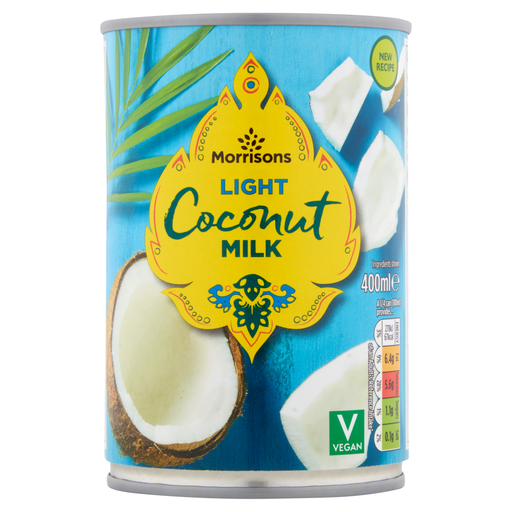
A canned cooking coconut milk to consider for curries or soups when you want a reduced-fat product. Check total fat, saturates and after-opening instructions on the current pack, then measure the amount your recipe uses.
A labelled reduced-fat cooking coconut milk is a more useful starting point if reducing fat is your main aim. Blue Dragon lists 68.0g fat per 100g of its creamed-coconut block, while Tesco Groceries lists 8.8g per 100ml for Amoy Reduced Fat Coconut Milk. Because a block and a liquid use different label units, judge them by the quantities your recipe calls for; measure any piece of block you add.
No. Water changes the concentration of the prepared liquid, not the fat contributed by the block. Sainsbury’s directions for Blue Dragon Creamed Coconut use 100g of block with 400ml of boiling water, so the amount of block used remains the relevant starting point for reading its nutrition information.
Check both values and note whether the panel gives them per 100g, per 100ml or per serving. Work from the amount going into your dish rather than treating values on different measurement bases as directly interchangeable. The NHS describes more than 5g saturates per 100g as high; check the unit on a liquid product’s label before applying that threshold.
No. Read the ingredient and allergen statements on the particular pack. For example, Ocado’s listing for KTC Creamed Coconut declares sulphur dioxide/sulphites; that statement should not be assumed to describe every coconut block.
Follow that product’s directions for transferring, covering and refrigerating any unused contents, and use them within the period stated on its pack. Check those instructions when planning a recipe that needs only part of a can.