Households with side seats
If viewers sit noticeably left or right of the screen, check how the chosen screen looks from those seats, not just from the centre. ProjectorCentral notes that ALR screens differ in their optimal viewing angles.


For cricket viewing from a side seat, choose a screen whose stated viewing angle covers the furthest seat before settling on a projector. A wide-viewing-angle matte-white screen is worth considering when you can control room light; in a brighter room, consider an ambient-light-rejecting (ALR) screen only if its usable viewing angle also covers those seats. Then check the projector’s brightness, throw distance and image-placement options against your room.
If viewers sit noticeably left or right of the screen, check how the chosen screen looks from those seats, not just from the centre. ProjectorCentral notes that ALR screens differ in their optimal viewing angles.
Window or room light makes screen choice and projector brightness part of the same decision. Check whether a screen intended for brighter rooms still has a usable viewing angle for everyone watching.
A restricted projector position makes throw distance, zoom and image alignment important. Placement features listed by Epson and ViewSonic can help fit an image to a room, but they do not change the screen’s viewing angle.
Settle the screen and seating positions first, then check how room light and the available projector position affect the models you can use. ProjectorCentral reports that ALR screens vary in viewing angle as well as their behaviour under ambient light.
Consider when: Side seats are important and you can control light falling on the screen.
Trade-off: It will not reject ambient light in the same way as an ALR screen; check the viewing angle of the specific material you intend to buy.
Consider when: Daytime room light is difficult to control and the screen’s published usable angle includes every intended seat.
Trade-off: ProjectorCentral found differences in optimal viewing angles among ALR screens, so a centre-seat picture cannot establish the view from an extreme side seat.
| Concern | What to check | Who this matters to |
|---|---|---|
| Side-seat picture | Compare the angle to the furthest seat with the exact screen’s stated viewing angle. | If I watch from the side, I want the picture to remain usable where I sit, not only in the centre. Around 33% of consumers would put side-seat picture consistency first. |
| Daytime visibility | Check where light hits the screen, the projector’s declared brightness measure and the screen’s viewing angle. | When a match is on during the day, I need a picture I can follow without assuming I can darken the room. For around 27% of consumers, visibility in ambient light is the primary concern. |
| Room fit | Measure the projector-to-screen distance and check throw range, optical zoom and lens shift for the intended image size. | With furniture limiting where I can put the projector, I need the image to fit the wall or screen from an available position. Room fit comes first for around 20% of consumers. |
| Match playback | Confirm compatibility with your match source and check whether the exact model offers the motion features you want. | If I rely on a particular streaming device or service, I want to know how I will watch the match and whether the picture presentation suits live action. Around 20% of consumers would prioritise playback and motion. |
A projector’s specifications cannot establish how bright or consistent the picture will look from a side seat. ProjectorCentral identifies viewing angle as one way screen materials differ.
Mark the furthest viewing position and compare it with the viewing-angle specification of the screen you plan to use before choosing projector placement and brightness.
Getting this order wrong could mean changing the seating arrangement or screen later.
More projector light cannot widen a screen’s usable viewing angle. Brightness figures also need comparable units and conditions: ViewSonic describes the X1-4K in LED lumens, which should not be treated as interchangeable with an ANSI-lumen figure.
Check the room light and the paired screen as well as the projector’s declared brightness, and compare brightness figures only on a supported, like-for-like basis.
Keystone and corner adjustment address projected-image geometry; they do not widen the screen material’s viewing angle for someone sitting to one side.
Measure the throw distance and intended image size. Check physical placement, optical zoom and lens shift where available, while assessing side-seat viewing separately.
BenQ says Sports Mode on the TK705i requires OS version V14.1.0.70 or later. A feature name alone does not establish whether it is ready to use on a particular unit.
Check the exact model’s software requirements and how you will connect or access your chosen match source.
These examples highlight features to compare for this setup, not a finding that any projector will produce a suitable picture from your particular side seat.
BenQ presents the TK705i as a home-entertainment projector with sports-oriented features.
Epson’s EH-TW7100 and EH-LS12000B are relevant when fixed-room projector placement needs adjustment.
The X1-4K is an example to examine when projector placement is constrained.
These projectors offer different stated setup and connection features for a cricket-viewing arrangement. Pair either one with a screen whose viewing angle reaches your side seats, and check its declared brightness against your room lighting.
 No image available
Consider this model if you need HDMI or USB connections for your match source and can check its fit with your screen and seating arrangement.
The product name states 900 ANSI lumens, 180° rotation and auto keystone correction. It describes 8K as supported, not as the projector’s native resolution.
Check how the stated brightness works with your room light and whether your chosen screen covers the furthest side seat.
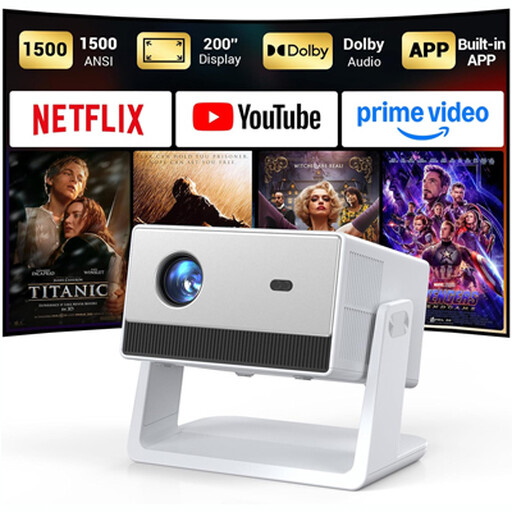 No image available
Consider this projector if you want to check a built-in-app setup for watching matches and need to assess where its supplied stand would fit.
The product name states Wi-Fi, Bluetooth and native 1080P resolution. Confirm the focus method before buying: the product title says auto focus, while its detailed description says manual focus.
Check the required throw distance, room-light conditions and your screen’s viewing angle before deciding whether it suits a side seat.
No. The screen’s viewing angle also matters: ProjectorCentral reports that ALR screens differ in their optimal viewing angles. Check the specific screen against your furthest seat before relying on projector brightness or image-placement features.
Consider an ALR screen if room light is difficult to control and its stated usable viewing angle includes every intended seat. ProjectorCentral found that ALR screens vary in optimal viewing angle, so assess the exact material rather than assuming it will suit an extreme side seat.
No. They can help position or align the projected image, but you still need to check the projector’s throw range, intended screen size and available distance. Neither feature changes the screen material’s viewing angle for side-seat viewers.