For a toddler’s usual snack, choose an option such as fruit, vegetable sticks, plain unsweetened yoghurt or toast rather than buying a crisp multipack for that purpose: the NHS lists crisps among salty foods to avoid giving babies and young children. If crisps are occasionally shared as a family food, the multipack changes the packaging, not that guidance; check the salt in the amount served, including any seasoning sachet, and stay with the child while they eat.
Who is this decision for?
Parents planning everyday toddler snacks
If you are deciding what to keep ready for regular snack times, start with the NHS examples for young children, such as fruit, vegetable sticks, plain unsweetened yoghurt and toast, rather than treating crisps as a routine choice.
Caregivers sharing an occasional family snack
If crisps will sometimes be served, compare the salt in the amount offered to the child. A small bag is a packaging unit, not a toddler serving recommendation; check separately for any seasoning sachet.
Families checking an England nursery or school policy
If the snack is for a setting rather than home, check that setting’s policy. England’s rules on qualifying retail promotions and its requirements for food provided in state-funded schools address different situations.
What should you check before buying?
Decide whether the purchase is for routine toddler snacks or occasional family sharing first. Then compare the exact packs and the amount you intend to serve.
| Priority | What to check | Your needs |
|---|
| Everyday snack |
The NHS lists crisps among salty foods to avoid giving babies and young children. Its snack examples for young children include fruit, vegetable sticks, plain unsweetened yoghurt, toast and unsalted rice cakes. |
For regular snack times, I want something other than a crisp packet to reach for. |
| Salt served |
Read grams of salt for the amount offered, not just the figure per bag or per 100g. The NHS says children aged 1 to 3 should have no more than 2g of salt a day in total. |
If crisps are shared occasionally, I need to account for that serving alongside the rest of the day’s food—not treat 2g as a crisp allowance. |
| Pack format |
Check the weight of each small bag or the stated servings in a sharing bag. Neither figure defines a toddler portion; a multipack does not change the food inside. |
Small bags may make storage convenient, but I want to decide what goes on the plate rather than hand over a whole packet by default. |
| Variant and seasoning |
Compare the exact flavour’s salt and fat declarations, ingredients and allergens. For example, Walkers lists salt separately for the sachet in Salt & Shake; a baked or lightly salted label addresses only particular product characteristics. |
I need to know what is actually being served, especially if a flavour has a separate seasoning sachet or an ingredient relevant to an allergy. |
| Eating supervision |
Healthier Together advises that toddlers sit still while eating and that an adult stays with them. Apply that advice to snacks generally, not only crisps. |
Even for an occasional family snack, I want the child seated and an adult present. |
| Food-setting rules |
Check the setting’s current food policy and which UK nation applies. Department of Health and Social Care guidance on qualifying HFSS retail promotions applies to businesses selling to England; Department for Education guidance addresses food provided in state-funded schools in England. |
For a nursery snack or school lunchbox, I need the relevant setting’s requirements rather than an assumption based on a shop promotion rule. |
Common buying mistakes
-
Taking small bags as a toddler-snack endorsement
A multipack changes how crisps are divided and stored. It does not change the NHS advice to avoid giving babies and young children salty foods such as crisps.
Choose from the NHS snack examples for regular use; consider a crisp multipack only for occasional family sharing.
-
Reading a lower-fat claim as a salt claim
Walkers says its Oven Baked Sea Salt crisps have 50% less fat than regular potato crisps, but its declaration still lists 0.19g salt per 22g pack. The fat comparison does not establish toddler suitability.
Check salt and fat on the exact flavour and pack rather than relying on one front-of-pack comparison.
-
Overlooking a separate seasoning sachet
Walkers lists 0.00g salt for its Salt & Shake base crisps and 0.60g salt in the separate sachet. What is added changes the salt served.
Check how the pack declares seasoning and compare the amount actually used.
-
Applying a retail rule to every nursery or lunchbox
England’s restrictions on promotions of qualifying HFSS products are distinct from requirements for food provided in state-funded schools. Those sources do not establish one rule for every nursery or parent-provided lunchbox across the UK.
Identify the nation and ask the nursery or school about its current food policy for the relevant type of snack.
Brand examples to compare
These product-level examples show why a flavour name or brand range cannot stand in for the nutrition declaration on the pack you buy.
Walkers
Its Oven Baked and Salt & Shake products illustrate two different label checks: a lower-fat comparison and a separate salt sachet.
- Walkers declares 2.8g fat and 0.19g salt per 22g pack of Oven Baked Sea Salt.
- The Walkers Salt & Shake declaration lists 0.60g salt in its sachet; check whether it will be used.
Tyrrells
Its Naked and Sea Salted Furrows sharing bags provide a comparison of declared salt for two specific variants.
- Tyrrells lists 0.02g salt per 30g serving of Naked and 0.22g per 30g serving of Sea Salted Furrows.
- Naked also lists 8.9g fat per 30g serving. The stated five servings in its 150g bag are not toddler portion guidance.
KETTLE Chips
Lightly Salted is a flavour description to check against the declared figures, not a conclusion about toddler snacks.
- KETTLE lists 0.7g salt per 100g of its Lightly Salted product.
- The same manufacturer declaration lists 29.5g fat per 100g; compare the amount you plan to serve.
McCoy's
McCoy's Salted provides an example of why both nutrition and allergen wording need checking on a specific flavour.
- McCoy's declares 1.3g salt and 32g fat per 100g of its Salted flavour.
- The manufacturer says this product may contain milk, so use the current pack label when checking allergens.
Joybuy crisp multipacks for occasional sharing
These Walkers multipacks are options to compare if adults are buying crisps for occasional family sharing, not recommendations for a toddler’s regular snack. Check the nutrition and ingredients on each current flavour packet before deciding what, if anything, to serve.
 No image available
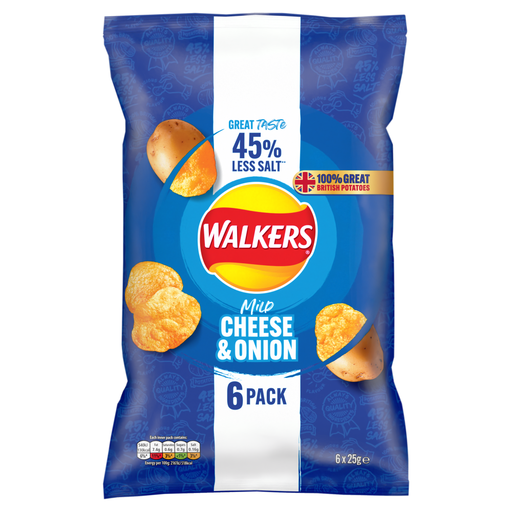
Walkers 45% Less Salt Mild Cheese & Onion, 6 x 25g
For occasional family sharing, the six separate 25g bags let you choose how much to serve without treating one bag as a toddler portion. The product name makes a 45% less salt claim; compare the exact packet’s salt declaration, ingredients and allergens rather than taking that comparison as a toddler-suitability claim.
View on Joybuy
 No image available
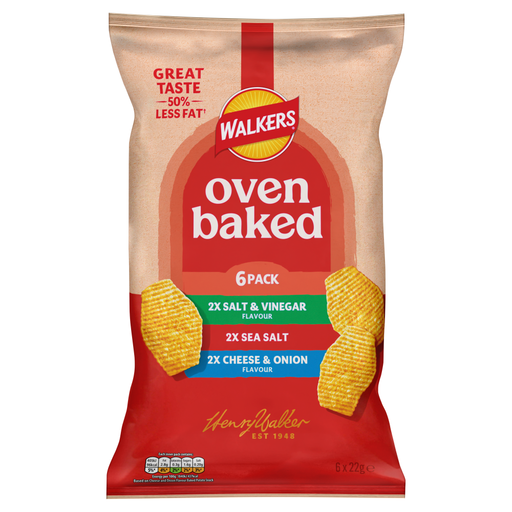
Walkers Oven Baked Variety Pack Crisps, 6 x 22g
This variety pack contains six 22g bags for occasional family sharing. Check the salt, fat, ingredients and allergens on each flavour’s packet: figures stated for Walkers Oven Baked Sea Salt should not be assumed to apply to every flavour in this variety pack.
View on Joybuy
Questions about crisps and toddler snacks
Should crisps be a toddler’s everyday snack?
Choose something else for routine snack times. The NHS lists crisps among salty foods to avoid giving babies and young children and suggests options for young children including fruit, vegetable sticks, plain unsweetened yoghurt, toast and unsalted rice cakes.
What matters on the label if crisps are served occasionally?
Start with the salt in the amount actually served, including any separate seasoning. The NHS says children aged 1 to 3 should have no more than 2g of salt a day in total; that is not an amount set aside for crisps. Check the exact flavour’s other nutrition figures, ingredients and allergens too.
Does a baked or no-salt multipack become suitable for regular toddler snacks?
No single pack claim establishes that. Walkers’ lower-fat comparison for Oven Baked Sea Salt is about fat relative to regular potato crisps; Tyrrells declares 0.02g salt but 8.9g fat per 30g serving of Naked. Compare the exact product figures without treating either claim as a replacement for the NHS’s routine snack examples.
How should I supervise an occasional snack?
Stay with the toddler and encourage them to sit still while eating. Healthier Together gives this advice for food generally; it does not single out crisps as the only food needing supervision.
Do England’s HFSS promotion rules decide whether crisps can go to nursery or school?
No. Department of Health and Social Care guidance concerns promotions of qualifying high-fat, salt or sugar products by businesses selling to England. Department for Education guidance separately addresses food provided in state-funded schools in England. Check the relevant nation, whether the food is provided by the setting or brought from home, and the nursery or school’s current policy.


