Savoury sandwich hosts
If guests will add their own fillings, compare croissant rolls with whole croissants you could split. St Pierre UK describes its rolls as a sandwich format; neither format promises thick-cut slices.


For savoury toppings, a pre-sliced croissant-style loaf gives you slices; for individual filled portions, croissant rolls provide a sandwich format. Choose ordinary croissants if you want whole pastries to serve alongside the meal or split for fillings. St Pierre UK describes its loaf as pre-sliced, but does not specify a thick-cut measurement, so check the exact product if slice thickness matters.
If guests will add their own fillings, compare croissant rolls with whole croissants you could split. St Pierre UK describes its rolls as a sandwich format; neither format promises thick-cut slices.
If you want separate slices for savoury toppings, consider a croissant-style loaf. St Pierre UK describes its loaf as pre-sliced, without specifying that the slices are thick cut.
Check the exact pastry and every filling against your guest’s requirements. Ingredients vary between products, and the M&S in-store bakery croissant listing warns that traces of allergens used in its preparation area cannot be ruled out.
Choose it for: separate slices to top or toast; St Pierre UK describes its loaf as pre-sliced and suitable for savoury toppings.
Bear in mind: it is a loaf rather than individual croissants, and its stated format does not establish a thick-cut measurement.
Choose them for: individual filled portions; St Pierre UK describes its rolls as suitable for sandwiches.
Bear in mind: a roll gives you a sandwich base, not ready-cut slices.
Choose them for: individual pastries to serve alongside dinner or split for a simple filling.
Bear in mind: preparation and allergens depend on the exact product, and a whole croissant is not a thick-cut slice.
| Priority | What to check | Your needs |
|---|---|---|
| Serving format | Check whether the pack contains a sliced loaf, rolls or whole pastries. If thickness matters, look for a stated slice measurement rather than relying on “pre-sliced”. | I want a base that suits toppings, individual sandwiches or pastries served on the side. |
| Preparation | Read the exact pack’s heating and storage directions. Sainsbury’s lists its All Butter Croissants x4 as ready to eat; M&S says its frozen Ready to Bake Croissants are raw and must be baked. | If guests are arriving soon, I need to know whether the pastries can be served as purchased or require oven time. |
| Allergens | Check the pastry and every filling. The M&S in-store bakery croissant listing warns that traces of allergens used in its preparation area cannot be ruled out. | For a guest with an allergy, I need information about the complete assembled dish, not just the pastry. |
| Portions | Check the number of rolls or croissants against the portions you plan to serve. St Pierre UK states its loaf information per approximately 36 g slice; a slice is not equivalent to a whole croissant. | I’m planning individual servings and need to distinguish a two-pack of rolls, a four-pack of croissants and a sliced loaf. |
St Pierre UK describes its Croissant Loaf as pre-sliced but gives no thick-cut measurement.
Choose the loaf for its slice-and-top format; if a particular thickness is essential, check the product’s slice specification before buying.
Sainsbury’s lists its All Butter Croissants x4 as ready to eat, while M&S says its frozen Ready to Bake Croissants are raw and must be baked.
Read the chosen pack’s preparation and storage directions when planning your serving time.
A raw frozen product also needs freezer space and time for baking.
An assembled serving contains more than the croissant. The M&S in-store bakery croissant listing also warns about possible allergen traces in its preparation area.
Check the specific seller’s allergen information and every filling before serving a guest with an allergy.
These examples describe particular listed formats, not every croissant made by each brand.
St Pierre UK lists a croissant-style loaf, croissant rolls and whole croissants for different serving formats.
Tesco Groceries lists a four-pack of Tesco Finest All Butter Croissants alongside other croissant formats in its category.
Sainsbury’s lists standard and Taste the Difference ready-to-eat croissant four-packs.
M&S lists an in-store bakery croissant, frozen ready-to-bake croissants and a separate Made Without Wheat product.
ASDA Groceries lists ready-to-eat four-packs under The Bakery and Exceptional ranges.
Waitrose & Partners lists ordinary croissants in several pack formats in its bakery category.
Lidl GB lists an in-store all-butter croissant as an individual pastry.
This whole-croissant option suits individual pastries or portions you plan to split for savoury fillings, rather than ready-cut loaf slices.
 No image available
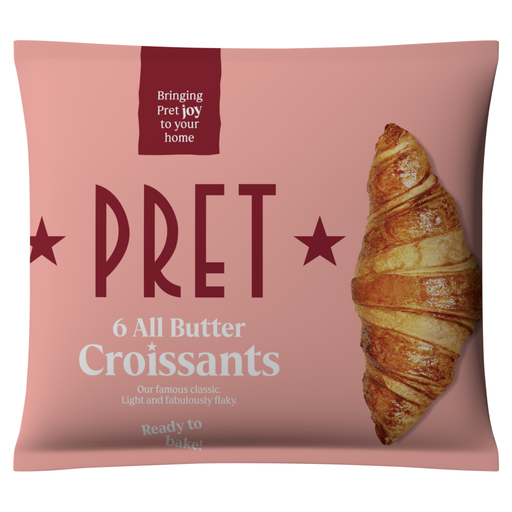
Whole croissants offer individual pastries that you could split for savoury fillings instead of using ready-cut slices. The pack is labelled 330g; check its preparation, storage and allergen instructions before planning the meal.
Not from its pre-sliced description alone. St Pierre UK gives information per approximately 36 g slice for its Croissant Loaf but does not state a thick-cut measurement; check the exact slice specification if thickness is decisive.
It depends on the product. Sainsbury’s lists its All Butter Croissants x4 as ready to eat, with optional heating, while M&S says its frozen Ready to Bake Croissants are raw and must be baked.
Follow the fillings’ storage instructions and keep ingredients that normally require refrigeration cold until serving. Food Standards Scotland’s event guidance says foods normally kept in the fridge also need to be kept cool; an unfilled pastry’s storage directions do not cover the assembled dish.
Check the allergen information for the exact pastry and every filling, including any bakery cross-contact notice. The M&S in-store bakery croissant listing warns that traces of allergens used in its preparation area cannot be ruled out.
No. Food Standards Scotland explains that use-by dates concern safety and food should not be eaten after that date, while best-before dates concern quality. Check the dates and storage instructions for each component of the meal.