Who each format suits

Hosts needing sliceable topping bases

For a shared world food night with sweet or savoury toppings, a sliced croissant loaf provides toastable pieces that are easier to portion for a serving board. Sainsbury’s and Asda describe the St Pierre loaf as sliced and toastable.

Hosts serving individual filled pastries

If each guest will receive a separate filled pastry, croissant rolls are designed to be split and filled. Tesco Groceries describes St Pierre All Butter Croissant Rolls as suitable for this use.

Warm-pastry planners with freezer space

Ready-to-bake croissants suit hosts who can store pastries frozen and bake them shortly before serving, when warm individual pastries matter more than ready-cut slices.

Buying priorities

Start with the serving style, then check portions, allergens and the preparation needed before your guests arrive.

Priority What to check Your needs
Serving format Look for wording such as “sliced croissant loaf” when toppings need a flat, portioned base. Choose rolls when each portion will be split and filled; standard crescent croissants are intended to be served whole. I want pieces that hold toppings without relying on a fragile crescent shape. A sliced loaf suits a sharing board, while filled rolls suit separate servings.
Portion planning Compare the stated number of servings or pastries with the number of guests. Sainsbury’s and Asda state that the 380 g St Pierre Croissant Loaf has around 10 servings, with each slice approximately 38 g. I need enough usable portions for the table without opening more packs than the menu requires. Rolls can suit a small batch, while a loaf gives a countable base for several toppings.
Allergen information Read the current pack before serving, including may-contain statements and any suitability warnings. Keep toppings with allergens separate from other food. I need product-specific information for guests with allergies or intolerances, especially where pastries are served alongside several fillings.
Preparation Choose ambient slices for quick serving or light toasting. Check oven time and freezer requirements for ready-to-bake products, and follow the instructions on the pack. I may need food ready straight away, briefly warmed, or baked fresh from frozen. The format should fit the kitchen time available before serving.

Pitfalls to avoid

  • Assuming every croissant can become a sturdy topping portion

    Conventional crescent croissants are individual pastries, so cutting them for a topping board can create uneven, fragile pieces.

    Choose a product explicitly described as a sliced croissant loaf, or choose croissant rolls when portions will be split and filled. Do not assume “thick cut” unless the pack states it.

  • Using online allergen information as the final check

    Croissants commonly contain wheat, milk and egg, and some products carry additional may-contain warnings. Ingredients and allergen information can change.

    Read the physical pack immediately before serving and keep allergen-containing toppings separate. For loose bakery items, ask the retailer for current allergen information.

  • Buying frozen croissants without planning freezer and oven use

    A ready-to-bake product cannot be served as purchased and may be unsuitable if it thaws before preparation.

    Choose frozen ready-to-bake croissants only when you can maintain the required storage temperature, bake them safely and serve them after cooking. Otherwise, consider sliced or bakery croissant options.

Relevant brand references

St Pierre

St Pierre is the relevant reference when the menu needs a croissant-style product that can be sliced, toasted or filled.

  • Sainsbury’s and Asda list its 380 g Croissant Loaf as a sliced, toastable loaf with around 10 servings.
  • The listings do not give a slice-thickness measurement. The loaf contains wheat and milk and may contain hazelnuts, mustard and soya.

Tesco Finest

Tesco Finest is a reference for conventional all-butter croissants served as individual pastries rather than prepared slices.

  • Tesco Groceries describes the four-pack as layered dough with butter churned in France and light, flaky layers.
  • It is not presented as a sliced or fillable format, and it contains wheat, milk and egg.

M&S

M&S is a reference for hosts who want individual all-butter croissants baked fresh from frozen.

  • M&S describes its eight-pack as raw, frozen all-butter croissants made in France for baking before serving.
  • They require freezer storage and baking, must not be refrozen after thawing, and carry allergy warnings for nuts, peanuts, sesame and soya.

Lidl

Lidl is a reference for a standard in-store all-butter croissant rather than a sliceable loaf format.

  • Lidl lists an All Butter Croissant as an in-store product for shoppers seeking an individual pastry.
  • The listing includes milk, wheat and egg, alongside possible traces of further allergens, so check the current label for guest requirements.

Asda

Asda is a grocery retailer reference for the sliced St Pierre Croissant Loaf format.

  • Asda identifies the product as a sliced croissant loaf with around 10 servings in a 380 g pack.
  • The product contains milk and wheat and may contain mustard, soya and hazelnuts; check the pack at purchase.

Joybuy product options

Joybuy product option for hosts choosing the oven-fresh, individual-croissant route rather than a sliced topping base.
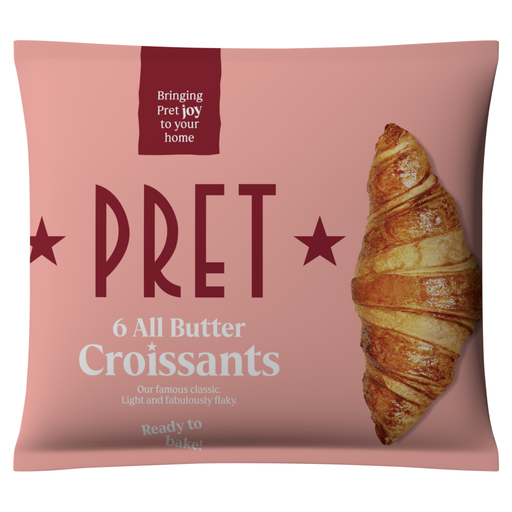
Pret A Manger Butter Croissants 330g

Pret A Manger Butter Croissants 330g

For a world food night centred on warm individual pastries, provided you have freezer space and time for oven preparation.

Frozen croissants intended to bake from frozen in about 20 minutes. Check the physical pack for allergens and serving information; do not refreeze after thawing.

Joybuy

Frequently asked questions

Are ordinary croissants a good substitute when I need thick, toastable slices?

Not usually. Standard croissants are individual pastries, while Sainsbury’s describes St Pierre Croissant Loaf as a sliced croissant loaf with toastable slices. Choose a loaf when the menu depends on slices, and inspect the pack in store if a particular thickness is essential.

How many portions does a St Pierre Croissant Loaf provide?

Sainsbury’s and Asda state that the 380 g loaf contains around 10 servings, with each slice approximately 38 g. The number you need still depends on whether guests will have one topped slice or several.

Can I warm croissant loaf slices before serving?

Yes. For the St Pierre loaf, Sainsbury’s advises removing the packaging and toasting or grilling on a low setting for 1–2 minutes, or until golden brown. Follow the current pack instructions if they differ.

What should I check for guests with food allergies?

Check the current package rather than relying only on a website. The St Pierre loaf lists wheat and milk and may contain hazelnuts, mustard and soya, while Tesco Finest all-butter croissants list wheat, milk and egg. GOV.UK guidance states that food businesses must provide allergen information for prepacked and non-prepacked food and drink.

Are ready-to-bake croissants suitable for last-minute serving?

Only when you have enough oven time and can follow frozen-storage instructions. M&S describes its ready-to-bake croissants as raw, requiring baking from frozen, storage at -18°C and no refreezing after thawing.