Parents looking for a substantial individual pastry
Useful when “thick cut” means a larger whole croissant rather than a sliced product. Compare a stated individual weight, such as M&S’s 75 g All Butter Croissant, and check the label before serving.


Choose a clearly labelled larger croissant when “thick cut” means a more substantial whole pastry: M&S lists its All Butter Croissant at 75 g. For several children or repeat tea times, compare the individual portion, allergens and storage instructions before choosing a multipack.
Useful when “thick cut” means a larger whole croissant rather than a sliced product. Compare a stated individual weight, such as M&S’s 75 g All Butter Croissant, and check the label before serving.
For comparing multipacks by individual portion information and freezing suitability rather than assuming that a larger pack contains larger pastries. Waitrose lists 180 kcal per croissant in its eight-pack, while Sainsbury’s lists 280 kcal per croissant in its four-pack.
For households that need to check the exact product label and the setting’s allergy arrangements before packing. In England, Department for Education guidance says schools must publish an allergy safety policy.
Start with the size of one croissant, then check the current label, per-croissant nutrition and storage instructions for the pack you are considering.
| Priority | What to check | Your needs |
|---|---|---|
| Individual portion size | Look for a stated whole-croissant weight. Where a pack weight and serving count are both given, calculate the weight per croissant. Use per-croissant energy only as a portion comparison, not as a thickness measure. | I want one pastry that feels substantial at tea time. M&S lists one All Butter Croissant at 75 g, while Sainsbury’s 228 g four-pack works out at about 57 g per croissant. |
| Allergens and school packing | Read the current ingredient and allergen label, including precautionary statements. Check for wheat/gluten, milk, egg and any nut warning. Follow the school’s own allergy arrangements when packing food in England. | I need to know whether the exact croissant suits the child and the setting. Plain all-butter croissants can still contain wheat/gluten, milk and egg, and some products carry nut-related warnings. |
| Nutrition per croissant | Compare the values for one croissant rather than only per 100 g. Check energy, saturated fat and sugars for the serving you plan to give. | I want to judge the actual tea-time portion. Waitrose lists 180 kcal and 7.1 g saturated fat per croissant, while Sainsbury’s lists 280 kcal and 10.0 g saturated fat per croissant. |
| Pack use and storage | Compare pack count with the number of servings needed. Check freezing instructions and use-by or best-before guidance. Treat promotional pricing separately from portion size and nutrition. | I want a pack that will be used across several tea times without relying on the pack count alone as a guide to portion size. Waitrose and Sainsbury’s both provide freezing guidance for their listed packs. |
Retailer listings use whole-item weight and pack count rather than a consistent thickness standard, so the phrase alone may lead to a smaller pastry than expected.
For a fuller individual croissant, use the stated whole-item weight where available. Calculate a per-item weight only when both the pack weight and serving count are supplied.
These croissants contain wheat/gluten, milk and egg, while some also have nut or other cross-contact warnings.
Read the current physical label for every purchase, including precautionary statements. For school packing in England, follow the school’s published allergy policy and any individual healthcare plan that applies.
Packs do not necessarily contain comparable portions, and a conditional offer does not show whether the individual croissants are alike in size or nutrition.
Compare the standard and conditional offer terms, item count, stated individual size or nutrition, and whether unused croissants can be frozen.
Verified servings differ: Waitrose lists 180 kcal and 7.1 g saturated fat per croissant, while Sainsbury’s lists 280 kcal and 10.0 g saturated fat per croissant.
Use the per-croissant panel to assess the serving you plan to give, rather than comparing only values per 100 g or the number of pastries in a pack.
An in-store bakery option with a clearly stated larger all-butter croissant: M&S lists one croissant at 75 g.
A four-pack all-butter option with a stated 228 g pack size, per-croissant nutrition and freezing instructions.
An eight-pack all-butter option for sharing or planned repeat servings, with per-croissant nutrition and freezing suitability listed.
A four-pack option within Tesco’s listed croissant range.
A fresh single all-butter croissant sold in participating Lidl stores rather than a listed multipack.
Joybuy product options for home tea times where frozen croissants can be baked and cooled before serving.
 No image available
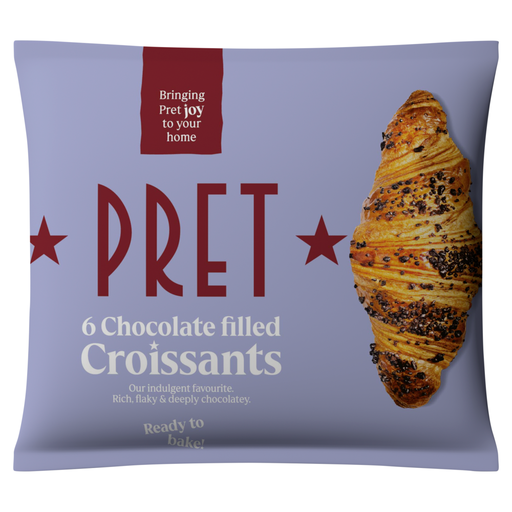
A frozen option for planned home tea times when there is time to bake the croissants before serving.
Six croissants in a 420 g pack work out at about 70 g each. The listing states 276 kcal, 9 g saturated fat and 10 g sugars per croissant.
Contains wheat/gluten, milk, egg and soya, and is stated to be unsuitable for nut and sesame allergy sufferers. Bake from frozen for 22 minutes and allow the pastries to cool before serving.
 No image available
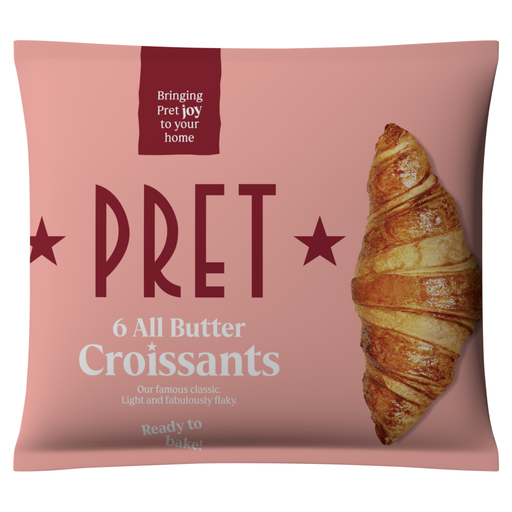
An all-butter frozen option for home tea times when freshly baked croissants are wanted.
The listing says to bake from frozen for 20 minutes. Check the pack for the croissant count and individual portion information before treating it as a larger-portion option.
Contains wheat/gluten, milk and egg and may contain nuts, sesame and soya. Check the current label and any school allergy policy before packing.
No. Retailer listings describe whole croissants by individual weight, pack weight, servings or nutrition rather than a standard thickness. Compare the stated individual weight where available, or divide pack weight by servings only when both are supplied.
Only after checking the child’s needs, the current food label and the school’s published allergy arrangements. Department for Education guidance says schools must publish an allergy safety policy; these croissants contain wheat/gluten and commonly milk and egg, while some have nut-related warnings.
Follow the instructions for the exact product rather than assuming warming is required. Waitrose gives an oven-heating instruction for its pack, while Sainsbury’s says its croissants are ready to eat but can be served warm; allow any warmed pastry to cool before serving.
Check the chosen pack. Waitrose marks its eight-pack suitable for freezing, while Sainsbury’s says to freeze its croissants as soon as possible after purchase and within the best-before date, then use them on the same day after defrosting.