For several half-term snack occasions, ready-to-eat croissant multipacks avoid baking, while frozen pastries require freezer space and oven time; check the pack quantity, ingredients and portion information before choosing. If a white-and-wholemeal flour blend is the deciding feature, Hovis lists it for Best of Both sliced bread, so check a croissant’s own ingredients rather than assuming it has the same blend.
Who is choosing?
Families sharing snacks through half-term
Match the number of pastries to the people and occasions you have in mind. Sainsbury’s and Asda list ready-to-eat packs in different quantities, with storage instructions that matter when a pack will be used over several days.
Shoppers checking ingredients or allergens
Check the exact product label, particularly when comparing standard wheat-flour pastries with M&S Made Without Wheat croissants or nut-filled products. For loose bakery items, ask the seller for allergen information.
Shoppers seeking a white-and-wholemeal blend
Hovis declares both white wheat and wholemeal wheat flour in its Best of Both sliced bread. A croissant is a different product: read its own flour ingredients if that blend matters to you.
What should you check?
Start with the snack you intend to serve, then compare preparation, pack size and the label of the specific product.
| Priority |
What to check |
Your needs |
| Portions and storage |
Count the pastries you will use. Compare opened-pack storage and freezing directions: Sainsbury’s lists an eight-pack, while Asda lists four- and ten-packs. |
I’m serving several people, but I want a pack I can use and store as directed. |
| Preparation |
Check whether the pastry is ready to eat or needs baking, and allow for the stated equipment and time. M&S says its frozen almond-and-hazelnut croissants cook from frozen in 30 minutes. |
For an unplanned snack, I’d choose something ready to serve; baking suits an occasion I can prepare for. |
| Portion information |
Read both per-pastry and per-100 g nutrition information when comparing different sizes. Tesco lists 253 kcal and 8.4 g saturates per Finest croissant; Asda lists 161 kcal and 3.7 g per croissant in its four-pack. |
I want to compare the portion I would actually serve, not assume two differently sized pastries supply the same amounts. |
| Ingredients and allergens |
Read the exact ingredients and precautionary statements. M&S describes its Made Without Wheat croissants as gluten-free, but their ingredients include milk and egg. |
Someone eating the pastry has an ingredient requirement, so a range name or the pastry’s appearance is not enough. |
| Flour blend |
Check for declared white and wholemeal flours. Hovis lists 32% wheat flour and 32% wholemeal wheat flour in Best of Both Medium Sliced bread; that bread label does not describe a croissant. |
If that particular blend matters most, I’m willing to choose sliced bread instead of assuming a croissant contains it. |
What is easy to overlook?
-
Assuming “Best of Both” describes a croissant
Hovis uses the name for a sliced bread with white and wholemeal wheat flours. A standard croissant does not acquire that ingredient profile through a similar description.
If the blend is essential, check the croissant’s flour ingredients or consider the labelled bread as a different snack choice.
-
Comparing nutrition per pastry without checking size
Tesco Finest and Asda give different per-croissant figures, but a per-pastry comparison also reflects the portion being measured.
Read the per-100 g and per-pastry figures together, then decide which portion fits the occasion.
-
Assuming a larger pack or frozen pastry is more convenient
An opened multipack has storage directions to follow; a frozen pastry needs freezer space and preparation before serving.
Plan how many pastries you will use and check the exact pack’s storage and cooking instructions.
Relevant brand references
M&S
Its croissant range includes products for different preparation and ingredient requirements; check each product separately.
- M&S describes its Made Without Wheat all-butter croissants as gluten-free; the ingredients still include milk and egg.
- Its frozen almond-and-hazelnut croissants require cooking and are not suitable for shoppers with a nut allergy, according to M&S.
Tesco Finest
Tesco lists a four-pack of all-butter croissants.
- The Tesco label gives 253 kcal and 8.4 g saturates per croissant and includes freezing and warming directions.
- Compare its per-pastry figures with portion size as well as with other products’ per-100 g labels.
Sainsbury’s
Sainsbury’s lists ready-to-eat croissants in different pack sizes.
- Its eight-pack lists 167 kcal per croissant and gives freezing instructions.
- The separate Taste the Difference four-pack lists 280 kcal per croissant; its figures should not be applied to the eight-pack.
Waitrose
Waitrose lists a four-pack of butter croissants with product-specific nutrition and warming information.
- The Waitrose product page lists 180 kcal per croissant.
- It carries a possible-nuts warning. Waitrose advises checking the physical label because recipes can change.
Asda
Asda lists ready-to-eat all-butter croissants in four- and ten-packs.
- Asda lists 161 kcal per croissant for each of these two products and says opened packs should be kept airtight and consumed within two days.
- Check the delivered label for current product details; pack count alone does not tell you how long an opened pack will keep.
Lidl
Lidl lists an in-store all-butter bakery croissant rather than a packaged multipack in this comparison.
- Lidl identifies milk, wheat and egg as allergens for this croissant.
- Check the product information and availability at the store you intend to use.
Joybuy bake-at-home croissants
These Joybuy options are frozen bake-at-home croissants for snack occasions you can plan ahead; they are not ready-to-eat multipacks or examples of a declared white-and-wholemeal flour blend.
 No image available
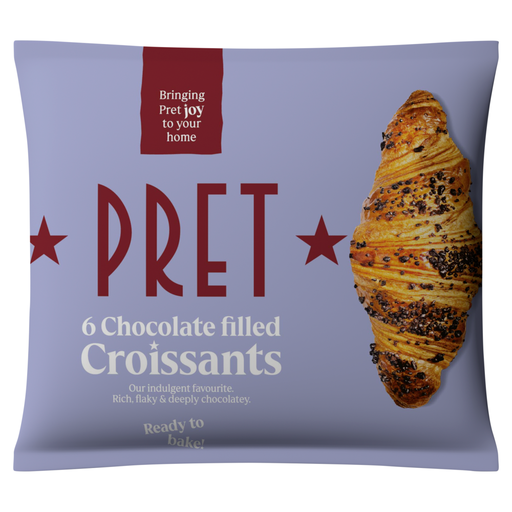
Pret A Manger 6 Chocolate Filled Croissants 420G
The six-pack offers individual chocolate-filled pastries for a planned snack occasion.
They require 22 minutes of oven cooking from frozen rather than being served straight from the pack. Check the product label for wheat, milk, egg and soya ingredients and its nut and sesame warnings before serving.
View on Joybuy
 No image available
Pret A Manger Butter Croissants 330g
These plain butter croissants suit a snack occasion with time to bake before serving.
Allow 20–22 minutes of oven cooking from frozen. Check the pack for wheat, milk and egg ingredients and precautionary allergen statements.
View on Joybuy
 No image available
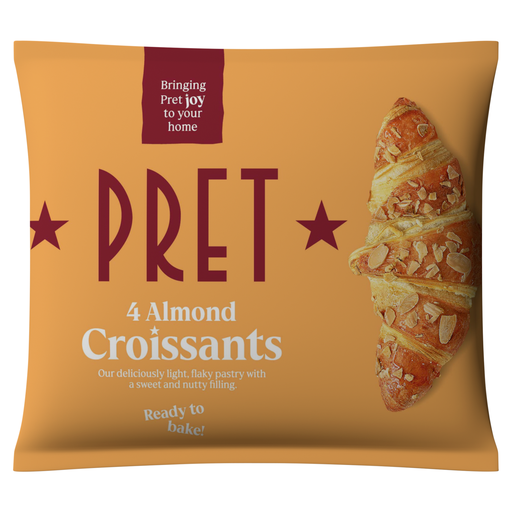
Pret A Manger Almond Croissants 280g
The almond variant is an option when that flavour suits the people sharing the snack.
It requires oven cooking from frozen and contains almonds, so it is unsuitable for anyone with a nut allergy. Check the full pack label for other ingredients and allergens.
View on Joybuy
Common questions
Can I serve the croissants without an oven?
Some can be served without baking: the documented Asda and Sainsbury’s multipacks are ready to eat. Frozen bake-at-home products, including M&S’s almond-and-hazelnut croissants, need cooking according to their pack instructions.
How should I store croissants bought ahead of half-term?
Follow the directions on the particular pack. Asda says its four-pack should be kept in an airtight container once opened and consumed within two days; do not apply that timing to other croissants without checking their labels.
Does “Best of Both” mean a croissant contains wholemeal flour?
No. Hovis uses the name for sliced bread whose ingredients include white wheat and wholemeal wheat flours. Check a croissant’s own ingredient list if its flour composition matters to you.
What should I check when someone has a food allergy?
Check the exact product’s ingredients and precautionary statements before serving it. GOV.UK says prepacked foods must clearly label any of the 14 regulated allergens they contain in the ingredients list, and food businesses must provide allergen information for loose food. If that information does not resolve the person’s specific risk, do not assume the pastry is suitable.


