What to check before buying
Ready-to-eat supermarket multipacks
Choose when: You want croissants straight from the pack for several snack occasions without planning oven time.
Consider: Similar-looking packs may have different fillings, ingredients and allergen information, so compare the individual label rather than the product name alone.
Bakery-counter single croissants
Choose when: One or two pastries are enough and a multipack is likely to leave leftovers.
Consider: Loose bakery products may have less immediately visible precautionary-allergen information, and availability can vary by store.
Frozen bake-at-home croissants
Choose when: A warm, freshly baked pastry is worth the preparation time and you have freezer capacity.
Consider: These are not instant snacks: follow the cooking, frozen-storage and thawing or refreezing instructions for the exact product.
Start with the preparation state, then compare pack count, per-croissant pricing and the current ingredient information for the option you intend to serve.
| Priority |
What to check |
Your needs and respondent concerns |
| Pack size and cost |
Compare pack count and displayed price per croissant on the same basis. Check the standard price, loyalty condition and offer end date where relevant. |
A six-pack may be enough for a short outing, while an eight-pack can suit repeated snacks. In Attest’s May 2026 study of UK parents of children aged five and under, 82.2% rated competitive pricing as important or very important when buying children’s snacks. |
| Recipe and nutrition panel |
Read the nutrition panel per croissant and per 100g. Compare plain and filled recipes separately, as fillings can materially change the product. |
You may want to compare a sweet pastry with your household’s usual snack routine rather than assume that an all-butter or premium label describes its sugar content. Attest reported that 75.2% of the same UK parent group opted for children’s snacks with low sugar content; this does not establish that a croissant meets that preference. |
| Allergen information |
Check the full ingredients list, declared allergens and precautionary wording on the exact product. Treat loose and prepacked bakery items as separate checks. |
Where an allergy or intolerance affects the household, current product-specific information matters before serving. Tesco Finest and Lidl examples list wheat, milk and egg, with some products carrying additional precautionary or suitability statements. |
| Preparation and storage |
Confirm whether the croissants are ready to eat or need cooking. For frozen products, check cooking time, freezer space and refreezing instructions. |
For an unplanned snack, I need something usable straight away. A bake-at-home pack is more appropriate when there is time to prepare it and frozen storage is available. |
Joybuy croissant options
These Joybuy options represent frozen bake-at-home croissants for planned half-term snacks where oven preparation and freezer storage are workable.
 No image available
Pret A Manger Butter Croissants 330g
Consider this for a planned warm snack rather than an immediate serving.
Frozen croissants that bake from frozen in 20 minutes. Keep frozen at -18°C or cooler and do not refreeze once thawed. Contains wheat, gluten, milk and egg; may contain nuts, sesame and soya.
Joybuy
 No image available
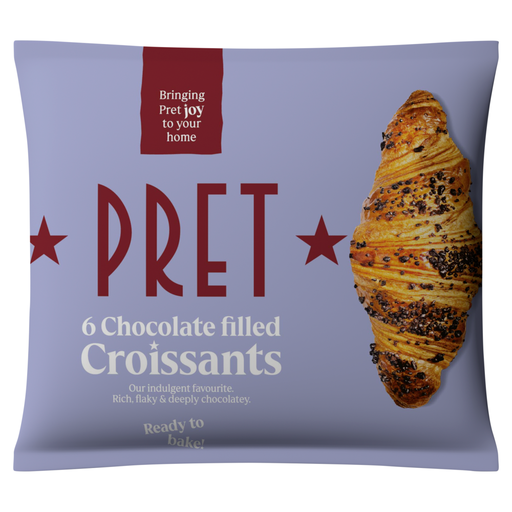
Pret A Manger 6 Chocolate Filled Croissants 420G
This six-croissant pack suits planned occasions when a warm chocolate-filled pastry is wanted.
Oven-bake from frozen in 22 minutes; do not reheat once cooled. Contains wheat, gluten, milk, egg and soya, and is not suitable for nut and sesame allergy sufferers. The stated nutrition is 10g sugars and 9g saturates per baked croissant.
Joybuy
Frequently asked questions
Are croissants suitable for a child with a milk, egg or wheat allergy?
Do not assume that plain or all-butter croissants are suitable. The reviewed Tesco Finest product contains wheat flour, butter (milk) and pasteurised egg, while Lidl lists milk, wheat and egg for its all-butter croissant. Read the exact current pack or counter information before serving.
Should I choose a prepacked croissant if allergen information is essential?
A prepacked item can make it easier to inspect a product-specific ingredients list before purchase. In England, Wales and Northern Ireland, prepacked for direct sale food must show the food name and a full ingredients list with allergenic ingredients emphasised, according to the Food Standards Agency. For loose bakery products, ask the retailer for allergen information; Lidl also warns that other allergens cannot be guaranteed absent from loose bakery products.
Can frozen bake-at-home croissants be served straight away?
No. M&S states that its ready-to-bake product is raw and must be baked, while Joybuy’s Pret butter croissants are listed as frozen and ready to bake from frozen in 20 minutes. Choose a ready-to-eat pack instead when there is no time for oven preparation.
How should I compare a supermarket offer with the normal price?
Compare the standard price and per-croissant price, then check whether an offer requires a loyalty scheme and note its stated end date. Tesco’s reviewed Finest listing showed a standard price and a time-limited Clubcard price, so the offer should not be treated as a permanent cost.
Should I rely on website product information instead of the pack?
No. M&S advises customers to read the label because product information can change as products are redeveloped. This is especially important for ingredients, allergens and storage instructions.


