
24/7 Customer Support

Free returns

Same-day & Next-day Delivery

Quality Guaranteed

Unlock Your Welcome Offers: FREE Delivery | Up to 80% OFF | Free 30-day JoyPlus trial
Download the APP
A cube bookcase can add useful storage without taking over a room, but a product that looks suitable online may prove awkward once assembled. Narrow shelving can be particularly deceptive: the listed width may fit beside a sofa, yet the shelf depth, load limit or overall height may not suit your books and belongings.
Before buying, look beyond colour and promotional photography. The most useful comparison points are the actual dimensions, shelf capacity, construction materials and whether the unit needs additional stability measures.
A narrow bookcase may be advertised as space-saving, but its internal shelf area can be smaller than expected. Check the complete dimensions, including height, width and depth, then compare them with the available floor and wall space.
A slim unit measuring 32 cm wide may work well in a hallway, bedroom or study, but it will not necessarily accommodate large art books or wide storage boxes. Measure the items you plan to store before choosing between a 3-tier cube bookcase, 4-tier cube bookcase or 5-tier cube bookcase.
Open shelving is convenient, but capacity varies between products. A shelf filled with hardback books weighs considerably more than one displaying photographs or lightweight ornaments. Look for a stated weight capacity per shelf, rather than relying on phrases such as “strong” or “durable”.
For example, the Vida Designs Oxford range specifies a 3 kg capacity per shelf. This is a useful benchmark, but it should still be treated as a limit rather than a target. Distribute heavier items evenly and avoid placing concentrated weight at one end.
Many affordable modern bookcase designs use MDF, particleboard or engineered wood with a paper or laminate veneer. These materials can provide a neat, consistent finish, but they need sensible care. Avoid prolonged contact with moisture, wipe spills promptly and do not drag an assembled unit across the floor.
A paper veneer can also look slightly different depending on lighting and screen settings. If matching existing furniture, allow for minor colour variation between online imagery and the product delivered.
A freestanding bookcase should fit its intended position with enough clearance for skirting boards, nearby doors and access during assembly. For compact UK rooms, a narrow bookcase with a vertical profile can preserve more floor space than a wide storage shelving unit.
The Oxford cube bookcases share a 32 cm width and 24 cm depth, while their height changes according to the number of tiers:
This makes tier selection relatively straightforward. Choose three tiers for lower storage or restricted wall height, four tiers for a balanced everyday option and five tiers when vertical capacity matters more.
Decide whether the unit will hold paperbacks, folders, toys, plants, ornaments or office equipment. An open shelf bookcase is practical for frequently used belongings, but exposed contents gather dust more readily than items kept behind doors.
For children’s rooms, rented accommodation or busy hallways, avoid placing unstable or top-heavy objects on upper shelves. Follow the supplied assembly instructions and any recommendations regarding wall anchoring or anti-tip fittings. If you are unsure whether a surface is suitable, seek appropriate installation advice before loading the unit.
MDF and particleboard can be suitable for everyday indoor storage when correctly assembled and kept dry. Check whether self-assembly is required, whether instructions are included and whether you have enough space to lay out the panels safely.
A tall unit should be assembled on a level surface. Tighten fittings carefully without forcing them, then check that the bookcase stands evenly before adding contents. Recheck fixings after initial use, particularly if the furniture is moved.
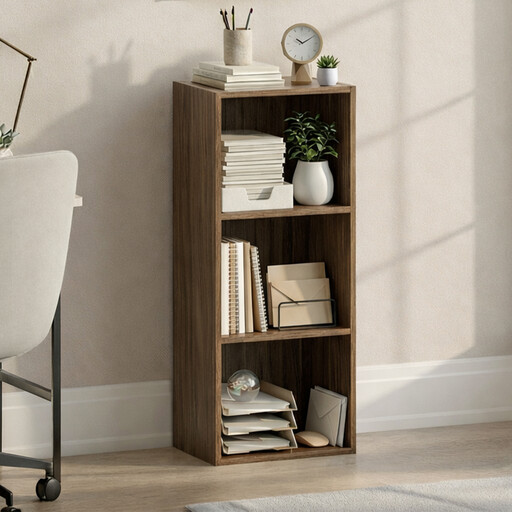
Why This Fits Their Persona: Its 80 cm height and narrow 32 cm width suit a first flat, student room, bedroom or small home office where floor space is limited.
The listed dimensions and 3 kg shelf limit make capacity easier to judge than vague storage claims.
Three open tiers; MDF and particleboard construction with a paper veneer finish.
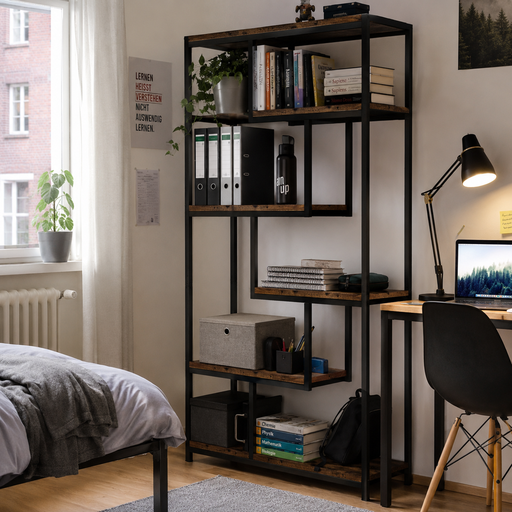
Why This Fits Their Persona: The 165 cm industrial-style silhouette suits shoppers who want storage to contribute visibly to a living room, study or home office scheme.
The product information states a 20 kg maximum load and identifies the wood and metal construction.
Staggered open shelves; metal brackets; suitable for display and storage.
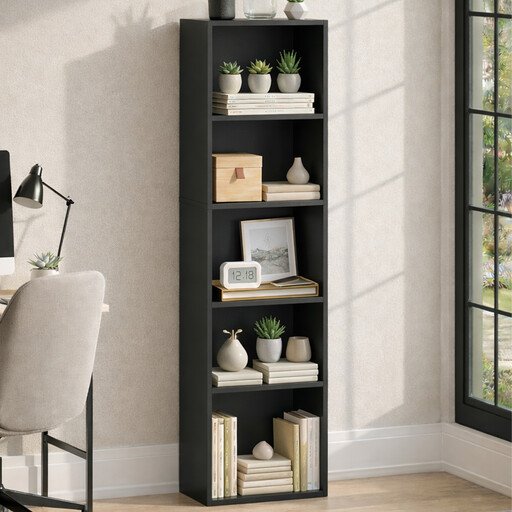
Why This Fits Their Persona: Five vertical levels provide more separation for books, files, plants and ornaments in a compact home office or living room.
The stated 3 kg limit per shelf helps prevent overloading, while the 132 cm height uses vertical rather than extra floor space.
Five open tiers; 32 cm width; MDF and particleboard with a paper veneer finish.
We have compiled a complete, real-time list of products that fully satisfy these strict selection criteria and UK safety regulations.
Yes, a narrow cube bookcase can work well in a bedroom, rented flat, hallway or study when its full depth and height are checked first. Vertical models preserve floor area, but tall furniture should be positioned securely and kept away from locations where it could obstruct doors or walkways.
Assemble it on a level floor, distribute weight evenly and follow the supplied instructions. If the product includes or recommends an anti-tip fitting, use it as directed and check that the wall and fixing method are suitable. Avoid placing heavy, loose objects on the highest shelf.
Use lower shelves for heavier books and storage boxes, and reserve higher shelves for lighter ornaments, photographs or decorative items. Leave some visible space between objects to keep the display shelf easier to clean and prevent unnecessary loading.