Cooks controlling the curry’s seasoning
Unsalted block butter lets you add salt to the curry separately, rather than accounting for salt already in the butter.


Choose unsalted block butter if you want to add butter to a curry while controlling the salt separately. An unsalted spreadable blend is an option when ease of use straight from the fridge matters, while ghee suits hot spice tempering but may give a more pronounced flavour. Check the ingredients and salt declaration on the pack rather than relying on the word “mild”.
Unsalted block butter lets you add salt to the curry separately, rather than accounting for salt already in the butter.
An unsalted spreadable product may be convenient for a small finishing addition. Check its ingredients if your recipe calls specifically for block butter: Lurpak’s unsalted spreadable product contains butter, rapeseed oil and water.
Ghee is worth considering for this cooking step. A Waitrose-listed clarified ghee specifies use across low-to-high heat, but its richer flavour may be less suitable when you want the butter taste to stay subtle.
Start with the cooking step, then compare salt, ingredients and the current pack label.
| Priority | What to check | Your needs |
|---|---|---|
| Seasoning | Check whether the butter is unsalted or salted, and read its salt declaration. Lurpak lists 0.01g salt per 100g for its unsalted block; Anchor lists salt at 1.7% in its Original Block Butter ingredients. | I’d rather adjust the curry’s salt after adding the butter, especially if paste or stock also contributes seasoning. |
| Cooking step | Match the format to gentle cooking, a finishing addition or hot spice tempering. A Waitrose-listed clarified ghee states a 250°C smoke point; do not apply that figure to other ghee products. | For hot tempering, I want to check whether a ghee suits my method. For a subtle buttery finish, I may prefer unsalted block butter. |
| Ingredients | Read the ingredient list if the recipe calls for block butter. Lurpak Spreadable Unsalted contains 64% butter alongside rapeseed oil and water. | Using something straight from the fridge matters to me, but I don’t want to mistake a spreadable blend for a block. |
| Milk ingredients | Check the current pack’s ingredients and allergen information before cooking for someone with a milk allergy or intolerance. | When cooking for another person, I need to confirm what is in the product I’m actually using. |
| Saturates and portion | Compare the saturates declaration per 100g and the amount your recipe uses. Lurpak lists 53g saturates per 100g for its unsalted block; the NHS identifies butter and ghee as foods high in saturated fat. | I want to know how much butter or ghee goes into the whole curry, rather than treating “unsalted” as a nutrition claim. |
That word does not tell you how much salt a particular butter contributes or whether it is a block or a blend.
Read the salt declaration and ingredients. Choose unsalted block butter when separate seasoning control matters most.
Anchor Original Block Butter lists salt at 1.7% in its ingredients, whereas Lurpak lists 0.01g salt per 100g for its unsalted block. Those are different starting points for seasoning.
If using salted butter, taste the curry before adding more salt.
Unsalted describes the seasoning, not the saturated-fat content. The NHS identifies both butter and ghee as foods high in saturated fat.
Check the per-100g declaration and measure the amount your recipe uses.
Ingredients can change, which matters particularly when cooking for someone who needs to avoid milk.
Read the current pack’s ingredients and allergen information before use.
These examples show why the product format matters more than the brand name alone.
Its unsalted block and unsalted spreadable product serve different cooking preferences.
Anchor describes its unsalted block as suitable for cooking and baking and also offers a salted Original Block Butter.
Kerrygold describes its 200g unsalted butter as suitable for cooking and baking.
Tesco British Unsalted Butter is a 250g block listed with a minimum of 82% milk fat.
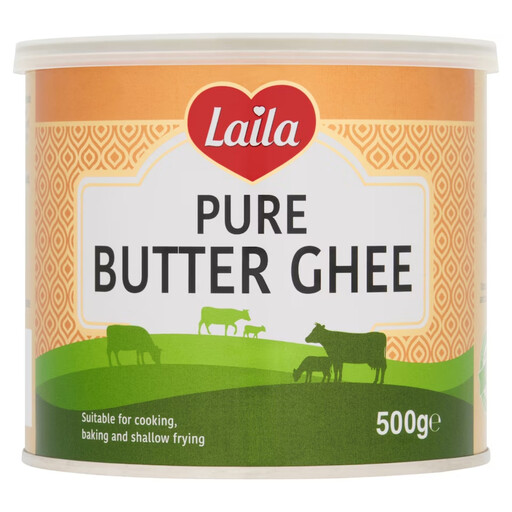
This selection covers ghee for curry cooking rather than the unsalted block butter suggested when separate seasoning control and a subtle butter flavour are the priorities.
 No image available
Consider this ghee format if your curry involves frying or tempering spices. Its described aromatic, nutty flavour may be too pronounced for a subtle buttery finish; check the current pack for cooking directions and milk allergen information.
Start with an unsalted block if you want to control the curry’s salt separately. Then check the actual ingredients and salt declaration: “mild” alone does not tell you whether the product is salted, unsalted or a spreadable blend.
Use unsalted butter when you want to add salt after tasting the curry. Salted butter can work when its seasoning is intentional; check the label and delay adding other salt until you have tasted the dish.
Check the recipe and ingredients before substituting it. Lurpak Spreadable Unsalted is 64% butter and contains rapeseed oil and water, so it is not compositionally the same as a butter block.
Consider ghee for hot frying or spice tempering. A Waitrose-listed clarified ghee states a 250°C smoke point, but that figure does not apply to every ghee; its richer flavour may also be more noticeable than you want.
Read the current product’s ingredients and allergen information before cooking. Butter and the spreadable example discussed here contain milk; do not rely solely on an older online ingredient listing.