Short-window family dessert planners
If you are preparing several desserts over a few days, match the pack’s stated servings to the portions you expect to use before its after-opening deadline.


A larger ready-to-serve pack suits a batch of family desserts when its stated servings and after-opening instructions fit your plan. Smaller tins can be easier to match to separate, smaller desserts; custard powder lets you make the quantity needed for each batch, but requires preparation rather than immediate pouring.
If you are preparing several desserts over a few days, match the pack’s stated servings to the portions you expect to use before its after-opening deadline.
If you usually serve two or three portions at a time, a smaller ready-to-serve pack may be easier to finish. Check its own storage instructions before planning the next dessert.
If you make trifles, puddings or several batches, powder offers a way to prepare custard in the quantity each recipe needs, provided you have time to measure and heat it.
Plan the portions and the days you will serve them before choosing between a fixed ready-to-serve pack and custard made from powder.
| Concern | What to check | Who this matters to |
|---|---|---|
| Enough for the batch | Compare stated servings with the portions needed for each planned dessert. Ambrosia states eight servings for its 1kg Devon Custard carton. | When several family desserts are planned close together, I need enough custard without opening another pack partway through. About 36% of consumers put batch volume first. |
| Leftovers after opening | Read the exact pack’s refrigeration, transfer and use-by-after-opening directions; they differ between products. | If I serve only a little custard at a time, I want a pack I can finish within its stated window. For about 29% of consumers, managing leftovers is the primary need. |
| Preparation flexibility | Decide whether custard must be ready to pour or whether you can measure ingredients and cook each batch. | For a trifle layer or a differently sized pudding batch, I would rather make the amount the recipe calls for. Making custard to order comes first for about 21% of consumers. |
| Ingredients and allergens | Check the current pack’s allergen declaration and ingredients; compare per-100g or per-serving nutrition if relevant to your choice. | When serving the same custard across several desserts, I need its ingredients and allergen information to fit everyone being served. About 14% of consumers prioritise those label checks. |
Ambrosia states eight servings for its 1kg Devon Custard carton. That quantity is useful only if your planned desserts will use it while the opened pack can still be kept according to its label.
Work out the portions and serving days before choosing a pack size.
Custard left unused beyond its after-opening instructions may need to be discarded.
Ambrosia says to refrigerate and consume the remainder of its 400g Devon Custard can within three days. Sainsbury’s instructs buyers of Stamford Street Co. 400g Custard to transfer leftovers to a non-metallic container, refrigerate them and use them within one day.
Follow the storage, transfer and reheating directions on the exact pack you open.
Custard powder allows you to prepare a chosen quantity, but it is not ready-to-serve custard. Tesco’s custard powder instructions call for whisking and cooking until thickened.
Choose powder for a planned cooking session; choose a ready-to-serve format if preparation time is the deciding constraint.
Allow for the recipe ingredients, preparation time and washing up.
Ingredients and allergen declarations can differ between a prepared custard, a richer variant and a powder that requires additional ingredients.
Check the current label of the exact variant, including any ingredients you will add when making powder.
Its Devon Custard range includes a 400g can and a 1kg ready-to-serve carton for different planned quantities.
Original Custard Powder is a make-to-order option rather than a ready-to-pour pack.
Tesco’s range provides ready-to-serve custard and custard powder as distinct preparation routes.
Its 400g ready-to-eat custard is a smaller-pack option for planned desserts.
Silky Smooth Custard is a 400g recipe made with whole milk and cream.
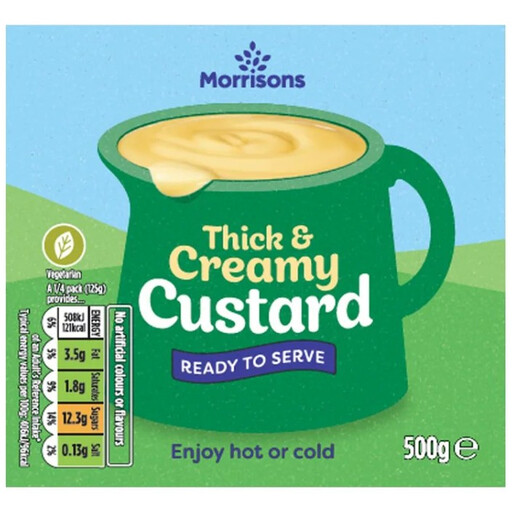
These ready-to-serve packs offer 1kg and 500g quantities to consider for planned family desserts. Check the exact pack’s serving guidance and storage directions against your schedule.
 No image available
Consider the 1kg pack when one ready-to-serve quantity needs to cover several planned desserts. Check the Light variant’s own serving guidance, milk-allergen declaration and after-opening instructions rather than applying directions from another Ambrosia custard.
 No image available
The 500g pack is a smaller fixed quantity to consider for a planned dessert batch. Work out the amount your recipe needs, then check the pack label for its serving guidance, allergens and directions for any remainder.
Ambrosia states eight servings for its 1kg Devon Custard carton. Use that as a serving guide, then calculate what your own puddings, toppings or trifle layers will require; do not apply that count automatically to another 1kg variant.
Plan later desserts around the exact pack’s after-opening instructions, rather than assuming an opened carton will last all week. For comparison, Ambrosia directs buyers to consume the remainder of its 400g Devon Custard can within three days, while Marks & Spencer states two days for Silky Smooth Custard.
Follow the directions for the product you opened. Sainsbury’s says not to reheat its Stamford Street Co. 400g Custard once cooled, so instructions for a different custard should not be substituted.
Do not assume it is. Bird's Original Custard Powder states that it may contain milk, and its standard preparation uses milk. Check the current powder label and every ingredient you intend to add.