Making one or two bread desserts
If you want a measured amount for each serving without opening a larger pack, individual pots are worth considering. Sainsbury’s lists Ambrosia Devon custard in a pack of four 120g pots.


Choose ready-to-eat pots when you want individual portions to serve with a bread-based dessert; choose a larger ready-to-serve pack when you need several portions and can refrigerate leftovers as directed. Custard powder requires preparation. For custard enclosed in bread dough, follow a recipe that specifies the custard type and method rather than assuming a ready-to-serve product will work as a baked filling.
If you want a measured amount for each serving without opening a larger pack, individual pots are worth considering. Sainsbury’s lists Ambrosia Devon custard in a pack of four 120g pots.
A larger ready-to-serve pack lets you portion custard for a bread pudding or for several plates. Check how much you will use after opening: Tesco and Sainsbury’s instruct shoppers to refrigerate leftovers from their cited larger products and consume them within three days.
If the custard will be enclosed in dough or baked with the bread, start with the recipe’s specified filling and method. Directions for serving or reheating ready-to-serve custard do not establish how it will behave inside a baked bun.
Settle the portion format first, then check the recipe method, storage instructions and ingredients.
| Concern | What to check | Who this matters to |
|---|---|---|
| Individual portions | Check the amount per pot and the number of pots. A pot is not a tin. | I only need custard for a small number of bread-dessert servings and would rather open one portion at a time; about 27% of consumers put pre-portioned servings first. |
| Several ready-made servings | Check the pack quantity and how long its contents can be kept after opening. | When I am serving several people, I want custard I can portion myself without making it from powder. That is the main concern for about 33% of consumers. |
| Recipe method | Check whether the recipe specifies ready-made custard, made-up powder or another filling, particularly for custard baked inside dough. | If I am baking custard buns, matching the filling to the recipe matters more than the pack format; roughly 20% of consumers prioritise that method check. |
| Ingredients and allergens | Read the current pack’s ingredients and allergen information, as well as those of the other recipe components. | Before making dessert for someone with an ingredient restriction, I need to check the complete recipe. Around 20% of consumers make ingredient and allergen checks their primary concern. |
Ambrosia’s four-pack contains 120g pots, not tins. A portion that is convenient for serving with a dessert is not automatically suitable as a filling enclosed in bread dough.
Check the packaging format and the custard method named in your recipe before choosing a product.
Unopened storage directions do not apply after opening. Tesco’s 400g ready-to-serve can and Sainsbury’s 500g ready-to-eat custard both call for refrigeration and use within three days once opened.
Plan how you will use the remaining custard, and follow the instructions on the pack you buy.
The cited Ambrosia and Tesco products contain milk, while the cited M&S chilled custard contains milk and egg. Bread and other recipe components need checking too.
Read the current ingredient and allergen information for every component before preparing dessert for someone with an allergy.
These examples show how custard formats differ; a brand name alone does not tell you whether a particular product matches your recipe.
Ambrosia Devon custard appears in individual 4 × 120g pots as well as larger ready-to-serve formats.
Tesco Ready To Serve Custard is a 400g can that can be divided into servings.
Sainsbury’s Ready To Eat Custard is a 500g product for self-portioned servings.
Bird’s Original Custard Powder is a preparation-based option for recipes that specify made-up custard rather than a ready-to-pour product.
M&S Collection Madagascan Vanilla Luxury Custard is a chilled ready-made option, not a tinned or cupboard-stored one.
These packs are options for self-portioning ready-made custard when a bread-based dessert calls for several servings. Check the recipe before using any ready-to-serve custard as an enclosed baked filling.
 Image unavailable
For several servings that you want to portion yourself, this 400g can is a ready-to-serve option rather than an individual pot. Refrigerate any remaining custard after opening and consume it within three days; use it as a baked filling only if your recipe specifies this type of custard.
 Image unavailable
For a plan needing multiple self-portioned servings, this 1kg carton is a larger ready-to-serve format, not a tin or individual pot. Refrigerate after opening and consume within three days. Check the recipe’s custard method before considering it for a baked filling.
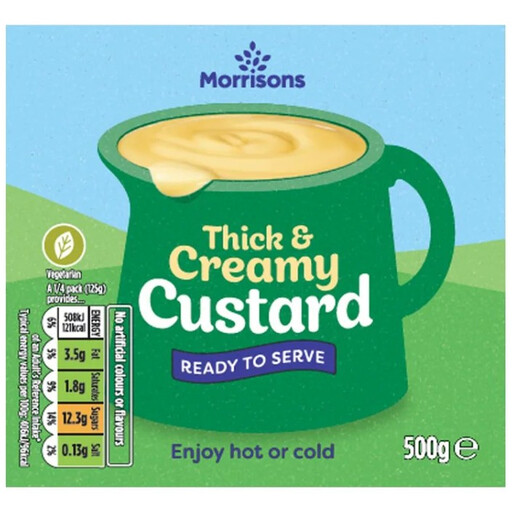 Image unavailable
For a dessert that needs ready-made custard divided into servings, this 500g tub can be self-portioned; it is neither a tin nor a single-serving pot. Refrigerate after opening and consume within three days. For a filling enclosed in dough, check that the recipe calls for this custard format.
No. The Ambrosia Devon individual option listed by Sainsbury’s comes in 120g pots, whereas Tesco Ready To Serve Custard comes in a 400g can. Check both the packaging and the amount needed for your servings.
Follow the instructions for the product you open. Tesco says to transfer unused custard from its 400g can to a covered non-metallic container, refrigerate it and consume it within three days. Sainsbury’s likewise says to refrigerate its 500g ready-to-eat custard after opening and consume it within three days.
Check the current ingredient and allergen information for the custard and every other recipe component. The cited Ambrosia and Tesco products contain milk, while the cited M&S chilled custard contains milk and egg. GOV.UK guidance says food businesses must tell customers when listed allergens are present as ingredients.