Shoppers looking for a low-fat biscuit
A reduced-sugar message does not answer your main question. Compare total fat and saturated fat per 100g first, then use the per-biscuit figures to work out the portion you intend to eat.


A reduced-sugar claim does not tell you whether a custard cream is low in fat: check the fat and saturated fat per 100g separately. The conventional custard creams listed by Sainsbury's, Tesco, Asda, Joybuy and Marks & Spencer in this comparison contain 19.0g to 23.4g fat per 100g, above the NHS high-fat threshold of more than 17.5g per 100g. If you still want a custard cream occasionally, compare labels on the same basis and decide how many biscuits you plan to eat.
The same biscuit can raise different questions depending on whether fat content, portion size or an ingredient requirement drives your choice.
A reduced-sugar message does not answer your main question. Compare total fat and saturated fat per 100g first, then use the per-biscuit figures to work out the portion you intend to eat.
Use the per-100g nutrition panel for a like-for-like comparison. A different pack size or a smaller stated serving can otherwise make the figures harder to compare.
Check the exact pack for the ingredients you need to avoid. A free-from custard cream may meet a stated ingredient requirement, but its fat, saturated fat and sugars still need separate checks.
Start with fat per 100g to answer the low-fat question, then check sugars, your intended portion and ingredient suitability. The NHS defines low fat as 3g or less per 100g and high fat as more than 17.5g per 100g.
| Priority | What to check | Your needs |
|---|---|---|
| Fat and saturates | Compare both values per 100g. The NHS defines high saturated fat as more than 5g per 100g; a lower figure than another biscuit does not itself make a product low in fat. | I'm looking for a low-fat product, so I need its total fat figure rather than a sugar claim to answer that question. |
| Sugars | Check sugars per 100g alongside fat and saturates. The NHS defines high sugars as more than 22.5g per 100g; a reduced-sugar claim alone does not establish the fat content. | If I'm comparing sugar as well, I want to see the actual nutrition values rather than rely on the wording on the pack. |
| Portion | Check the stated values per biscuit and how many biscuits you plan to eat. Sainsbury's and Tesco provide per-biscuit fat, saturates and sugars for their conventional custard creams. | One biscuit may not be my whole snack, so I'll use the figures for the number I intend to eat. |
| Ingredients | Read the exact pack's ingredient and allergen statements. For example, Asda declares wheat and milk for its conventional Custard Creams and lists possible traces of other ingredients. | I need to confirm that this particular pack meets my ingredient requirements; a free-from label does not answer the separate nutrition question. |
Sugar and fat are separate entries on the nutrition panel. The conventional custard creams in this comparison exceed the NHS high-fat threshold, regardless of which sugar figure a shopper focuses on.
Compare total fat and saturates per 100g before deciding whether a biscuit meets your low-fat requirement; assess sugars separately.
A per-biscuit value describes that stated serving, not the whole snack if you eat more than one.
Decide on the number of biscuits first, then multiply the stated per-biscuit values by that number.
Sainsbury's Free From Custard Creams are labelled milk-free and gluten-free, but contain 16.8g fat, 13.0g saturates and 24.9g sugars per 100g. Those figures need assessing independently of their ingredient suitability.
Use a free-from declaration for the requirement it actually states, and read the nutrition panel for fat, saturates and sugars.
These figures describe the specified custard cream products, not every biscuit made or sold by each brand. Compare the current pack when making a purchase.
Its conventional Custard Creams and Free From Custard Creams serve different ingredient needs.
Tesco Custard Cream Biscuits are a conventional 400g product.
McVitie's Tasties Custard Creams Biscuits are listed as a 300g conventional product.
Crawford's Custard Creams are listed by Tesco as a 300g conventional product.
Asda Custard Creams are a conventional 400g product.
This gluten-free custard cream is relevant if ingredient suitability is part of your choice. Check its current nutrition panel separately if you are looking for a low-fat biscuit.
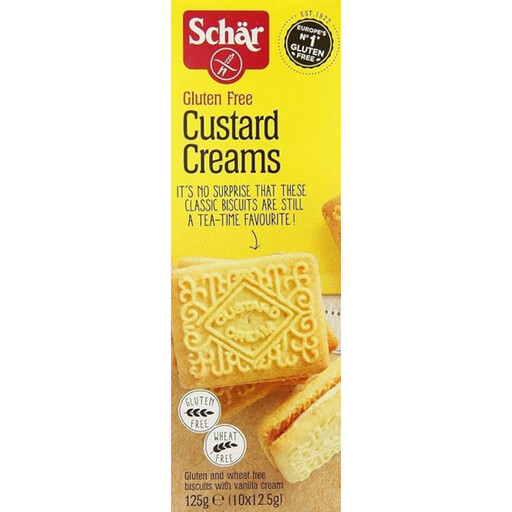 Image unavailable
A gluten-free custard cream to consider when comparing ingredient suitability. The 125g pack name does not tell you whether the biscuits are low in fat; check fat and saturates per 100g on the current label.
No: sugar and fat are separate nutrition values. The NHS defines low fat as 3g or less per 100g, while the conventional custard creams listed by Sainsbury's, Tesco, Asda, Joybuy and Marks & Spencer in this comparison contain 19.0g to 23.4g fat per 100g. Check the fat figure on any reduced-sugar product you are considering.
For a low-fat requirement, compare total fat and saturated fat per 100g first, then check sugars separately. Use per-biscuit figures to assess the number you intend to eat, rather than assuming the pack's stated serving matches your portion.
Sainsbury's lists 19.0g fat per 100g for its conventional Custard Creams, the lowest figure among the five conventional products compared here. That is still above the NHS high-fat threshold of more than 17.5g per 100g, not a low-fat claim.
A free-from label does not establish that. Sainsbury's lists its milk-free and gluten-free Free From Custard Creams at 16.8g fat and 13.0g saturates per 100g. Check ingredient suitability and nutrition as separate questions.
Read the ingredient and allergen statements on the exact pack you intend to buy. For example, Asda declares wheat and milk for its conventional Custard Creams and lists possible traces of rye, barley, oats and sesame; do not assume another custard cream has the same ingredients or warnings.