Parents portioning biscuits at home
A larger packet may cover several occasions, but choose the weight you expect to use. Compare the pack’s per-biscuit nutrition and follow its storage instructions once opened.


A 400g plain packet can suit several portions at home if you will use it; a 300g or smaller pack may make more sense when you want fewer biscuits left over. For school, check the actual packet’s allergens and the school’s food arrangements before bringing biscuits for others: a sharing-size pack does not make food-sharing appropriate for every child.
A larger packet may cover several occasions, but choose the weight you expect to use. Compare the pack’s per-biscuit nutrition and follow its storage instructions once opened.
Check the ingredients and precautionary allergen statement on the packet you will use, alongside the school’s arrangements. The NHS-linked North West Allergy Network advises that children with food allergies should not share food.
Start with how many portions you plan to take from the packet, then check the exact product label and how the biscuits would be used at school.
| Priority | What to check | Your needs |
|---|---|---|
| Packet size | Compare net weight with the portions you plan. ASDA Groceries and Tesco Groceries list 400g plain packets; Morrisons lists McVitie’s Tasties at 300g. | I want enough biscuits for several occasions without buying a larger packet than I expect to use. |
| Allergens | Read the current packet’s ingredients and precautionary statements. The checked ASDA, Tesco and McVitie’s listings identify milk and wheat; additional precautionary statements differ. | Before giving a child a biscuit, I need to check the exact packet against their allergy arrangements. |
| School use | Ask the school about food brought in for others. The North West Allergy Network’s school-allergy guidance advises children with allergies not to share food. | A packet labelled for sharing does not tell me whether biscuits can be offered to classmates. |
| Portions and storage | Use the product’s per-biscuit nutrition to compare portions. Tesco Groceries lists 3.4g sugars per biscuit for its 400g custard creams; follow the chosen packet’s instructions after opening. | I would rather portion biscuits at home and keep the remaining packet as its label directs. |
| Pack contents | Check each variety in a mixed pack. M&S lists custard creams, malted milk biscuits and bourbon creams in its 530g triple pack. | If I only want custard creams, the total weight of a mixed pack will not tell me how many I am getting. |
The checked plain biscuits contain milk and wheat. The NHS-linked North West Allergy Network advises children with food allergies not to share food.
Portion biscuits at home for the intended child, and speak to the school before proposing biscuits for a group.
According to M&S, its 530g triple pack also contains malted milk biscuits and bourbon creams.
Check the varieties in the pack and read the ingredients for each one that someone might eat.
More total weight does not establish what you will use before the biscuits need storing after opening.
Choose a quantity that fits your planned portions, compare like-for-like unit prices when buying, and follow the packet’s storage directions.
These pack details describe specific listings, not every biscuit made or sold under each name.
ASDA Groceries lists a 400g plain custard-cream packet for households planning several portions.
Tesco Groceries lists a 400g plain custard-cream packet with per-biscuit nutrition information.
Morrisons lists McVitie’s Tasties Custard Creams in a 300g packet.
Tesco Groceries lists Crawford’s vanilla-flavour custard creams in a 300g packet.
Sainsbury’s lists a 200g plain packet for a smaller quantity.
M&S lists a 165g Extra Cream custard-cream packet and a 530g triple pack containing three biscuit varieties.
This 125g custard-cream packet is a smaller-quantity option, rather than a larger packet for repeated portions at home.
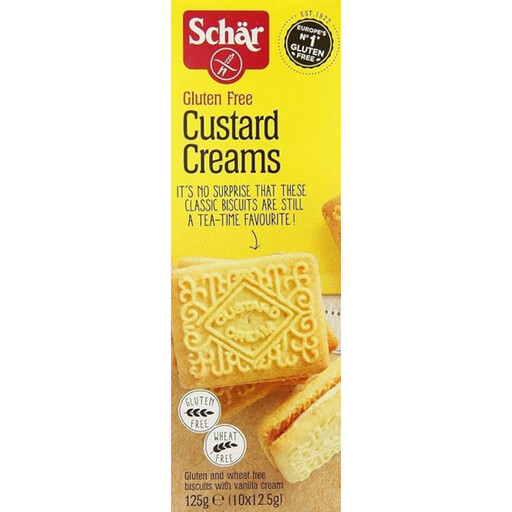 Image unavailable
The 125g packet suits a smaller-quantity purchase rather than the several-portion plan described for 300g and 400g packs. Its product name states gluten-free; check the current packet’s full ingredients and precautionary allergen information for the intended child, and confirm the school’s arrangements before sending biscuits for others.
Do not treat the packet’s size as permission to share food at school. The NHS-linked North West Allergy Network advises children with food allergies not to share food; ask the school about its arrangements before offering biscuits to a group.
The checked ASDA, Tesco and McVitie’s custard-cream listings identify milk, as well as wheat. Check the ingredients and precautionary statements on the actual packet against the child’s allergy arrangements; a product name alone is not enough.
Follow the instructions on that packet. The checked Tesco and Crawford’s listings advise keeping their biscuits in a cool, dry place and using an airtight container after opening.
NHS Healthier Families suggests swapping biscuits for fruit and vegetable snacks as part of its children’s snacking advice. If you include custard creams, use the chosen packet’s per-biscuit nutrition to decide on a portion and check the school’s food arrangements.