Who is choosing these biscuits?

Runners considering a pre-run snack

A biscuit may be familiar and easy to count, but timing and fat content matter if you are considering one before a 5k. University College London Hospitals NHS Foundation Trust describes different snack considerations for exercise lasting under and over 60 minutes.

Households sharing a biscuit pack

Pack weight and the number of inner packs affect how much is opened at once. Tesco and Asda list 400g custard creams; Tesco also lists a 750g format divided into five 150g packs.

Buyers checking food allergens

Ingredient and precautionary allergen wording differs between products. Check the current physical pack for the person who will eat the biscuits rather than relying on a previous purchase.

What should you check before buying?

Start with whether the biscuits are for ordinary household sharing or a snack around a run, then compare the pack and label details that matter for that use.

Priority What to check Your needs
Run timing University College London Hospitals NHS Foundation Trust describes pre-workout snacks eaten 60–90 minutes before exercise as containing carbohydrate and protein with minimal fat. For shorter activities, a snack during exercise may only be needed for hypoglycaemia prevention or treatment. If I am considering a biscuit before a 5k, I want to think about when I last ate and whether this snack fits my usual running routine, rather than treating it as necessary during-run fuel.
Pack format Tesco and Asda list 400g packs. Tesco lists a 750g format as five 150g packs; its product page marked it out of stock when reviewed, so check availability before choosing that format. For a shared biscuit cupboard, I want enough for the household without opening more biscuits at once than we expect to use.
Per-biscuit figures Tesco lists 8.4g carbohydrate and 2.5g fat per biscuit for its 400g pack. Asda lists 8.1g carbohydrate and 2.6g fat per biscuit for its 400g pack. Compare the same serving basis on current labels. I would rather count the biscuits I plan to eat than judge a serving from the weight of the whole pack.
Ingredients Read the current ingredient and allergen statement on the physical pack. Asda lists wheat and milk and warns of possible rye, barley, oats and sesame; precautionary wording varies by product. When buying for someone with a food allergy, I need to check the exact product each time, including its precautionary wording.

What can make a pack less practical?

  • Treating a family pack as necessary 5k fuel

    For shorter activities, University College London Hospitals NHS Foundation Trust says snacks during exercise may only be needed for hypoglycaemia prevention or treatment. A larger biscuit pack does not change that distinction.

    Choose the pack for how your household will use it. If you manage glucose around exercise, follow your individual clinical plan rather than general biscuit-buying advice.

  • Looking only at carbohydrate

    Custard creams also contain fat. Tesco and Asda list 2.5g and 2.6g fat per biscuit respectively for their 400g packs, while University College London Hospitals NHS Foundation Trust describes minimal fat as a feature of a pre-workout snack eaten 60–90 minutes before exercise.

    If you are considering biscuits before a run, check the per-biscuit label and try any unfamiliar snack during ordinary training rather than relying on it for the first time at an event.

  • Choosing the largest pack without a use plan

    Tesco lists its 750g custard creams as five 150g packs, but the product page marked the format out of stock when reviewed. The inner packs are useful only if the size and availability suit the household.

    Recheck stock and decide how many biscuits you expect to use after each inner pack is opened.

  • Relying on an old ingredient listing

    Allergen statements vary: Asda warns of possible rye, barley, oats and sesame, while Sainsbury's says its 200g custard creams are not suitable for customers with a barley allergy because of manufacturing methods.

    Read the physical pack's current ingredients and allergen statement before eating or serving the biscuits.

Which brand formats are relevant?

Tesco

Tesco lists both a 400g custard-cream pack and a 750g format divided into five 150g packs.

  • The 400g listing gives per-biscuit figures of 8.4g carbohydrate and 2.5g fat.
  • The 750g product page marked the format out of stock when reviewed; check its current availability.

Asda

Asda lists an own-label 400g custard-cream pack for household sharing.

  • Its listing gives 8.1g carbohydrate and 2.6g fat per biscuit.
  • It contains wheat and milk, with precautionary wording for rye, barley, oats and sesame.

Crawford's

The Crawford's custard-cream listing is a 300g branded pack with approximately 26 biscuits.

  • The stated biscuit count helps when planning how a pack will be shared.
  • Tesco marked this product out of stock when reviewed and lists a possible sesame warning; check the current listing and pack.

Sainsbury's

Sainsbury's lists a smaller 200g custard-cream pack with approximately 16 servings.

  • The smaller pack may suit a household that wants fewer biscuits open at once.
  • The listing says it is not suitable for customers with a barley allergy because of manufacturing methods.

M&S

M&S lists Extra Cream and chocolate-coated custard-cream variants for a flavour-led biscuit choice.

  • The Extra Cream pack is 165g, a smaller format than the 400g supermarket packs discussed here.
  • M&S lists 23.4g fat per 100g for Extra Cream and 26.0g per 100g for its chocolate-coated variant; neither matches the minimal-fat characteristic in University College London Hospitals NHS Foundation Trust's pre-workout snack guidance.

McVitie's

Joybuy listed McVitie's Tasties Custard Creams Biscuits in a 300g format.

  • The listing gives carbohydrate and fat values per 100g for label comparison.
  • Joybuy marked that product no longer available when reviewed; it should not be treated as a current purchase option.

Joybuy custard-cream option

The Joybuy option here is a 125g gluten-free custard-cream pack for shoppers considering a smaller format, rather than a like-for-like 400g household pack.
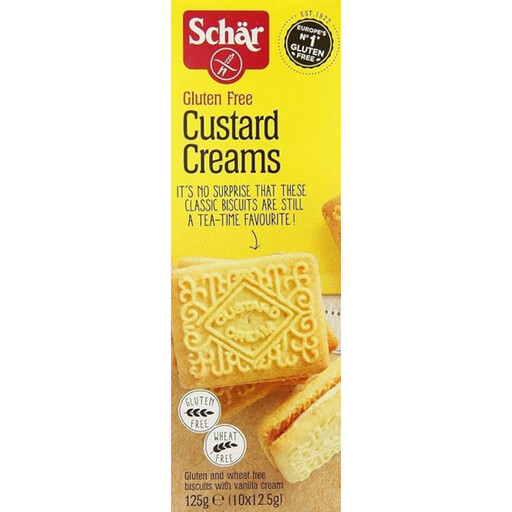
Schar Gluten Free Custard Creams 125g pack

Schar Gluten Free Custard Creams 125g

For a household considering custard creams in a smaller format, this gluten-free pack contains 125g. Check the current physical pack for its full ingredients and allergen information before buying for a dietary requirement.

View on Joybuy

Questions about packs and running

Do I need custard creams during a 5k?

Not necessarily for a 5k lasting under an hour. University College London Hospitals NHS Foundation Trust says snacks during shorter activities may only be needed for hypoglycaemia prevention or treatment; individual glucose-management decisions should follow a clinical plan.

What should I consider if I eat one before running?

Consider timing, portion size and the fat listed per biscuit. University College London Hospitals NHS Foundation Trust describes a snack 60–90 minutes before training as containing carbohydrate and protein with minimal fat; the Tesco and Asda 400g custard creams list 2.5g and 2.6g fat per biscuit respectively.

Which pack format makes sense for household sharing?

Tesco and Asda list 400g packs if that amount suits your household. Tesco's 750g format comes as five 150g packs, but its listing marked it out of stock when reviewed, so check availability and how many biscuits you will use after opening an inner pack.

Can I rely on the product name for allergen information?

No. Read the current physical pack's ingredient and allergen statement for the exact product. Asda's 400g custard creams contain wheat and milk and carry additional precautionary wording; other products can have different warnings.

How should I keep biscuits after opening a large pack?

Follow the storage instructions on the pack and its best-before information. If a format has separate inner packs, consider opening only the one your household expects to use.